
Spokane’s stricter camping law has quick impact on the street
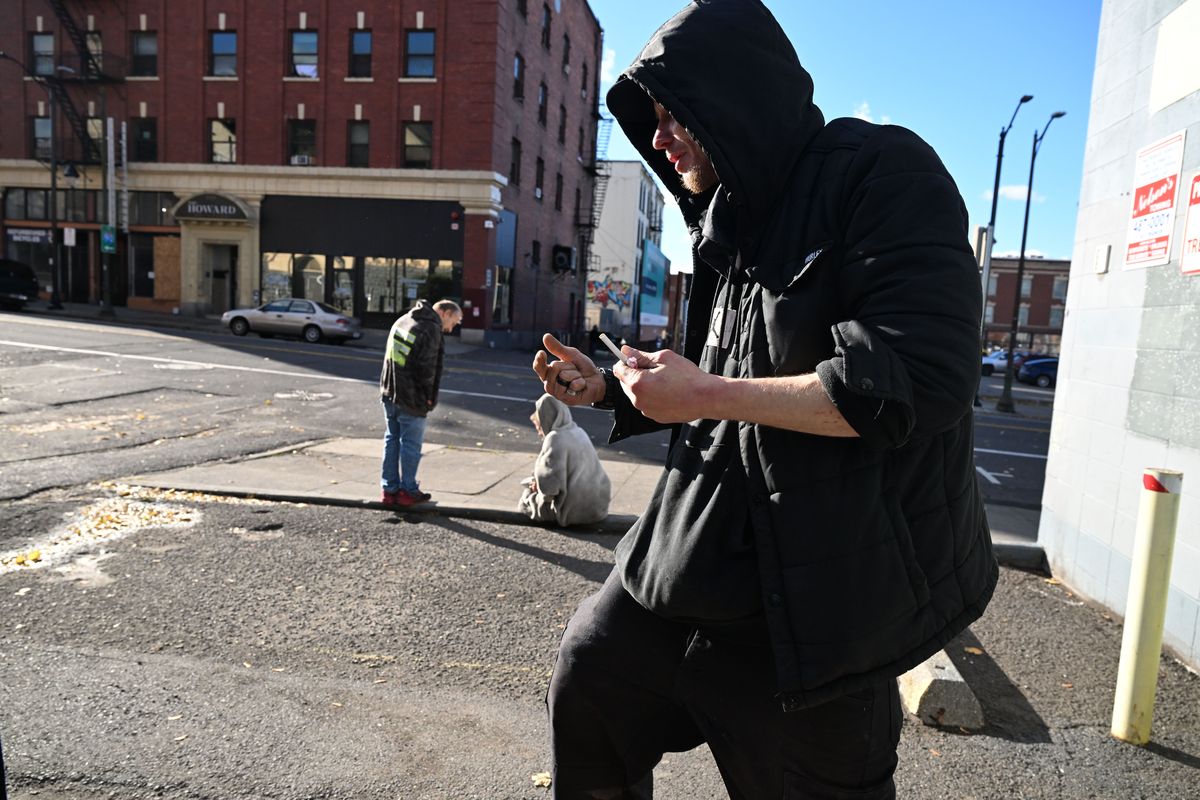
Robed in two sweaters and a rain coat, Blain Blaire clutched two crumpled cigarettes for sale next to Shalom Ministries on Friday afternoon.
The church doesn’t offer its free meals on Fridays, but he and a small group still linger there. It’s a place to gather, as it has been for years.
But in that alley next to the church, or under the viaducts nearby or in the neighboring parking lots, there are visibly fewer people than even a few weeks ago.
Ask the police, or politicians or downtown business owners or even many service providers, and they’ll tell you it’s a new day in Spokane.
Two weeks after the city toughened its laws prohibiting people from sleeping in public or sitting on the sidewalk, people are cheering the reduced visibility of homelessness.
The increase in police contacts – 125 citations have been issued in just the first nine days, involving unauthorized camping, obstruction, harm to waterways and unlawful burning – are cleaning up downtown’s image and pressuring the homeless into entering shelters, services and potentially treatment.
Those still sleeping on Spokane’s streets who remain wary of city shelters seem to agree that the laws are applying more pressure, but for the sake of making them move, not to improve their lot in life. Rather, they describe a new weight on lives they were already struggling to hold together.
“It was already tough,” Blaire said. “Now it’s tougher.”
Blaire got out of jail earlier this week. He started using hard drugs while living on the streets to stay awake at night – always on the move, always an eye open to fend off thieves from stealing what little he owns – and selling them to get by. He’s ashamed, but said there are few ways for him to make money. People won’t hire him for daywork, few people carry loose change anymore and he needs a car to get a job and needs a job to get a car, he said .
He tends to sleep under the viaduct, one of the few places where sleeping was never decriminalized amid the back and forth of court decisions and policy changes of the last few years. But increasingly, he and others sleeping under the bridges or eaves of downtown Spokane say that, if they don’t enter the city’s limited shelter space, they’re being pushed by police to go north of the river or south of the highway.
“It’s pretty far to go just to fall asleep somewhere in the rocks,” he said. “Under the bridge is better.”
Many business owners and residents had empathy for the homeless, said Robin Bernart, who co-owns Frank’s Diner and The Onion restaurants. But drug use and mental health issues frayed their patience.
Replacing broken windows and cleaning feces from front steps made business owners jaded and disengaged, Bernhart said, and that is no way to live.
“Because there has been an appearance of lawlessness that has felt allowed, it was the breaking point,” she said. “It’s gone on for so long that you have people that don’t care about the homeless (anymore). That is where we are.”
Spokane’s downtown homeless population, meanwhile, laments the frequent issue of public urination or defecation – namely, the indignity of having no public restrooms available to them, particularly at night, an issue frequently raised by City Council President Betsy Wilkerson but one her colleagues have not prioritized funding for.
“Put that in your article,” said Mel Morrison, who’s sitting a block away from Shalom, resting at a corner that smells sharply of urine next to her cart full of clothes, a lawn chair and a plastic bag full of dried lavender. “There’s no bathrooms. People have to go.”
The Oct. 28 emergency ordinance that significantly toughened homeless camping laws has changed Bernhart’s outlook on the area.
In just a two-week period, the effects of the ordinance on Spokane’s downtown core is clearly visible to her and other business owners, like Doyle Wheeler, who owns First Avenue Coffee.
“This is what a clean and safe downtown looks like,” Wheeler said. “It’s almost a strange feeling.”
The “Safe and Accessible Spaces” ordinance was unanimously passed by the Spokane City Council after two previous camping laws were either struck down by the Washington Supreme Court or rendered largely ineffective for its lack of enforcement and accountability.
Some of the biggest critics of the city’s leaders are now praising the sharp pivot in approach to homelessness, welcoming the citations and reduced visibility of the homeless – even if they dismiss the changes as an election season stunt. Developer and city hall critic Sheldon Jackson, who built a platform with daily lists of the homeless people he saw on drives around downtown, hasn’t blunted his criticism of the local politicians that had long hesitated to rely so heavily on police to address homelessness, but he has begun to celebrate the emptying street corners and alleys.
The reformed law requires a notice be posted before removing an encampment to allow a homeless outreach team to contact the camp’s occupants, but it gives police officers enough discretion to cite or arrest someone. Lawmakers stated their intent was for there to be tougher penalties for those resistant to leaving or refusing to accept mental health or housing services, but the decision rests with officers.
It also toughens penalties for littering, damaging street trees and illegal fires.
The unanimous decision was a shock on both sides of the political aisle, some of whom had butted heads before over what to do about Spokane’s homeless. The fact that both parties were in agreement for the first time in a long time was a breath of fresh air for many.
“It is about time. It felt so good everybody was working together for the first time. That was the biggest deal,” Bernhart said. “In a nutshell, I’m very hopeful.”
Change
Two weeks may seem like a quick turnaround to see progress, but Spokane Police Capt. Kurtis Reese says he saw a difference almost immediately.
“One of the key points is to steer people towards services, and we have seen that. A lot of people we have contacted are now willing and open to receive services,” said Reese, who is stationed out of the downtown precinct. “Some of that has to do with accountability, since we are now able to reinforce a lot that we were not able to before.”
Under the prior city law passed last summer, police had no discretion, and the lack of action yielded zero citations. It was an ongoing cycle of warnings with no consequences.
For example, if an officer told someone to leave an area because it was illegal to camp there, the person could move 100 feet away. The officer would warn them again and they’d move another 100 feet down the sidewalk, Reese said, calling the process “a never-ending grace period.”
Now police get to choose how to respond.
“(The officers) are happy. They are happy with the trust and confidence put in them by the mayor and council to do what they normally do,” said Spokane Police Chief Kevin Hall. “It also gives them the ability to make the determination what is best for this person – like a citation or treatment.”
Police now coordinate with the newly formed Catholic Charities homeless outreach teams that respond to reports of illegal camping to get unhoused people into resources . Should all other actions fail, police can issue a citation or make an arrest.
Reese said when those teams are called, they usually respond to an encampment within 10 minutes.
The goal is to direct people to a shelter, treatment or the city’s newly-formed navigation center, a day-use center run by nonprofit Jewels Helping Hands, where homeless people can go to have specialists connect them to services.
It looks like this: Police show up to an encampment and talk to the occupants about the alleged violation. They switch over to documenting the people’s names and learning more about the occupants to determine what services they need.
Catholic Charities’ outreach teams might be called, an officer may take someone to the navigation center themselves or the center may send a transport van to pick people up.
“It’s a multifaceted approach. We really are doing anything we can to get people connected to services,” Reese said. “It’s been incredible to watch them work in the last week. Officers are really connecting with people.”
Some people being contacted are well known to police. According to a summary issued by Hall, 15% of the most often arrested people accounted for more than half the arrests downtown.
That has prompted the start of a “High Utilizer Program” partnership between law enforcement, the local jail, the prosecutor’s office, homelessness outreach agencies and health providers to target chronic resistant behavior of 10 people that most often face co-occurring issues like drug use or mental health problems.
According to Hall, seven out of the 10 have been arrested and contacted by specialists while in jail for further treatment or to be placed on a treatment plan. Four are in treatment, and two of those four are in the process of getting housing, he said, a step toward reducing constant confrontations with police.
“This is the intent,” Hall said. “This is about long term outcomes for a very vulnerable community.”
Tracking the city’s most vulnerable
More than 300 people had been contacted by police or the outreach team by Wednesday evening, with 125 citations issued and 34 people accepting services when approached by police.
Nearly half of the police contacts have happened downtown.
“I’ve witnessed (police) being gentle. They aren’t trying to get rid of the homeless, they’re trying to help people,” Wheeler, who walks downtown repeatedly multiple times a day, told The Spokesman-Review. “And they’ve been given the gift of being able to do that now. It’s beautiful to watch. The law is being enforced, but it’s being done in a civil and polite manner.”
Morrison agrees that police have been increasingly contacting the homeless downtown, but she paints a different picture about the interactions.
“They judge you,” she said.
So if the homeless are told to leave, where are they going? Likely a shelter or the city’s navigation center, Reese told The Spokesman-Review.
“Before, you would have people camping on the sidewalk when there was open shelter space available. They are going to those shelters now,” Reese said. “You are seeing a wide range of responses to this ordinance. It has nudged a certain element of the population into services.”
According to the city’s Neighborhood, Housing, and Human Services Director Dawn Kinder, the navigation center is seeing about 100 people per day, a sign that word is getting out, and the outreach process is working.
So far, Kinder said, the center has connected 50 people to shelter beds and placed 12 into substance use treatment. All four outreach teams are also contacting around 30 people a day, and 15-20 people a day are transitioning into the navigation center.
“We are seeing good engagement and good movement, which is exciting. Getting 50 folks into a shelter bed is exciting,” Kinder said. “It’s showing (people at the center) are making the right connection with someone. Having an agency finding a bed for them and giving them a ride is far more effective and is contributing to a more individualized placement of people.”
It’s not clear how sustainable this success is. The city has hundreds fewer shelter beds today than it did two years ago, even if City Hall argues those beds are now better and more successful at getting people back on their feet. Mayor Lisa Brown authorized funding for 50 more shelter beds through an emergency declaration just days after the laws were reformed – notably the exact number the city claims it has filled in the last two weeks.
“A lot of the shelters are starting to fill up, and we’re finding a bottleneck,” said Dave Meany, spokesperson for Catholic Charities Eastern Washington. “We’re trying to utilize all the beds we have available citywide. Spokane Police have a few beds available that we’ve set aside at the House of Charity, as well, so they can take them there if it’s appropriate.
“As of right now, we’re doing our best to make sure we have a bed if someone wants it.”
Not everyone wants one. Blaire says he usually only uses the shelters during the winter; Morrison resists sharing a room with strangers.
“There’s some people who just flat out refuse,” Meany acknowledged. “We just have to work with them the best we can.”
The new programs and reforms are a big difference from someone coming into the shop and screaming at Wheeler’s baristas during a mental health crisis, his employees finding knives hidden away in their planters or discovering vomit on their shop’s chairs, he said.
“These people are not well,” Wheeler said. “It was worse than a movie. It’s not a homelessness problem; it’s a mental health problem.
During its worst, he came to council frustrated. He called it “wrecking my empathy.” And he told council that if someone died of an overdose outside his store, it was their fault. Since then, Wheeler has felt the progress. A clear sign the outreach is working is the atmosphere outside his coffee shop every day. More people are coming by, especially people he hasn’t seen in months.
“Council did listen to small business owners in Spokane, and I appreciate that. I think there is a strong future ahead no matter where they put their political values,” Wheeler said. “We heard a huge majority of these people are accepting help. That’s all we ask for. I can’t tell you how excited I am that these people are getting the help they deserve.
“My encouragement is people give downtown a second chance and see the work that these wonderful people have put in.”