
Collector: ‘It’s philosophy in fabric,’ says tush kyiz gatherer with much appreciation for detailed wall hangings
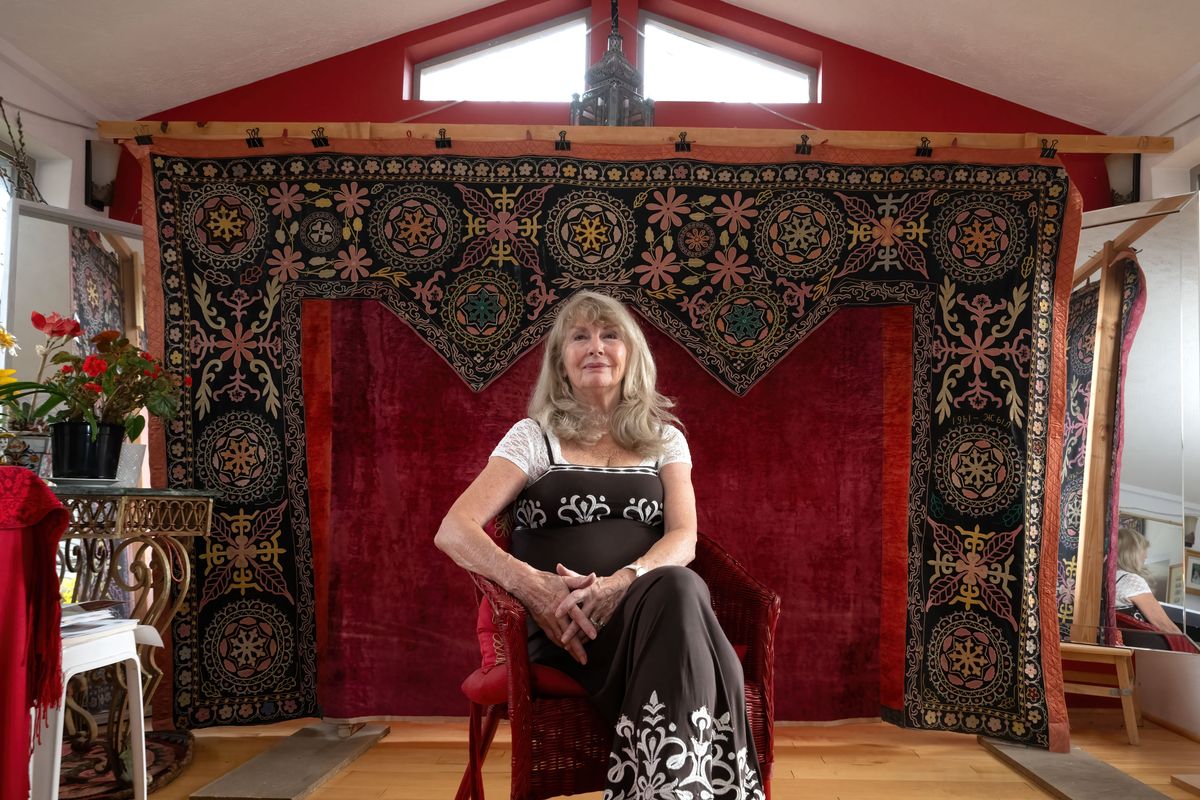
For more than 2,000 years, the Kyrgyz people enjoyed a nomadic lifestyle in Central Asia.
They lived in yurts and followed the seasons, moving their livestock from pasture to pasture. Large hand-embroidered textiles called tush kyiz (pronounced tush keys) hung in their yurts, often serving as walls. These remarkable works of art narrate their values and beliefs through symbols and designs.
“It’s philosophy in fabric,” said Ann Marie Burk.
In 2003, she got a job with the U.S. State Department teaching English in Kyrgyzstan.
“I lived and taught there for two years,” she said. “While there, I became fascinated with these amazing wall hangings.”
She was introduced to them when a woman visited Burk in her apartment and invited her to tea.
“I knew she wanted to sell me something, and I wanted some carpets,” Burk recalled. “She didn’t have any carpets, but she had these beautiful tush kyiz. She had eight, and I bought them all.”
And a collection now numbering over 200 was born.
“Each one is different and embroidered with tiny, tightly compacted chain stitches,” she said. “Each piece tells a story.”
The textiles reveal the culture of Kyrgyz nomads before Kyrgyzstan was occupied by Russia in 1921 and transformed into a Soviet state.
“The Soviets were there for 70 years,” Burk explained. “Their philosophy prevailed, eradicating the nomadic philosophy. Their standard of living went up, but their culture was repressed.”
During this era, the Kyrgyz people were encouraged to abandon the old ways, and the crafting of tush kyiz became a lost art.
“Almost none were made after 1970,” she said.
In her South Hill living room, she displayed a richly hued tush kyiz made in 1961, and pointed out the recurring symbols.
“Typically, they feature some type of crossroad design to represent choices and a Tree of Life design representing family,” explained Burk. “Many include birds –they’re viewed as messengers from the spirit world because of their ability to fly between the heavens.”
Another tapestry featured a pair of blue birds.
“This is one of my favorites,” she said.
Many tush kyiz were created by skilled women known as Saimachi and given as gifts to celebrate weddings and births; many are signed and dated. Burk believes that 80 pieces in her collection were made by these master craftswomen.
“They would go into a trance and dream the design and then execute it,” Burk said. “Tush kyiz took years to complete.”
The designs were typically stitched on black cotton backgrounds, showcasing vibrant tones of red, purple, green and gold.
Burk showed another example in her living room.
“They used bright colors to scare evil spirits away.”
In her granddaughter’s room, the bed is framed by beautiful examples of this folk art. Bordered with birds and filled with large crossroad symbols, this tush kyiz is rich with the symbolism revered by the Kyrgyz people.
“The themes are similar – find balance in life, ask for guidance when you come to a crossroad, honor your ancestors,” she said. “I love the messages.”
Another room features a wall hanging commissioned for a Soviet exhibition.
Dated 1964 and signed “Batma,” the design includes a Kyrgyz Soviet emblem in the center, with wheat, cotton, a sunrise over the mountains, a hammer and sickle, and the Soviet star.
“I have about 20 that feature the Soviet state emblem,” said Burk.
As much as she enjoys her collection, she believes most of them belong in museums or galleries.
The Minneapolis Institute of Art purchased four of her tush kyiz.
“I’m of an age that I don’t want to hang on to so many,” she said. “I want to pass on the legacy to museums and galleries. They are the works of a culture that is gone, but doesn’t need to be forgotten.”
Though she hopes the bulk of her collection will land in places where they are widely viewed and appreciated, she treasures the pieces displayed in her home.
“I’m fascinated by them. The nomads called them the ‘Song of Silence,’ ” Burk said. “I like to listen to them sing to me.”
For more information visit tushkyizfromkyrgyzstan.com.