
Ukraine-born artist Sasha Barrett shows reality of war through ‘Resilient People’
Since February 2022, when Russia invaded Ukraine, images and video from the war have practically become commonplace.
For artist Sasha Barrett, who spent the first 10 years of his life in Sumy, Ukraine, the images were the reason he didn’t sleep, the reason he spent hours on the phone talking with friends and family still living in the country.
It’s also the story behind his exhibit, “Resilient People (Vytryvali Lyudy),” which continues through Dec. 4 at the Spokane Falls Community College Fine Art Gallery.
The exhibit features clay sculpture, documentary film and actual objects and artifacts from the war to tell the story of what the last three years have been like for the people of Ukraine.
In happier times, Barrett’s first steps in the art world were via drawings he made in kindergarten. His mother was his kindergarten teacher, and also a cellist, and his grandmother was a seamstress. His grandfather worked in a factory, and the four all lived together, so he was surrounded by a lot of creativity.
When Barrett was 10, he and his mother moved to Boise. Prior to the move, Barrett’s mother put him in an English as a Second Language class, so he arrived in America knowing simple words like “apple” and “monkey.”
He continued drawing once he settled in Idaho, and, encouraged by his father, took classes in different art mediums outside of school.
Up until high school, Barrett said he wasn’t the best student. After too much time spent “being a little knucklehead,” Barrett’s father, who wasn’t interested in punishments like grounding, signed him up for a pottery class at the local community center.
Barrett was open to the idea, as he saw ceramics students at work while in his Advanced Placement Drawing class.
“When he signed me up for that class, I was like ‘OK, I know the environment a little bit.’” he said. “Then, of course, I think for a lot of people the pottery wheel really draws you to the medium, so once I started doing that, it was an obsession to do.”
After a couple months making mugs and bowls, a then-15-year-old Barrett got a job at the studio working with potter Rick Jenkins. Barrett quickly got the hang of clay, to the point where community members would compliment Jenkins on a bowl he pulled out of the gas kiln only for Jenkins to tell them it was one of Barrett’s pieces.
Barrett continued developing his skills through AP Ceramics classes led by potter Jerry Hendershot. Hendershot, who Barrett said genuinely cares about teaching high school, took the ceramics students to Phoenix and Philadelphia for National Council on Education for the Ceramic Arts conferences so they could attend the lectures and view the exhibitions.
“The whole time I was in high school, I was working in the studio downtown, so it was a crazy obsession,” he said. “I lived and breathed in the clay pottery world.”
After high school, Barrett continued with the obsession as he earned his BFA from Boise State University. He did an exchange program in Missoula as an undergrad and loved the city and clay community so much he decided to attend the University of Montana for grad school.
While in grad school, he began working with photography and documentary film. He taught himself a lot about filming and editing, though he also had friends help with editing and sound.
“It was a whole different process from clay, which I think was really exciting for me because a lot of the clay stuff I’ve been doing for a while, and it felt safe,” he said. “I rely on myself for every step of the way, so diving into a different medium, I really learned a lot about being on someone else’s schedule, collaboration, communication, all these things that fall into making work that is not just self-made but is a collaborative effort.”
At this point, the war in Ukraine had been going on for about a year and a half. Barrett borrowed a lens and rented a camera before heading to Ukraine to visit family and friends still living in the country and document what life was like.
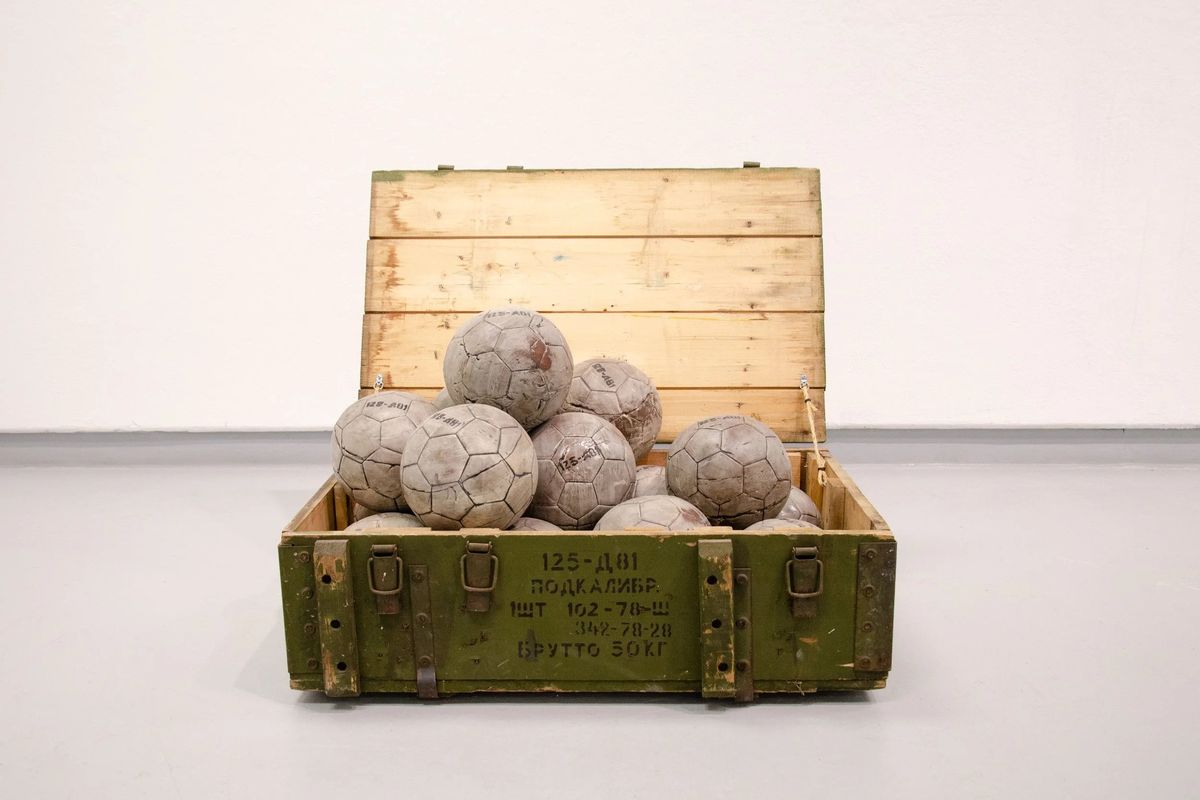
The resulting film, “The Creative Front: July in Wartime Ukraine,” is part of “Resilient People (Vytryvali Lyudy).” Another straight-from-Ukraine piece in the show is a wooden artillery crate sent to Barrett from his friend Sasha Cherednyk. The crate is full of clay soccer balls, a piece called “Playing Ball with My Friend Sanya.”
The exhibit also features sculptural wall panels, and there is an installation of dozens of clay drones that acts as a fundraising piece. Those interested in buying a drone can do so for $100, with a majority of the sales going to an organization called Shield Ukraine.
This is the second time Barrett has created drones for a fundraising piece. In the past, he’s also created and sold Ukrainian-themed mugs, with proceeds helping Cherednyk to buy a car so he could evacuate people during the first months of war.
“It’s really surreal to me to see these batches of mugs… and then seeing them as bulletproof vests and as helmets and as drones and as cars,” he said.
Barrett said everyone in Ukraine, not just soldiers, is fighting the war in any way they can. Along with his fundraising efforts, Barrett also hopes his art brings awareness of not only the war but also Ukraine’s existence. Not many knew where Ukraine was on a map when he first moved to America, so if his work can educate someone or help them have compassion for the country and its people, he considers that a win.
“There’s so many other things about my own story that I would love to make artwork about,” he said. “As soon as the war is over, I have intentions of making artwork about being an immigrant and about childhood and about being bilingual. Those things are really interesting to me, and I’d love to dive into a body of work on that matter, but I feel like, for now, this is my war too. I’m firsthand affected by it so for me, my way of contributing and my way of finding the fight is through this, people being aware of it.”