
MAC showcases most comprehensive survey to date of works by Walla Walla Tribe painter, printmaker James Lavadour
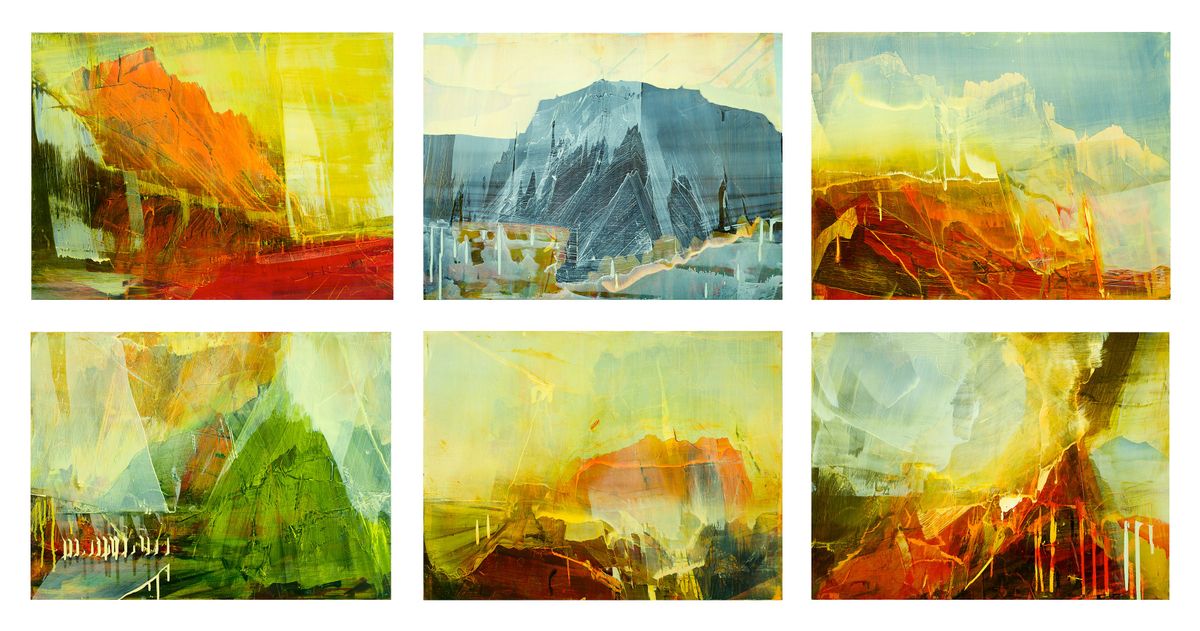
There are countless artists capable of painting a beautiful landscape. Capturing the exact angle of a ray of sunlight, every single leaf on every single tree, a field of bright, colorful flowers, a rushing river or babbling brook – they nail every detail.
Not every artist can bring as much energy, as much electricity to a landscape as James Lavadour.
Maybe it’s because of the layers in his paintings, which come as the artist works on multiple paintings, sometimes as many as 50, at once, brushing paint on one, scraping paint off another, until he deems them complete.
And when they are complete, he arranges these seemingly unrelated paintings into grids that, taken as a whole, seemed to have been created together from the start.
“Land of Origin,” which opened Saturday and runs through June 7 at the Northwest Museum of Arts and Culture, features 18 paintings and 10 works on paper by Lavadour, of the Walla Walla Tribe.
Spanning five decades of his work, the exhibit showcases Lavadour’s connection to and appreciation of eastern Oregon, especially the Umatilla Indian Reservation and the surrounding Blue Mountains region, where he has spent most of his life.
Curator of Modern and Contemporary Art Rachel Allen said rather than receive a formal art education, Lavadour learned from the land during sunrise hikes that have, as he’s gotten older, turned into early morning drives of the same area.
“I realized that everything that’s out there is in here,” Lavadour said in a statement from 2024. “And so it became a big question of what of me is out there. I began to approach nature and hiking as a way to understand who I am, and what I am, and how I am, and where I am.
“Exposure and sensual perception and the daily accumulation of bits and pieces of knowledge that sticks with you is what I made the paintings out of.”
Allen said that exhibit attendees will see how Lavadour’s understanding of the landscape changed over the years. The changes in how he used color will also be evident, as well as how he’s seen the life of the land, “the energetic forces, the geological forces,” change over time.
“He also talks about how … color is medicine to the world, and how he feels as an artist,” Allen said. “It’s really important for him to bring that care to the world through his artwork.”
“Land of Origin,” which was curated by Danielle M. Knapp from the Jordan Schnitzer Museum of Art at the University of Oregon, isn’t the first time the MAC has featured Lavadour’s work; his “Landscapes” was one of the first exhibits in the museum’s newest building upon its opening in 2001.
During this period of his career, Lavadour notably had a bout of productivity in his paintings which he credits to his experience after his first printmaking residency. After the experience of adding to the print one layer of color at a time, Lavadour said things clicked with his painting.
“I went home, and I started working frantically, one layer at a time,” he said in 2024. “I’d start hundreds of paintings. And then I’d come back around and do the next layer, the next layer, the next layer of all these different piles. And eventually, they started appearing, a new thing started appearing, and it was extremely exciting.
“I was more excited about painting than I’ve ever been in my entire life. I felt like I had just discovered something really, really fantastic. … It was an extremely fertile, prolific period, because all of a sudden I realized that I knew everything I needed to know, and I was able to isolate the different stages. Before, I just made a painting, I didn’t really know how I did it, I just intuitively did it. But with printmaking, I could go in these stages, and I could do anything I wanted.”
Lavadour thinks of painting as his life. He therefore must figure out time to be in his studio, no matter what else is going on in his life. Painting, he said, is a type of knowledge one has to renew every day, something that requires active participation in the world.
“My painting is living in the world, it’s alive, and it’s not fantasy, it’s something right in your face, the energy of it,” he said in 2024. “I don’t know how to describe it … It’s like I’ve got my nose in the groove of the world, like a phonograph needle, and the world is just spinning around, and this is what comes out.
“To me, these paintings are medicine to the world.”