Super Mario? Saint-Superman? El Principito? Gonzaga’s Mario Saint-Supery doesn’t care what you call him, just get used to saying his name
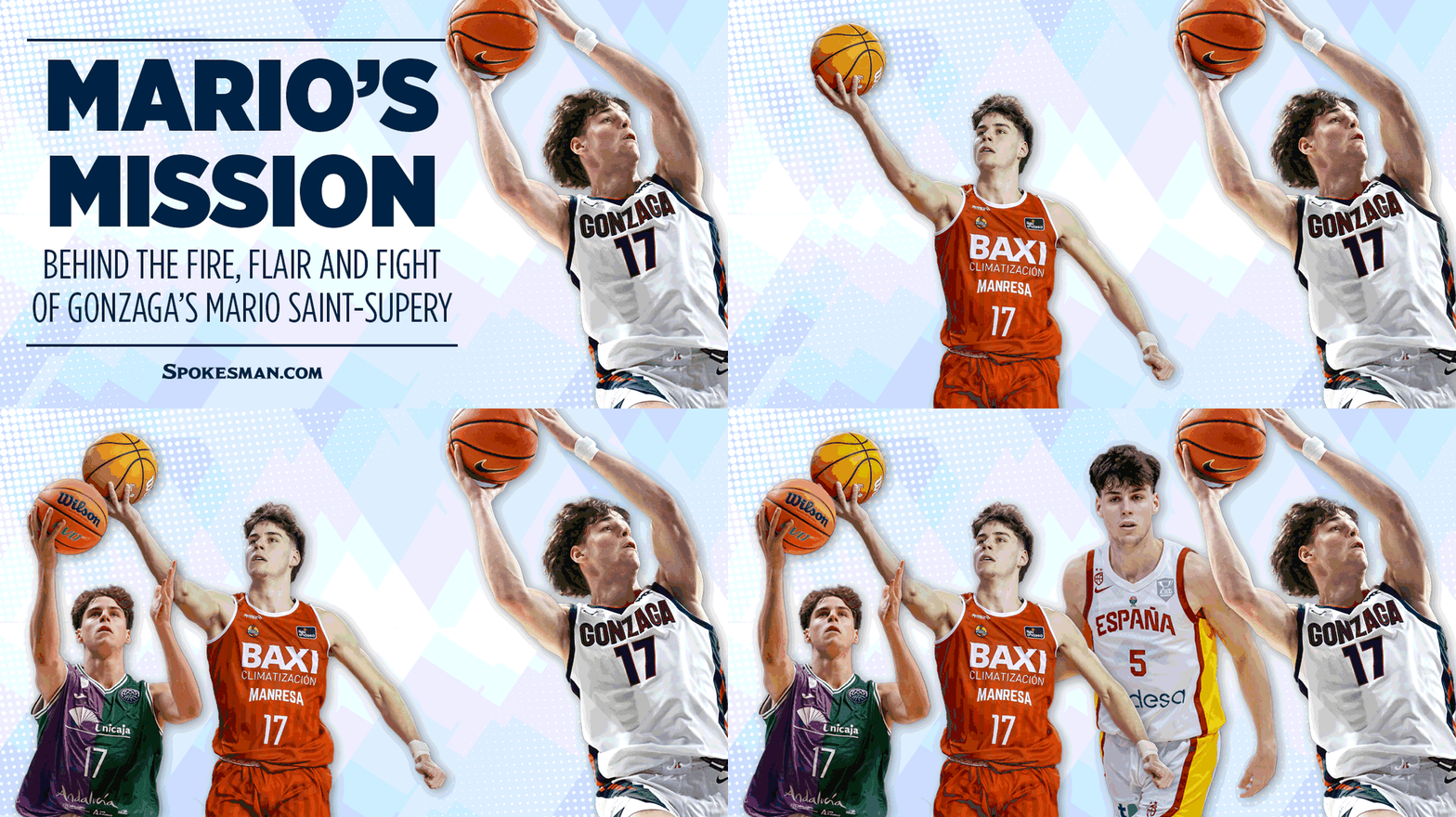
MALAGA, Spain – It’s a quarter past noon and the lunch rush hasn’t quite arrived at Bar Meson Paco.
Outside, five or six patrons enjoy food and beverage under sprawling white umbrellas that hang over the streetside patio. Inside the establishment, a middle-aged employee is tending to a kitchen stove in the back left corner.
Simultaneously, he’s keeping an eye on 12 slabs of pork knuckle slow-cooking in separate pans on one burner, and flipping sliced French rolls that toast on a flat steel surface. Twenty feet away, an older employee sits at a square table where thickly cut home fries soak in plastic water tubs.
A waiter approaches the table occupied by someone who just strolled in. Speaking decent English, he drops a not-so-subtle hint while taking the customer’s order.
“Do you want the house special?” he asks.
The mouth-watering “bocadillo” is why you dine at this Andalusian-style spot in Malaga’s Carretera de Cadiz district. Between two toasted baguettes, there’s a generous helping of shredded beef and traditional Spanish omelette (egg and potatoes). Aioli sauce is drizzled over the beef before the sandwich is sliced into two halves and plated.
The house bocadillo gets high marks from the foody sector of TikTok and when you walk up a staircase to access the second floor, it’s hard to miss the framed painting depicting a human-sized anchovy wearing a jeweled crown and Unicaja Baloncesto basketball jersey holding the sandwich with two fins.
Mario Saint-Supery swears by the bocadillo.
The Gonzaga freshman would make morning detours to Bar Meson Paco for fuel and sustenance before long training sessions at Unicaja’s Los Guindos facility, located just two left turns from the cafe.
A 10-minute walk in the other direction puts you smack dab in the middle of the beach. Palm trees. Sandy shores. Soft waves rolling onto the land. Sweeping views of the Mediterranean Sea are available for miles in the foreground. Turn 360 degrees and Malaga’s lush mountain peaks and foothills provide more postcard-quality snapshots.
It’s understandable why no one would want to leave this place. In some ways, it’s a more affordable San Diego, with cuisine, history, culture, outdoor recreation and more than 300 days Spanish sunshine. As one travel blog put it, when Malaga weather is bad, locals are still just a few degrees from “full-on bikini weather.”
“It’s my hometown,” Saint-Supery says, “it’s the city I love.”
And Saint-Supery might still be there if another love didn’t pull him away.
This summer, the young Spanish sensation parted with the weather, left family members and friends and paid a six-figure buyout to terminate the contract he signed years earlier with a club he’s supported since before he could shoot a free throw.
It’s early, but the calculated gamble to play college basketball in the U.S. has paid off, both for Saint-Supery and Mark Few’s 13th-ranked Gonzaga program. The tantalizing young guard is averaging 9.8 points, 4.0 assists, 3.2 rebounds and 2.4 steals for the unbeaten Zags (5-0) after working his way into the starting lineup on Monday against Southern Utah.
After posting the most impressive stat line of anyone who played in that game – 16 points, seven rebounds, six steals – there’s no reason to think he won’t be back in the starting five when Gonzaga tangles with No. 11 Alabama on Monday (6:30 p.m., TNT) at the Players Era Festival in Las Vegas.
There’s growing excitement about Saint-Supery’s future, as well as an aspect of all this some Gonzaga fans might not be ready to confront. What happens if he gets too good, too quickly? Saint-Supery isn’t consistently showing up on NBA Draft boards, but a couple have printed his name.
There were 12 scouts watching live when he took over in the second half against Creighton. That’ll be a fraction of the scouting entourage that shows up in Vegas to see players like Darryn Peterson (Kansas), Nate Ament (Tennessee), Labaron Philon (Alabama) and others.
Saint-Supery could pop in a way that forces them to take a longer look at him, too.
“He can shoot the ball when you go under a ball screen. He’s got good size. There’s vision there,” Few said. “It’s just a matter of putting it all together. … He just plays with a good intensity and kind of a zeal that kind of is infectious.”
There isn’t a bocadillo within a few-thousand miles of McCarthey Athletic Center, but Saint-Supery’s already starting to feel comfortable. It helps when a Spanish flag pops up in Gonzaga’s student section during the second home game of the season and students sitting behind ESPN’s broadcast table show up wearing caps from the Super Mario video game franchise as an homage to the young guard.
“There was a lot of other schools (recruiting me). There was some good ones, I would say,” Saint-Supery said. “But I didn’t focus (on them) that much. From the first moment they told me Gonzaga and when I had the interview, I was like, I don’t want to hear (from) other schools.”
…
Malaga is more likely to ring a bell when Saint-Supery tries to explain where he’s from, but his actual hometown is located 20 minutes south of Spain’s sixth most-populated city.
The Gonzaga guard lists Malaga on his school bio and the guard was born inside a Malaga hospital – ironically, the same one as his father – but Saint-Supery was raised 11 miles down the coastline in the smaller municipality of Rincon de la Victoria.
Saint-Supery’s last name comes from his mother, Amelia, whose family lived in France before relocating to Madrid. Mario’s father, Sebastian “Kiko” Fernandez, possesses a more traditional Spanish name. After Mario’s birth, the couple went to a judge to see if he could adopt Amelia’s surname as a way to protect and prolong the Saint-Supery legacy.
“It’s very important,” Mario said, “and I think it’s beautiful to have a last name like that.”
Now to the historical significance of the family name.
During a home game against Creighton, ESPN’s broadcast crew highlighted the possible connection between Saint-Supery and French author Antoine de Saint-Exupery, whose 1943 novel, The Little Prince, has sold 140 million copies worldwide and in 2017 became the most-translated book of all time, after the Bible.
Yes, there’s a reasonable chance Saint-Supery is a distant relative of the prominent author. Family members speculate “Exupery” was converted to “Supery” when Amelia’s ancestors moved to Spain.
Nobody knows for sure, but nobody’s scrambling to find the genealogy charts, either. Mario’s nickname, “The Little Prince”, translated to “El Principito” in Spanish, already has a high approval rating in Spain and the U.S., and it seems like nobody wants to spoil the fun.
“50/50, we don’t know,” Kiko said. “It’s great to have a mystery.”
Kiko and Amelia were divided on their son’s first name. She liked “Alejandro,” but Andalusians tend to shorten names and Kiko was concerned people would call their boy “Ale.”
His proposal was vetoed even faster.
“I wanted to call him Thor,” he said.
As a boy Mario resembled the Nordic superhero, with long blonde hair and a physically advanced frame for his age.
“We have photos of him throwing into the swimming pool and if you cut the head,” Kiko said, “it looks like a 25-year-old.”
But “Thor” was never going to fly.
“In Spain,” Amelia said, “Thor is a dog’s name.”
Kiko’s a basketball junkie who can watch upward of 17 games a week, catching the “virus” in 1984 when Spain won an Olympic silver medal in Los Angeles – a landmark moment for the sport’s growth in the country. Mario has photos of his dad watching three different games on three screens at the same time.
With his hair styled into a ponytail and gray fuzz covering his face, the gregarious and congenial Kiko pulls up to a meeting at a laid-back beachside bar in Rincon owned by Mario’s uncle wearing a vintage Pau Gasol Spanish national team jersey. Amelia comes dressed in a Zags shirt.
Kiko works from home as a programmer. When there’s down time, he likes to plug away on a passion project that’s nearly a decade in the making. Since 2016, Kiko has been designing detailed trading cards for Mario and his teammates/coaches. The cards are Topps-quality and fit into plastic sleeves that fill two large binders. It’s a big undertaking as is, but the task became especially exhausting early on when Kiko had to take his own photos. The Gonzaga collection is coming next, he assures.
A natural entertainer, Kiko can carry on basketball conversations for hours. He’s willing to talk about Mario, the ACB, NBA or wider-scale trends within the game. Take your pick. On more than one occasion during an interview, Amelia urges him to be more precise with his answers, so a visiting reporter doesn’t have to rebook his bus ticket. The ticket is rebooked anyway. Twice.
“There’s nothing in the world he loves more than basketball,” Mario said. “He’s crazy.”
A play-making center, Kiko had a chance to play professionally until the age of 26, when he jumped for a rebound, came down on an opponent’s foot and snapped his knee.
“It’s the worst of the sport,” he said.
Amelia played, but not competitively. She’s an endurance athlete who’s completed four mountain marathons and is still signing up for new races at the age of 55.
Within a year of their son’s birth, Kiko and Amelia installed a small hoop on the ceiling of the family’s home before Mario progressed to a “mini-basket.”
At the age of 6, Mario joined a youth team in the beachfront neighborhood of El Palo. The outdoor court wasn’t maintained well and gravel pieces precariously covered certain parts of the playing surface. Diving for loose balls was an equally admirable and dangerous proposition. Mario would come home with bloody knees and gravel bits lodged into parts of his leg, forcing Kiko and Amelia to send him back in sweatpants and kneepads.
But there was no curtailing the boy’s energy.
During a 3-on-3 tournament in the coastal town of Torrox, Mario played with close friend Manu Trujillo, now a member of Unicaja’s first team and the son of Unicaja U-22 coach Manolo Trujillo. Manolo and Kiko have been close friends since their teenage years.
A stone barrier separated the concrete court from the beach. During one game, a loose ball bounced over the wall, out of play. Saint-Supery sprinted toward the divider, flew over the stone slab and caught the ball before crashing onto the beach. He returned to the court with sand morsels caked to every inch of his body.
“Like sandman,” Kiko said.
“It probably wasn’t necessary,” Manolo Trujillo laughed.
“He’s a fighter,” Kiko added.
…
Kiko’s basketball career had a short shelf life, but he was deeply invested in his son’s development. It was a perfect match; the father who never wanted to stop teaching, the boy who never wanted to stop moving.
They’d accumulate thousands of hours dribbling on the family’s outdoor terrace. Kiko always admired Ricky Rubio’s ability to keep his eyes neutral while handling the ball, so he bought a pair of goggles for Mario that were blacked out from the middle to the bottom of the lens, partially obstructing his vision.
Kiko’s rolodex of unorthodox basketball drills ran deep. Another included a black elastic cord he’d attach to pillars on the family patio. Straddling the line with one leg on either side, Mario would go through different dribbling patterns trying not to make contact with the cord.
The meticulous ball-handling routine he goes through almost exactly two hours before every game is the same one he started with his dad 15 years ago. It’s just performed at a faster cadence now.
During the COVID-19 pandemic, Mario couldn’t play competitively for three months, which ramped up the household dribbling activities – an unfortunate development for neighboring apartments. Bothered by the nonstop beat of a basketball against the floor, other families in the complex pleaded that Mario switch to a ping pong ball.
In the attic, Kiko and Mario would work on passing. Magic Johnson was Kiko’s favorite player and sharing the ball was a critical part of Mario’s upbringing.
“He thinks he’s the G.O.A.T. (greatest of all time),” said Mario, who wore Johnson’s No. 32 – a tribute to both the Lakers legend and his dad – when he debuted for Spain’s senior national team in 2024.
At El Palo, it left a bad taste in Amelia’s mouth when Mario scored 30 of his team’s 35 points in one game. She and Kiko devised an incentive plan, offering “chucherias,” or pieces of candy, for every assist he threw. Mario’s assist average and sugar intake both escalated in a hurry.
At the age of 15, when Mario began splitting time between Unicaja’s youth and senior teams, Kiko had access to other analytic tools that could measure his son’s impact. Now that he could pull up a box score and track Player Efficiency Rating (PER), Kiko told his son the family would take him for chicken wings if his efficiency reached at least 20. It wasn’t long before he had to raise the threshold to 30.
“One thing that’s important is since he’s the only child, we eat together every day,” Kiko said.
…
Manolo Bazan is both a towering and respected figure in Unicaja’s youth academy. The 6-foot-9 former center/forward played at Unicaja way back when and still coaches the club’s U-11 teams.
Players typically don’t arrive at the academy with Saint-Supery’s level of skill, competitive drive and ambition. Only one other player comes to mind for Bazan when asked if there’s a reference point for Saint-Supery.
“Domantas Sabonis,” he replied.
The former Unicaja player-turned Gonzaga standout-turned three-time NBA All-Star showed up at the club in 2004, when father Arvydas retired from the NBA and moved the family to Torremolinos just south of Malaga.
Sabonis was 5 when he started training on the outdoor courts reserved for Unicaja’s preschool-aged players. The forward grew through his years in the academy, playing for both Bazan and Trujillo before earning a role on the first team in 2012 and joining the Zags two years later.
“One thing in common clearly is the ambition. You can see when you are in the practice, the players that are 100% focused on the court. Mario and Domas are similar like that,” Trujillo said. “… (Sabonis) wants to win. Mario’s similar. Both of them don’t tolerate – they’re very frustrated with loss. They have ambition because they hate loss and they’ve very aggressive because they transform when they’re going to play because they want to win.”
Bazan traces his earliest memory of Saint-Supery back to Unicaja’s U-11 mini-basket team. Players at that age are required to play full 10-minute periods without subbing. Saint-Supery used all five fouls in the opening period and dropped to the floor sobbing in frustration when he realized his day was over.
“He went to the floor crying and he was crazy,” Bazan said through the help of an English translator, Jose Carolos Romero, Unicaja’s Branding and Sales Management Director. “He was always ready to compete and he was frustrated because he saw that he has to go to the bench. … So that reaction was special.”
Saint-Supery attributes the emotional swings to being Malagueno, explaining natives of the area are “very expressive.”
Representing the Andalusian region in a U-15 tournament, Saint-Supery was playing against a Madrid-based team and longtime friend Hugo Gonzalez, who was drafted No. 28 overall by the Boston Celtics in June. After hitting his fourth straight 3-pointer, Saint-Supery turned to a section of Madrid parents and began strumming an air guitar. Kiko later heard about it from Gonzalez’s mother.
“We both I think are really, really competitive,” Gonzalez said in July at NBA Summer League. “If we play (NBA) 2K, we’re going to try to beat each other. If we’re playing free throw competition on the national team, we’re going to try to beat the other guy or we’re going to try to (make them flinch).”
Saint-Supery injured his back against Madrid and tried to play through the pain in a championship game the following day. The guard seized up after a few trips down the floor and subbed out of the game, presumably for good. When Andalusia found itself trailing by six points in the third quarter, Saint-Supery summoned the strength to return. Unable to jump, he still scored 18 or 20 points, making every shot he took to clinch the championship.
“He’s like Hulk,” Trujillo said. “In the competition, he develops and transforms.”
Amelia agreed her son rises up in pressure situations. Kiko recounts numerous examples of him doing “incredible things in bad conditions.” Trujillo cites two popular Spanish expressions – “afila el colmillo” (sharpens the fang) and “como un lobo” (like a wolf) – to characterize Saint-Supery’s spirit on the court.
Trujillo kept tabs on what American media outlets were writing and saying about Gonzaga’s incoming freshman before the season started.
The consensus? It could take some time before Saint-Supery’s ready to contribute. Freshmen usually face a steep learning curve, but not as steep as the one international players face. That put not one, but two theoretical obstacles in front of Saint-Supery.
“I read something from Gonzaga, ‘Oh Mario’s in the second line of the team.’ They don’t know Mario,” Trujillo said. “‘Oh, he’s a first year.’ They don’t know Mario.”
…
At the age of 15 years, 11 months and two days, Saint-Supery became the youngest player to debut with Unicaja’s first team. That also made him the fifth-youngest player to debut in the Spanish ACB, generally considered the second-best domestic pro league in the world after the NBA.
For a frame of reference, Luka Doncic was only 16 years and two months old when he debuted for Real Madrid. Sabonis was 16 years and six months old when he got his first minutes with Unicaja’s first team.
Two other Zags, Kyle Wiltjer (2018-19) and Killian Tillie (2024-present), played at Unicaja well after their time in Spokane ended. Saint-Supery did it four years before he arrived at Gonzaga.
…

…
Over the summer, he became the youngest player in 16 years to represent Spain at FIBA EuroBasket. Rubio was playing on Spain’s 2009 EuroBasket squad at the age of 18.
The point being, Saint-Supery was thrust into adulthood while others his age were still enjoying nights out with friends, weekends without obligations. At a stage of life when teenagers are normally afforded space to make mistakes, Saint-Supery didn’t have the same margin for error. Not on the court, especially not away from it. While his friends may have been off pursuing romantic interests, Saint-Supery was also looking for the perfect match. He needed a good sports agent to handle business matters off the court.
Amelia and Kiko tried their best to normalize things, but that becomes virtually impossible when the Spanish basketball federation is calling in the afternoon and expecting you in Belgium 24 hours later for national team duties.
Four years ago, the family enlisted a sports psychologist to help Saint-Supery navigate the chaos. The woman, who preferred to stay anonymous, still holds regular video calls with Saint-Supery to check in. Tuesday morning. Every week. Without failure.
“It’s more important for me that Mario, he has his feet on the ground always,” Amelia said.
Added Kiko: “We always say, we’re the ones catching him from the feet and putting him on the ground.”
Saint-Supery’s psychologist will also visit with his parents, often revealing things they don’t know about their son. It’s equally important for Saint-Supery to meet with her in times of joy and pain.
“As I told you, I’m a very emotional guy. I feel my emotions very strong, very hard,” Saint-Supery said. “… It’s very good if you’re physically healthy, but I think the mind and being mentally healthy is another key to success as a player.”
Something still resonates with Saint-Supery from the first meeting he had with his psychologist four years ago.
“With her, the word ‘try’ doesn’t exist,” he said. “We’re not trying to do anything, we’re doing it. That’s a mentality I think is very important to have.”
Saint-Supery’s taken a measured, professional approach to his physical health, too.
At 14 years old, a doctor encouraged him to stop consuming lactose to reduce inflammation that forced him to plant his foot in an awkward way. He switched to almond milk and started eating six almonds per day to replace the calcium he lost without traditional milk.
The guard’s diet in Spain usually consisted of an egg, avocado and tomato scramble in the morning, a salad or pasta for lunch and salmon or chicken for dinner. Saint-Supery’s consuming more red meat in Spokane and has packed on 15 pounds since arriving at Gonzaga on June 14, adding 10 before he left to play for Spain’s EuroBasket team.
When he arrived in the U.S., it was challenging to string together five pull-ups. Now, Saint-Supery’s able to knock out 21 consecutively before dropping. A shoulder issue limited what the guard could put up on a dumbbell press last season and he mainly used 20-pound weights. He acknowledges this type of load would be nothing for a power-lifter, but Saint-Supery’s now pressing 50- and 55-pound dumbbells at GU, making impressive progress under strength coach Travis Knight.
“First two weeks, I was so sore and I couldn’t move,” he said.
…
Eighth-year Gonzaga assistant Jorge Sanz has been plugged in with the Spanish basketball federation since he moved to the U.S. from his hometown of Zaragoza, Spain, two decades ago.
In 2023, Sanz was tabbed to help coach Spain’s U-18 team at the FIBA European Championships. Saint-Supery was called up to join a roster that also included Gonzalez, Michigan center Aday Mara and Iowa forward Alvaro Folgueiras.
Saint-Supery was on Sanz’s radar years earlier but this was his first real point of entry to the young guard. The 17-year-old guard was advanced for his age and inquisitive in a way the team’s older captains were not.
“I remember the feeling of thinking, ‘Oh, that’s a good question,’ ” Sanz said. “I remember feeling like, ‘This guy gets it, this guy knows what we’re trying to do.’ ”
Saint-Supery helped Spain capture a silver medal, averaging 9.9 points, 2.0 rebounds and 1.6 assists. Not long after the tournament, the wheels began spinning inside Sanz’s mind. He knew Saint-Supery had the talent to play at Gonzaga and his style seemed like a perfect fit. At the minimum, it was worth exploring.
Before bringing Saint-Supery’s name to GU’s coaching staff, he had to make sure the college route was something the guard and his team were interested in. Sanz contacted Richi Gonzalez, who represents Saint-Supery as part of Xpheres Basketball Management. It wasn’t an immediate no, but Gonzalez’s analytic-oriented team wanted to find a spot where Saint-Supery could play 600 minutes the following season.
The Zags had just signed transfer point guard Ryan Nembhard and Saint-Supery was only 17, without the two years of ACB experience he has now. Sanz crunched the numbers and came to a quick conclusion.
“I did the math. Honestly, no. The reality is no. It’s not going to happen,” Sanz said. “It will get there, but it will not be there year one.”
Unicaja loaned Saint-Supery to CB Tizona, a team in Spain’s second division that could offer more court time, for the 2023-24 season, and the guard joined ACB club BAXI Manresa on loan in 2024-25. Sanz did his due diligence, checking in at the end of each season.
“The hardest thing is trying to normalize different stats from different leagues from an AAU event to an ACB cup game,” he said. “There’s not just one tool that says the six points here represent 13 here. There’s no math to it.”
Saint-Supery was earning the league’s minimum salary at Manresa. Money has never been a factor in the family’s decision-making process, but once college offers began flowing in, Saint-Supery’s parents began hearing from his agency with more regularity.
“We’re talking about serious money and we have to have a meeting,” Kiko said, relaying the agency’s message.
Kiko estimates 8-10 schools reached out with concrete offers and presumes there were others the family didn’t know about. A top ACC contender was in the mix. A traditional blue blood offered. A national champion within the last 10 years joined the sweepstakes.
Gonzaga remained confident in its position with Saint-Supery, evidently for good reason.
“Maybe I’m just naive, but it made sense from both sides, the clear fit,” Sanz said. “I was not just hopeful, but I knew it had to happen.”
…
Revisiting the moment months later, Saint-Supery can look back now and chuckle, but there was no smiling in the middle of his first official practice when the Zags were going through full-court 1-on-1 defensive drills.
Saint-Supery’s turn came around and he was paired against Steele Venters. The 24-year-old Venters was in the early phases of returning to the court from consecutive Achilles and ACL injuries. Adding context, Saint-Supery also acknowledged Venters “isn’t the most crafty player in 1-on-1’s.”
Didn’t matter. The guard couldn’t keep his teammate in front. Blow-by after blow-by, Venters continued to find ways to beat Saint-Supery until the young guard, dazed and winded, finally pulled himself out of the drill.
“It was bad,” he said. “I had to step out for one second. I needed to chill out. I was getting dizzy.”
Given time, Saint-Supery’s never failed to adapt to a new situation. This experience hasn’t been any different.
In Spain, for example, he played in “four-out” offensive schemes, with four players on the perimeter and one stationed in the paint. Running off pick-and-rolls, he had more space to operate with once he turned the corner and started to go downhill. The paint’s more jammed-up at Gonzaga, with 6-foot-11 Braden Huff and 6-foot-10 Graham Ike occupying space and commanding most of the offensive touches.
“But I think it’s good for me because now I don’t have only one pass on the pick and roll, I have also the dunker,” Saint-Supery said. “I have G and Braden Huff. They’re crazy. They have crazy touch.”
The last handful of games confirmed what most in Spain already knew about Saint-Supery, who had 13 points in 18 minutes off the bench against Creighton before earning game MVP honors in a 72-point romp of Southern Utah where he had 16 points, seven rebounds and six steals.
“They’re going to get a slasher that’s really, really aggressive,” said Hugo Gonzalez, now 11 games into his rookie NBA season. “Really good defender on ball, I’d say a big competitor. … They’re getting a player who can shoot, who can pass, he can run the court, he can space the floor.”
During his time at Real Madrid, Gonzalez regularly went head-to-head with Saint-Supery’s teams at Unicaja. A Real Madrid teammate used to poke fun at Gonzalez, insisting he and Saint-Supery had similar mannerisms on the court. Ismaila Diagne could probably speak to that even better now.
“I was trolling (Gonzalez), I’d be like, ‘Oh, that’s your twin,’ because you play the same style and do the same moves and stuff,” said the Gonzaga center, a member of Real Madrid’s academy and first teams. “(Saint-Supery) was fast, that’s the only thing I can remember.”
Saint-Supery hasn’t had trouble fanning his competitive flames at Gonzaga. During preseason practice, the guard elevated his play and intensity to a level GU’s staff hadn’t seen once they started keeping score during a particular drill.
“He’s complained more than once to the staff that he thought the rules weren’t quite equal or the number of possessions weren’t quite equal,” Gonzaga assistant Brian Michaelson said. “Which, for a freshman to step up to the staff and say hey, his team wasn’t getting treated how they should and they should’ve won or they did win and they have the score wrong, I appreciate his fire and his competitiveness.”
From the point guard position, there’s not much Saint-Supery isn’t doing for a top-15 Gonzaga team. On certain plays, he’s hitting Ike and Huff for easy duck-ins. On others, he’s attacking soft spots in the defense and getting to the rim at will. In Monday’s win, he was one steal shy of tying Derek Raivio’s single-game school record.
“He’s got a great feel and great IQ for the game,” said assistant Stephen Gentry, Gonzaga’s offensive coordinator. “He’s obviously got great size. He’s going to be a great trigger for our offense. He’s going to be able to create a lot of offense, whether that’s in transition or off pick and roll for other guys.
“So he’s just going to be a great creator and facilitator for our offense, but he can also really pick his spots to score the ball, too.”
Saint-Supery’s spirits could be particularly high next week in Vegas. Kiko and Amelia are traveling to the Players Era Festival from Rincon de la Victoria, with plans to spend roughly a month in the U.S., catching every home and road Gonzaga game they can. It’s a trip they’ve had on the books for months. Amelia’s spent countless hours brushing up on her English in anticipation.
“I always say I’m lucky,” Kiko said. “If I won the lottery – I’d prefer to have Mario than win the lottery.”