
Beedlebug Socks: Spokane grandmother invents “adaptable” socks for grandson with disability
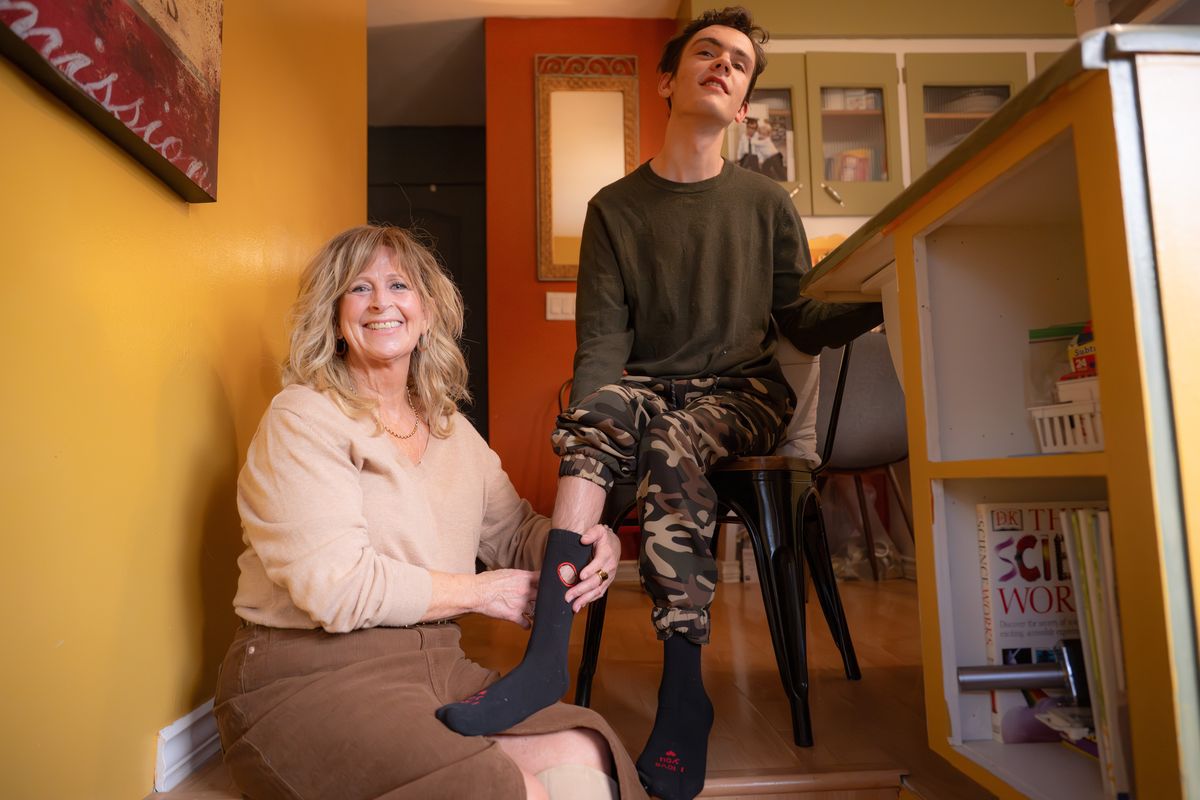
The day Coen Tucker was born, doctors said that he was likely going to die.
He had a bleed in his brain, his grandmother Linda Beedle remembers of that chaotic day in 2009. His parents flew with him from their hometown of Spokane to Portland’s Oregon Health and Science University, where he had three brain surgeries and a stroke.
“He survived everything they said he wouldn’t,” Beedle, 64, said. “And they told us when we were taking him home that he would need lifelong care.”
Wanting to help, Beedle left her human resources job to become a caregiver for her grandson while her son and daughter-in-law continued their careers.
“I am his person,” she said, describing Coen as a sweet and funny guy.
Today, Coen is a 16-year-old Shadle Park High School student. He lives with autism and cerebral palsy, along with weakness on his left side from the stroke he suffered as an infant.
Every day, he wears leg braces, zipper-topped shoes and his grandmother’s signature creation – Sockietalkies.
“He’s older now so I don’t have him very much,” Beedle said. “But when he was little I had him a lot, and during that time is when I was trying to figure things out for him. Try to find a way to make it easier. Try to find a way that he could do it.
“And then, I literally just put some holes in socks and he could put them on himself.”
Sockietalkies are above-the-ankle socks with two distinctive features: a positive phrase printed across the toe and a pair of holes, which wearers can use to pull them up.
“Each of them has a message on it. ‘Practice makes progress.’ ‘I love you more than all the stars.’ ‘Hey, you… you’re amazing,’ ” Beedle said. “That’s a big thing because I’ve talked to him so much about just saying positive things to him, to help him in his day.”
Coen said he likes the socks because of their good messages (“I am strong and capable,” he quoted in particular) and soft feel. There are both woven and printed sock designs – the latter of which is particularly important for individuals with textural sensitivities.
The realization that such a simple modification to socks could be useful to others set in fast for Beedle. In 2018, she officially launched her business Beedlebug Socks.
“Adaptive simply means ‘made for everybody, but especially helpful for those with disabilities,’ ” she said. “That’s why I love this space so much, because anybody can wear this. And then, who wouldn’t want to wear a sock, or give a sock, that says, ‘Hey you…You’re amazing?’ ”
Occupational therapist Teresa Skinner is the executive director of ParaSport Spokane, a nonprofit that organizes recreation for people with disabilities. She, along with around a dozen para-athletes she works with, owns pairs of Sockietalkies.
Existing aids for putting socks on are typically geared toward people who have trouble bending over, featuring a cloth or plastic platform that a sock gets rolled over and two strings to pull the platform out from the sock, leaving it on a foot. This is not a particularly useful device for people with quadriplegia or weak grip strength, Skinner said.
“Someone who doesn’t have any hand mobility at all could hook their thumb in to these,” she said.
Even as an able-bodied individual, Skinner said that she wears the socks for their comfort. They are just really well-designed, she said.
But it has been a rocky road for Beedlebug Socks. In the beginning, an issue with an employee led to a complete shut down and restart of the business. Once getting back on her feet, COVID-19 hit the states.
The world of adaptive products is on course to explode in the next few years, Beedle said, largely due to the growing percentage of senior citizens in the United States. Specialty clothes and furniture can be expensive and impractical for users and caregivers, though. Sockietalkies run about $12 online.
“They’re wanting to age in place,” she said. “They want their dignity. They want to dress themselves. They need to put their own shoes and socks on, so if we can offer that and they can find us then we’re able to help them do that.”
It is the “if they can find us” part of the equation that has been the biggest struggle for Beedlebug Socks in recent years. Beedle has negotiated with a number of companies, including CVS and the online shoe-seller Zappos, only to have plans fall through for one reason or another. Federal rollbacks of Diversity, Equity and Inclusion policy added another challenge.
“You know, when DEI was taken out of everything, people don’t realize that people with disabilities are part of that,” she said. “And they just basically – their executives are gone. The adaptive people I’ve been talking to at Target for years – gone the next day after years of service. So I don’t have those connections anymore.
“So, now I’ve just kind of moved away from retail, and I’m working with more foundations, hospitals, children’s organizations. I think that’s the direction I need to go.”
So far, the switch in her approach has been fruitful. Patients who have spinal injuries at NeuroHope, a clinic in Indianapolis, were able to use Sockietalkies.
“I sent (the clinic) socks and those fellas were able to put them on, and it was the first time they ever put their socks on,” Beedle said. “There was a lot of tears. A lot of emotion. So that’s the kind of thing that drives us.”
Skinner said ParaSport Spokane has considered partnering with Beedle for a unique sock design – perhaps for basketball tournaments, since players’ socks aren’t regulated – though it is ultimately a question of affordability.
“Linda’s just fantastic,” she said. “Anything to help support her, too, I would be happy to do.”
With the help of occupational therapists, Beedle has been working on developing a compression Sockietalkie. She is also designing pairs that incorporate the pull loop into a design for individuals who may be worried about the socks appearing unusual.
Despite the new direction, she hasn’t given up on retail entirely. Though not physically in stores, Beedlebug Socks can be purchased from Kohl’s and JCPenney online, along with the official Beedlebug.com website.
Beedle worries about the future of her business, though. Since 2018, creating adaptable socks has not turned a profit without retailers diving in. She would sell Beedlebug Socks to a manufacturer if it meant more people could access Sockietalkies.
“In my dream mind, I think I would like to hire Coen and a lot of his buddies from school and have them packaging and have them helping me,” she said. “I’ve dreamt that, but we’ll see how things go. But like I said, I’m kind of a bulldog getting into these organizations and just being able to talk to them about what this is and how it can help.”
After years of pushing, Beedle feels like she is sitting on the cusp of greatness. Leaving Coen with a legacy and funds to “be OK” for the rest of his life is Beedle’s personal goal, but on a larger scale, she wants to help people in general.
“I had a whole career. I never dreamed that I’d be doing this,” she said. “That career couldn’t have given me what this has given me. I have found my calling.”