
‘They call us Camp Dope’: There’s more nuance to the block housing the Ridpath than what’s seen on the outside
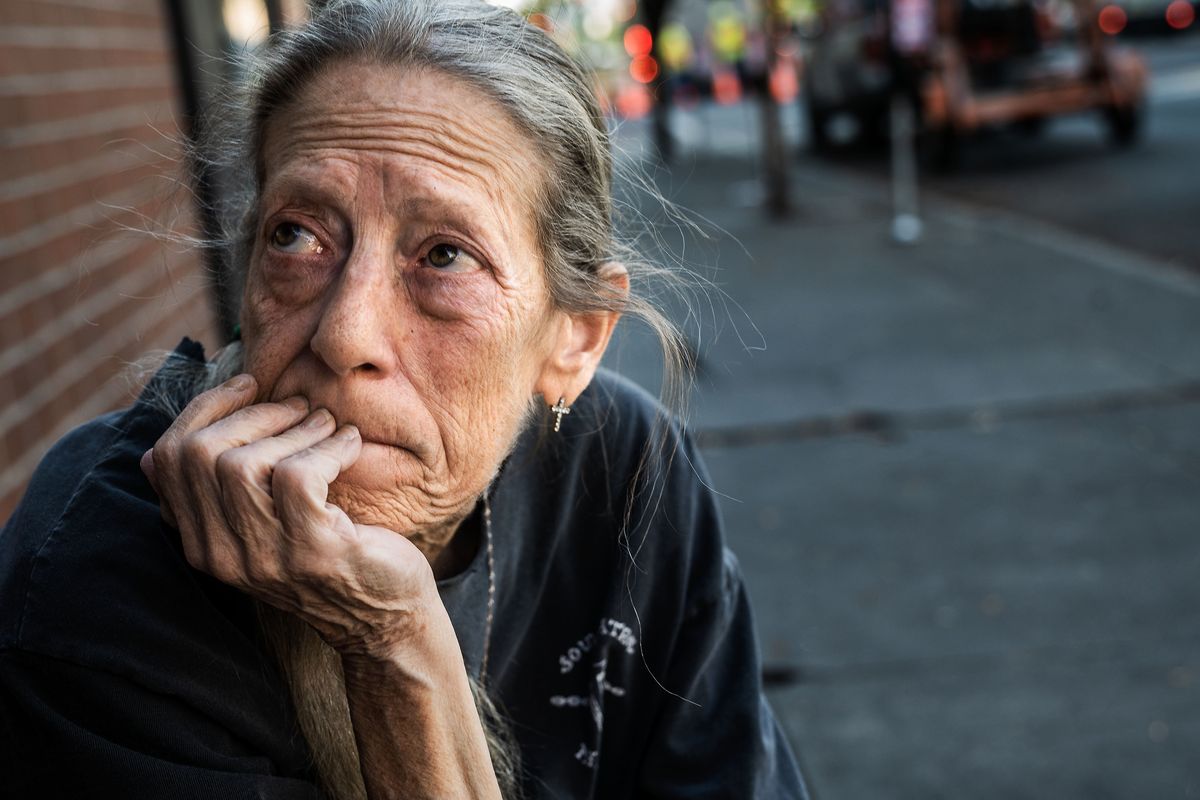
Most warm days, Rhona Gardener sits outside the Ridpath Apartments in her red camp chair with a pack of cigarettes in the cupholder and cellphone in her lap.
She is among dozens of people – some using wheelchairs, some with dogs, some talking with friends and others just leaning against the building – with a cigarette in hand, since smoking is prohibited inside, including in their “micro” 250-square foot apartments.
Across the street, dozens of other people mill about with their shopping carts, backpacks, blankets and bags of clothes. Some of them are addicted to drugs, Gardener said. Some of them have mental illnesses and are unable to get a job much less keep one. Some of them have fled to the streets to hide from an abusive spouse.
There’s violence around the area, too – local stores have been robbed, windows smashed and broken, people have been beaten and shot, and fentanyl foils sometimes litter the sidewalks.
“They’ve preyed on some of the residents in terms of their disabilities or their certain habits. It’s a difficult situation for everyone in involved,” Black Realty Management CEO Dave Black said of the people who don’t live at the Ridpath but congregate outside.
Along that strip of West Sprague Avenue, Gardener said the two groups are unfairly lumped together.
“We are guilty by association,” Gardener said. “Just by living here, we are assumed guilty.”
Lilac City leaders have spent the better part of the past five years puzzling over how to keep downtown safe and clean. And these days the people hanging around the once-swanky hotel have earned scrutiny.
Gavin Cooley, a former city chief financial officer who worked for five Spokane mayors and now is the director of strategic initiatives for the Spokane Business Association, recently picked up former Boise Mayor David Bieter at the airport, who was brought to Spokane to speak to 700 downtown business people about how he managed homelessness in Idaho’s capital city.
Cooley said the flight arrived around midnight. On the way to the downtown hotel where Bieter was set to stay, Cooley drove past the Ridpath and the two got an eyeful: two bonfires across the street from the building and plenty of people hanging around.
“He was pretty appalled,” Cooley said, remembering Bieter’s reaction to the scene.
The problems afflicting downtown are many, and include high office vacancy rates, small business closures and the nagging feeling that the streets aren’t safe. And if people don’t feel safe, they won’t want to live, work, shop and dine downtown, a recipe for a hollowed out city core. It’s all connected with visible homelessness, people ranting and yelling as they wander along the sidewalks, open drug use and the resulting overdoses.
Last year, at least 327 people died of a drug overdose in Spokane County, a 309% increase from 2019, when there were 80 deaths, according to the Spokane County Medical Examiner’s Office. The numbers are expected to be even worse this year, and the Ridpath is no stranger to the tragedies.
According to data from the Spokane Fire Department, the downtown apartment high-rise has had more than 40 calls for overdoses so far this year, 24 calls for sickness and eight calls for a possible or reported death.
The search for solutions is ongoing. What kind of shelters should be offered? Should police crack down on open drug use? Should resources be directed to housing people first? Should the focus be first treating the often underlying problem of addiction?
The homelessness, drugs and mental illness on display downtown are provoking these difficult and politically fraught conversations at Spokane City Council meetings, with regional and statewide elected boards and at gatherings of community advocates.
And in one way or another, it tends to lead back to Spokane’s homeless population and the areas they congregate, like sidewalks around and adjacent to the Ridpath. The high-rise hotel was purchased in 2012 after it had fallen into disrepair and remade into more than 200 affordable housing units.
Many are fed up.
A prominent critic of the city’s homelessness policies is developer Sheldon Jackson, who tends an email chain of 500 people where he decries the local response and media coverage of homelessness and crime.
In a July writing that decried the “housing first” approach touted by progressive elected officials and their advocates, Jackson took aim at a familiar target: the nonprofits operating in downtown Spokane. He alleged organizations such as Catholic Charities and Spokane Neighborhood Action Partners are operating “destroyed” housing projects overrun by criminals.
“Not only are the buildings destroyed from the inside out, but drug dealers and addicts control the buildings as others suffer,” Jackson wrote. “Check out the occupancy in the Ridpath, those people are not outside having a smoke break, unless it is smoking Meth and Fentanyl.”
Jackson declined to give an interview for this story.
But many share his criticisms of the focus of housing homeless people before they kick drug addiction.
“You can’t help people who don’t want help,” said Phil Altmeyer, the CEO of Union Gospel Mission in Spokane. He said drug addiction must be dealt with first so that the people who need help can make clear-headed decisions rather that making choices centered around where to get their next high.
“We want housing to solve the problem but we need to solve addiction first,” he said. “Housing needs to be a safe place.”
Altmeyer, who has been at UGM for 39 years, underscored that he wasn’t necessarily talking about the people at the Ridpath, but believes that any apartment complex, homeless shelter or transitional housing unit must ensure that people addicted to drugs are kept away to protect those trying to stay sober and improvement their lot.
The “housing first” model holds that people need the basics such as a place to live and food before they can pursue employment or sobriety.
Gardener found herself at the Ridpath four years ago using rental assistance from the Spokane Housing Authority. She is 68 years old, a former paralegal and still cannot make ends meet with a fixed income following retirement because groceries, rent and other prices have skyrocketed, even though she maintains a job at a nearby bar. It’s a similar story for many at the Ridpath, which sees a steady influx of older people, formerly homeless people coming from transitional housing and those with disabilities.
“I talk to business owners, I talk to patrons. They call us ‘Camp Dope,’ ” Gardener said, but “not everybody does drugs here.”
Spokane Mayor Lisa Brown said the Ridpath poses multiple challenges, including a lack of on-site services for residents.
“We have some very active conversations happening internally and with some external parties regarding the Ridpath,” she said in an interview on Friday. “So I’m kind of in a position where I’d like to get resolution on those conversations before I really talk about where we’re headed, but it’s something that has been on our radar for a year and a half and that we are working on. It’s multifaceted.”
City spokeswoman Erin Hut noted that there isn’t an outdoor space for Ridpath residents to congregate besides the sidewalk.
“So there have been conversations around, how could there also be a place for people to go without necessarily having to be right at the front door,” Hut said.
‘My people’
Paul Mann, one of the primary investors who revamped the Ridpath from a shuttered hotel into affordable apartments, lives on the top floor of the building that used to be Ankeny’s Restaurant. On a recent morning, he stood in the lobby chatting with his neighbors before opening the door to a reporter.
Making his way up the small staircase that opens to the former hotel’s mezzanine, Mann spoke of the building’s beauty. Rich, rounded wood banisters line the stairs and mezzanine openings to the lobby below, while elaborate light fixtures cast a warm glow on the stone-tiled walls.
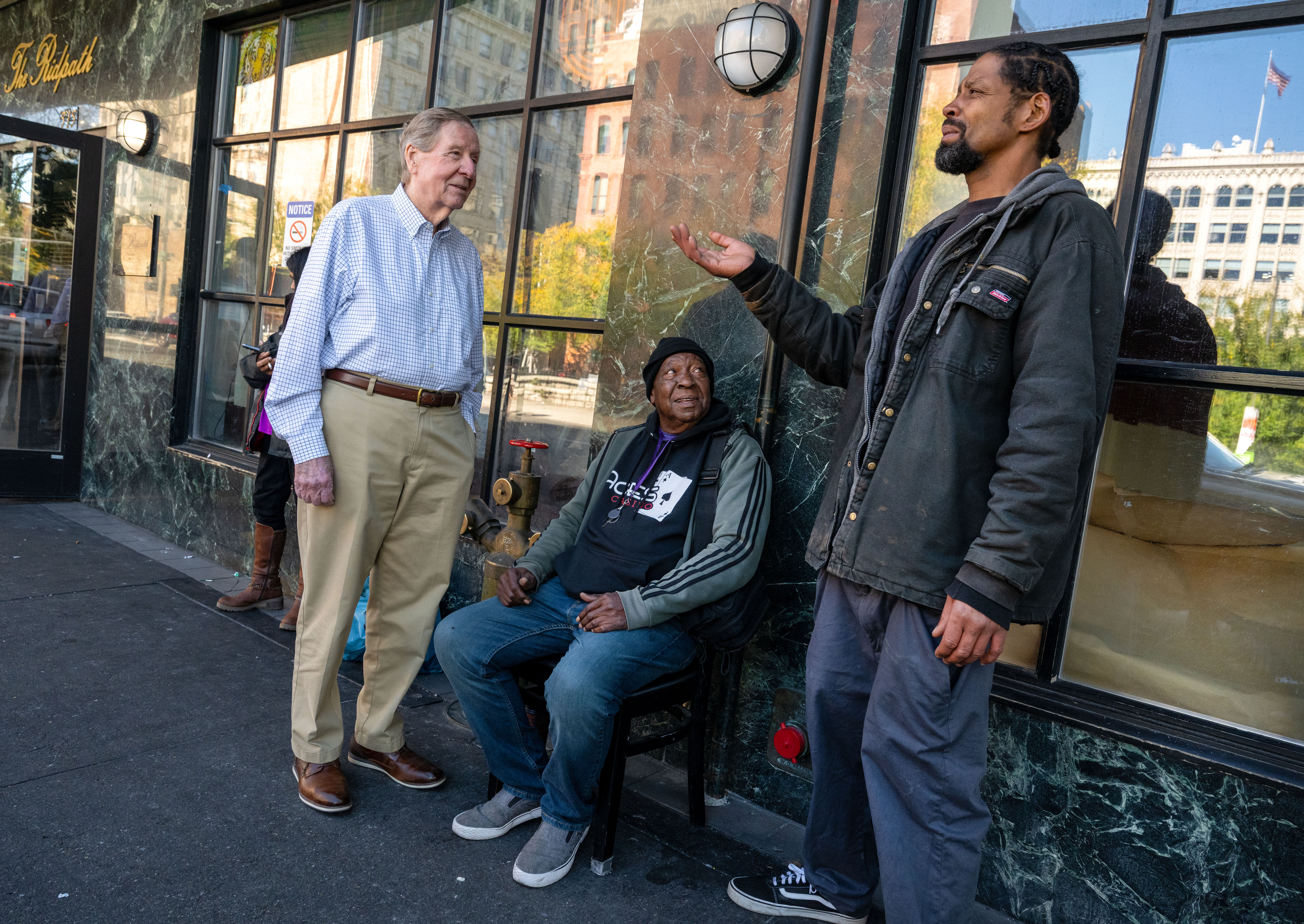
Mann clearly adores the place that is 125 years old this year, and his neighbors. He recalled that when he and his late wife, Janet Mann, moved from their Cliff Park home of 30 years into the 13th floor, a friend asked incredulously: “You’re going to live with those people?”
“And she said: ‘Those are my people,’ ” Paul Mann recalled Janet saying.
Janet Mann, 78, was killed in a hit-and-run crash while walking in a crosswalk at Browne Street and Main Avenue in June 2024. Paul Mann said the community within the Ridpath helped him navigate what’s been an otherwise difficult time. Following Janet’s death, flowers and cards from tenants were spread across the front lobby. Since many did not have the means to travel to her service at St. George’s School, they held a separate service in the Ridpath.
“And there were a lot of them here, and a lot of them, in that process, shared their own struggles,” Paul Mann said, “in ways that your average landlord does not get from tenants.”
When the Ridpath comes up in the conversation about downtown, Mann said it often lacks the necessary nuance. People without a thorough understanding of the issues are “conflating the Ridpath with everything near us,” he said.
Mann acknowledged people can and do gather in front of the building, but it’s not solely his tenants who pop out of their small quarters for a cigarette, or to enjoy the weather in the only available outdoor space. The Ridpath does not have balconies or a private courtyard. Homeless people also congregate in the area, he said, giving the perception of one large crowd.
“It’s difficult to have people angry at the Ridpath, and I can’t say we’re totally blame free, but we work hard with the police to minimize the crowds,” Mann said.
Intermixed with the tenants and homeless groups, Mann said, are bad actors who take advantage of the homeless and vulnerable groups like his tenants, an issue cited by other local operators of low-income and affordable housing services who’ve grappled with similar challenges – including with public perception.
Catholic Charities has been a perennial target of similar accusations regarding its big housing projects on the fringes of downtown. This has led to denial of a senior housing facility in Spokane Valley and backlash to the Catalyst project in the West Hills Neighborhood.
Jonathan Mallahan, chief housing officer, echoed Mann’s and Gardener’s calls for distinction when approaching the topic of gatherings of people living on the streets near housing projects. Spokane’s homeless population includes a large percentage living on the streets, he said, who don’t have anywhere to go and then tend to frequent the same locations.
“There are areas in the city where they congregate,” Mallahan said. “I think people conflate housing as being the cause of those congregations, and the reality is the data doesn’t really support that.”
As an example, Mallahan pointed to the largest Catholic Charities facility downtown, the Delaney Apartments. At 83 units, it serves those exiting homelessness with around-the-clock support services and security staff – a staple of Catholic Charities properties, Mallahan said.
“You don’t see any of that congregation outside,” he said.
Kim Sample is the president of Black Realty Management, the company that manages the Ripath. While there are problems with the area, Sample said, it’s not Mann’s fault. He has spent hundreds of thousands of dollars out of his own pocket just to get people off the street, Sample said, because he believes in affordable housing and he believes in helping the vulnerable.
“We hear the Ridpath is a failure. I think it’s the opposite,” Sample said. “The Ridpath is still here with one guy putting his own money into it to make sure people have resources for food and shelter.”
The 15 years it took to turn the Ridpath from abandoned hotel into apartments cost an estimated $30 million and included a complex web of condo sales, foreclosures and intervention by the city of Spokane in 2011 after transients began squatting at the property. Concerns about fire and the entire block burning down because of lack of a sprinkler system led to an order to evacuate.
Then in 2012, a team of investors including the Manns, Mark Mackin, Ron Wells and Lawrence “Mickey” Brown formed the Ridpath Penthouse LLC and purchased the property for $500,000.
The overhaul of the site led to the creation of 206 affordable, but not low-income, housing units. The building’s infrastructure made expanding most of the former hotel rooms impossible, Mann said, so 184 apartments remain at 230 to 240 square feet. Each unit resembles a hotel room but with a small kitchenette added. The building is around 75-80% full.
Gardener loves it – there is a resource room, a community closet and a space for movies and games inside. Younger residents in the area call her “mom” for her reputation of taking care of others, even scolding them.
Many of the people at the Ridpath know what it’s like to struggle, or have gotten a place at the Ridpath while their friends have remained homeless. It’s why they will often feed the people waiting across the street or let them in for a quick shower, Gardener said. All of them look out for each other like a “family,” she calls it.
There are cameras throughout the facility, key fobs must be used to enter the building, elevator access is limited to the floor of residence and tenants must check in their guests at the front desk. Last November, Mann and his partners created an around-the-clock doorman position .
But the population of people who don’t live at the Ridpath but hang around anyway has only grown during the past year with places like the TRAC homeless shelter closing its doors last November, Gardener noticed. The city closed the shelter doors to move toward a “scatter-site” model Spokane Mayor Lisa Brown’s administration argues is more effective at getting people permanently off the streets, compared to the roughly 10% who transitioned out of the Trent Avenue shelter. The big shelter was meant to be a facility with low barriers to entry and a first stop out of homelessness, not the last.
The people at the Ridpath, more often than not, have case managers to assist them with housing. That is a great first step, Sample says.
“These people don’t have resources for addiction recovery or mental health. A lot of times, once these people get housed, they are forgotten. And then we are picking up the pieces,” Sample said. “We are the ones that get called when they don’t have food or are having a mental health crisis. The people coming through transitional housing, they don’t know the basics – so they are set up for failure.”
A complicated block
Downtown Spokane commuters talk about the large lot owned and operated by Diamond Parking between Sprague and Riverside avenues, directly across from the Ridpath. It tends to be one of those congregation sites Mallahan mentioned – and by extension, so are the surrounding blocks.
“You would be amazed at the amount of rubbish that is hauled to the dump each week out of that one parking lot,” said Diamond Parking Regional Vice President Dan Geiger. “We patrol all of them, of course, but that particular one on Howard and Riverside, for some reason, is a magnet for people to hangout.”
Cleaning and security costs for the lot have “skyrocketed” post-pandemic, Geiger said, with the latter including the contracted guards with Go Joe Patrol swinging by multiple times a day, sometimes to move loiterers along. At the same time, revenues have decreased as fewer people visit downtown or feel comfortable parking on the lot.
Mann understands and shares many of the same frustrations. He’d prefer to put the money devoted to security and cleaning back into the business, just as his peers have expressed.
Mallahan agreed, noting Catholic Charities works constantly to clean the public spaces around its facilities and keep the public and its residents safe.
“I totally understand the frustration of business owners and things that are trying to address those challenges around their businesses,” Mallahan said. “I feel the same way. I would love to spend those resources helping people rather than cleaning up.”
Last November, Samere Kentiba opened his third downtown shop, Downtown Grocery III, at Sprague Avenue and Stevens Street. It offers an array of convenience snacks, grocery items and limited produce, and includes a laundromat and a liquor store behind a gate.
Mann said he and his partners opposed the idea of a liquor store opening on the block. The first few months there were some issues, but he believes the store’s management has it headed in the right direction while having to navigate the same landscape as other downtown businesses. They’ve made improvements to the facade, went from borrowing the Ridpath’s sidewalk cleaning equipment to investing in their own and are doing their best to discourage loitering, he said.
The location features a larger staff than its sister locations located on opposite sides of the Spokane Transit Authority Plaza, and the layout of the store appears to have been reconfigured to allow more clean lines of sight since its opening. Kentiba is spending $2,000 a month on 24-hour private security, as reported by KHQ.
In the interview with the broadcast station last November, Kentiba said he was proud to breathe new life into a long abandoned storefront. He immigrated to the U.S. more than 25 years ago, and stressed how grateful he was for the opportunities life in America has afforded him. He has faith downtown will rebound and his store will see the benefits, he said.
Like the Ridpath, the space was vacant for years. It hasn’t had a stable renter since 2008, when longtime downtown pharmacy Hart and Dilatush relocated after more than 30 years.
Mann is of the opinion that fostering a sense of community downtown could go a long way in addressing the concerns of property and business owners. The area is in dire need of “middle housing,” which he said is the missing gap between affordable or low-income units and condos available for purchase.
“The more people we have living downtown, the better we are,” Mann said. “And we need more variety of services.”
There’s growing interest in converting some of the downtown’s commercial buildings, which have high vacancy rates, into living quarters, Mann said. He said he’s encouraged by the ongoing conversion of the Peyton building above the Spokane Transit Authority plaza.
Mann added that converting office space into dwellings is not a one-size-fits-all solution for older buildings. The costs can be astronomical, and it’s not always structurally feasible.
Mann also said a wider diversity of downtown shopping and eateries would help. But the biggest need, he said, is for a bona fide grocery store where prospective downtown residents can easily purchase what they need.
“We need a full service grocery store, and just more amenities downtown for people who live here, not just people who are visiting or working here,” Mann said.
Bob Hemphill, owner of downtown staple Chicken-N-Mo, said the crowds and general fears about downtown have hurt his business. He yearns for the downtown of decades ago, when “you could not jaywalk on Sprague Avenue, it was so, so busy.”
Hemphill believes the onus for revitalizing his section of downtown is on the city’s elected leaders. He said they need to do more to bring in people and address homelessness and the oft-related opioid epidemic.
There is a lack of long-term strategic planning for effective change, and local leaders are instead focused on “putting out spot fires,” he said.
“Man, this is a great city, a fantastic city,” Hemphill said. “And somebody just needs to bring out the greatness in Spokane.”
Cooley, of the business association, agrees with Hemphill that a policy shift is needed to properly address the challenges downtown. He spent 100 days this year traversing Spokane on 5 a.m. walks, which he said illustrated the need for more drug enforcement in the city.
Often the path to homelessness and the challenges people face in finding stable housing are distinct from the “broader economic housing instability,” Cooley said.
He added that the introduction of the highly addictive and cheap opiate fentanyl has only exacerbated the issue for that segment of the homeless population.
Geiger said stopping open drug use should be a priority if Spokane’s elected leaders want to see a thriving downtown.
“I suppose they’re trying, but they’re still not doing enough,” Geiger said. “They got to do something more to get this cleaned up. It hurts downtown, and if you don’t have a vibrant downtown, then you start losing your tax base, and it’s not good.”
For the past few years, Cooley has banged the drum for more drug enforcement. His organization has brought speakers to town to share their thoughts on addressing homelessness and drug use, like Mayor Bieter last Wednesday.
Cooley puts a lot of stock in Bieter’s belief that services and affordable housing like the Ridpath are not attracting homeless people, but, rather, the lack of law enforcement does. He called the Spokane City Council’s replacement for the Proposition 1 camping ban of 2021, known as the HOME ordinance after it was overturned by a judge, “part of that misguided philosophy” within City Hall.
In evaluating the challenges downtown, around housing projects or efforts to address soaring overdoses, Cooley said it’s time to “take a step back and say, ‘Are these policies working?’ ”
“Is it a manifestation of something we just can’t do anything about, because it’s a national problem that’s bigger than us, or is this a manifestation of poor policy?” Cooley said. “I believe it’s a manifestation of very poor policy.”
Cooley said increased enforcement should prioritize helping those affected find the resources and treatment they need. He supports a model in which those stopped by law enforcement are given the option between citations and voluntary treatment, but the region will need to invest in more treatment facilities for that to happen.
Cooley said Spokane County has been a “bright spot” regionally in investing in more services, and under the leadership of Community Services Director Justin Johnson.
Jurisdictions across the country have received large settlements stemming from lawsuits against drug manufacturers, and the Spokane County Commission dedicated millions to build a new crisis relief center. The region is in dire need of a facility like that for the “tough love” approach advocated by Cooley.
“The tough love thing is coming very hard to the left-leaning city, and tough love is hard,” Cooley said. “I’ve got a couple of kids who have struggled with addiction, and I wasn’t good at it. But from a policy standpoint, you gotta do it.”
Life on Sprague
Tina Anderson, who has lived in Spokane her entire life, just became homeless two months ago because she said her ex-boyfriend stole all of her things and her disability checks stopped coming in due to an error. She is using disability checks because her ex-husband broke her neck in an act of domestic violence many years ago, she said.
She stood outside the Ridpath on Thursday with nothing left to her name besides the shirt on her back, the holes in her jeans and a cherry-red purse.
“I’ve seen guys shot here,” she said. “They trade stuff. They walk around and steal. They’ll hold some guys up. … It’s unreal.”
Anderson stopped talking to look at a man in a gray sweatshirt dancing on the corner of Sprague and Stevens.
“He’s high,” she said.
Anderson said she is sober, with the exception of an occasional vodka and marijuana. She left her last affordable housing complex, because “they were all shooting up in the bathroom,” and it made her uncomfortable. She’d still never rent at the Ridpath, she maintains, because of the types of people that hang out across the street. The only reason she’s there is the store nearby and working part time at a restaurant down the street.
“I’ve been attacked by kids on bikes. They beat me. I held my hand over my head while they attacked me,” Anderson said. “People are going to beat me up. Spokane, it’s changed.”
Black, the CEO of Black Realty Management, believes police are not doing enough to remedy that type of behavior in the area.
And the justice system that lets drug users out of jail the same day is a contributing factor, he said.
“The overreaching problem is the police department doesn’t really enforce the laws. Those people should be arrested,” Black said. “In my opinion, you wouldn’t have this problem in cities that enforce the law as a regular course of activities.”
But Black praised Mann for having “a huge heart for all the residents there.”
“He’s very compassionate and a very good human,” he said.
Eye on Boise
How does Boise, a similar mid-size city, handle homelessness? Former Boise police Chief Ron Winegar, who also worked as a captain of Boise Police’s Community Outreach Division for a few years, believes that city’s approach to homelessness works because the department put an extensive amount of effort into being proactive with the homeless community instead of reactive.
It started with changing the police department’s first instinct when dealing with a homeless encampment that had spiraled out of control during Winegar’s time as captain. Don’t just start arresting people. Instead, the officers assessed the problem, including health and safety issues, and made sure to have services and crisis negotiators on-site when they conducted camp cleanups.
They also pushed Boise’s bicycle patrol officers to interact more with the homeless community to build trust. That is the type of proactive work Winegar is referring to, he says. If they do that, people might be more willing to trust officers when they try to usher them into substance abuse or mental health treatment services.
He refers to the incentive as a “carrot” – if someone wants vouchers, food and shelter enough to trust an officer to help them get it, it will work out for the better in the long run, Winegar believes. But there are some who are also very resistant.
“If they don’t want to, there is really nothing you can do to force it,” Winegar said. “You are left enforcing the types of crimes that could go along with that population, like littering. Officers are left with only one option of enforcement at times, but when you do it with compassion, we have had lots of success stories.
“The problem as a whole cannot be solved through strict enforcement. But the effects can somewhat be avoided.”
Spokane has more than double the homeless population of Boise and a much higher crime rate, which means Spokane police are responding to more calls on average. Boise, meanwhile, has more time to devote to community policing.
“If you’re responding to emergency situations all the time, and that’s where your resources are going, you don’t have a lot of time to invest in community policing. The officers here can only invest in that problem by building relationships,” Winegar said. “Citations were a last resort, but there has to be some type of enforcement mechanism. It’s a balance and a constant effort.”
Accessible and affordable housing is often a topic that is brought up as a solution to homelessness – and while Winegar believes it’s a factor, he thinks successful outcomes require addressing underlying issues such as drug addiction.
“You can’t pluck someone out of homelessness and put them in a mansion,” he said. “The elements are tough. If we don’t address the underlying issues, you’re not going to fix it. There has to be a bigger solution.”
Former Spokane police Chief Craig Meidl, who left the department at the end of 2023, believes that helping problem areas within the city must start with the court system. The court system has a high threshold for people who reoffend and continue to refuse to show up to their appearances, he said in an interview last week.
During Meidl’s time, a captain expressed concern to him that his team had referred a homeless woman to court seven times in six weeks and nothing changed.
“That is something that has to be considered,” Meidl said. “This is a solvable problem. If we keep doing what we are doing, we are going to keep getting what we are getting.”
Meidl had assigned four officers as part of a full-time outreach team to work with the homeless population during his time. If he had to do it again, he wouldn’t add any more officers to that team, even with an increase in officers or funding.
“Our officers were doing their jobs, but the courts were not holding them accountable, so we were dealing with the same people over and over again,” he said. “At some point, we need to be able to say, ‘You are not changing your behavior.’ ”
And while Meidl knew the types of behavior exhibited on those streets, no one knows it better than police Capt. Kurtis Reese, who works at the department’s downtown precinct.
Reese knows the people on the streets of downtown by name, and he knows their struggles, too.
“I contacted a guy with congestive heart failure. He has five months to live. Another guy’s wife kicked him out. He has a CDL license, is sober, nowhere to go.”
Police refusing to stop criminal activity on the Ridpath’s stretch of street is a misconception, Reese said.
Police just this year busted a drug dealer inside the Ridpath with meth and more than $100,000 inside his apartment as part of the department’s efforts to help.
“We’ve made that area a designated ‘hot spot.’ We’ve pulled resources from the south precinct to provide us with extra patrol. … We have contacted everyone we can to get them into services. We have worked on upgrading the lights on that block, trimming back bushes. We took all parking spaces away and made it into a no-parking zone, so officers can drive by and see if there is open drug use.”
Police have even partnered with Diamond Parking, so if homeless people spill into the parking lot near the Ridpath, police are contacted to trespass them.
Spokane’s code enforcement recently formed a three-person team that walks the blocks near the Ridpath every day, as well as a team to clean up the trash on the street. It’s an “everyday grind” between the police and other collaborative teams, Reese maintains.
Sometimes the crowds ebb and flow, he said.
Police can patrol back and forth all day long and then get dispatched to an emergency, he said. When officers come back within an hour there might be 60 people standing around.
“We are enforcing everything we possibly can,” he said. “But we also have to balance the Constitution.”
People have a right to assemble on city property just as long as they’re not obstructing the public right-of-way, Reese said.
But sometimes, to help solve a problem, it just takes a police officer to go out there and start talking.
Last week, “we contacted a group of people that appeared to be unhoused,” Reese said. He talked to them for 20 minutes anyway. Everyone had a different story, he said, like the man who was kicked out by his wife and the man with congestive heart failure, sleeping on the streets with five months to live.
“It wasn’t about enforcement,” Reese said. “We were trying to help them. They were just appreciative that someone listened.”
Emry Dinman, John Stucke and Jonathan Brunt contributed to this report.