
Spokane prepares for cooling weather, La Niña winter
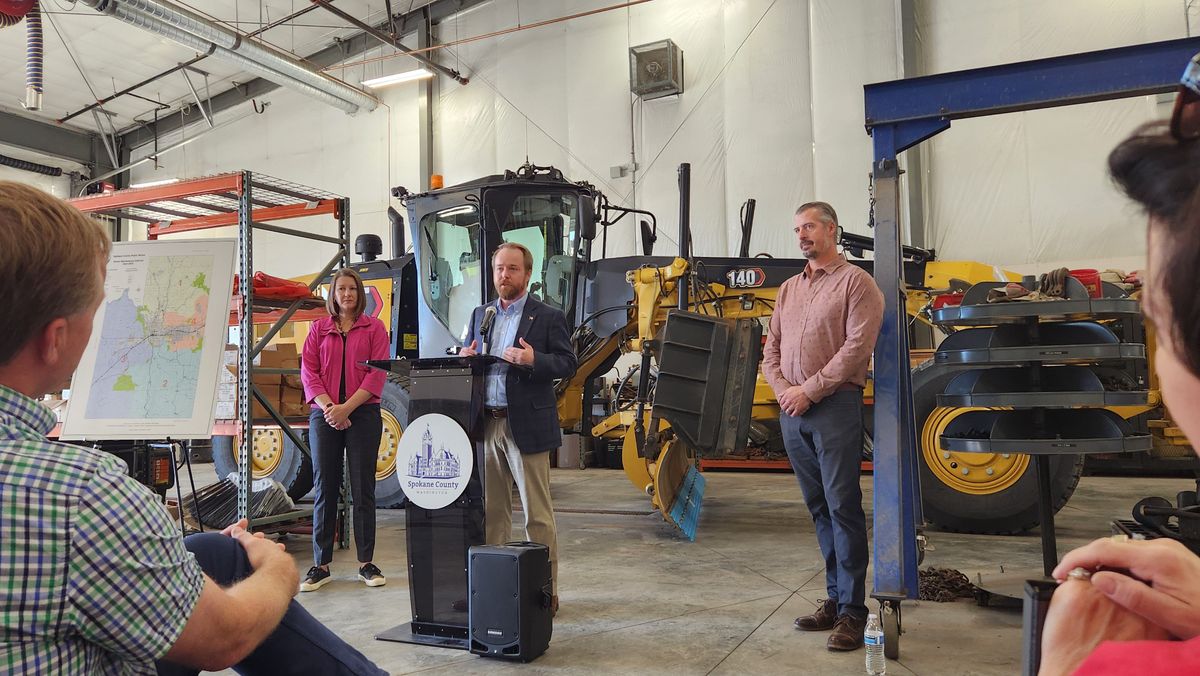
On one of the last warm, sunny days of the year, Spokane County had snow on the mind.
“As we know, fall in the Pacific Northwest, specifically in Spokane, the weather changes rapidly, and we’re about to see that this weekend,” County Public Works director Kyle Twohig said at a news conference Thursday.
While Thursday was just a few degrees shy of being a record high for Oct. 9 in Spokane, Saturday is looking at a high of 57 degrees followed by 53 degrees and 51 degrees on Sunday and Monday, respectively. In the mountains, highs will drop into the 30s. There is around a 75% chance of rain all weekend in the area and a 30% chance on Monday.
While it is too early for sound predictions about freezing and snowfall now, National Weather Service meteorologist Jeremy Wolf said that Spokane is on track for a normal “first freeze,” possibly Monday night. The yearly average date for the area is Oct. 9.
The last two winters have been light snow years, Wolf said. 2023 was an El Niño year – a climate event that tends to be correlated with a lighter snowfall in the Inland Northwest – dropping 33 inches on Spokane. 2024 had 29.6 inches. Average snowfall in Spokane is about 45 inches.
This winter is set to be a “weak La Niña,” Wolf said. Opposite of El Niño, a La Niña tends to bring a higher snowfall to the area. Though there are plenty of exceptions year to year, the average La Niña year sees an average of 57.3 inches of snow.
“The 2008-2009 was a weak La Niña, and that was the snowiest winter on record for Spokane where we had 98 inches,” Wolf said. “But in contrast, 2011-2012 was also a La Niña winter and we only had 30.8 inches.”
The first snow, on average, falls in Spokane on Nov. 10, the first inch accumulating Nov. 16.
Regardless of how much snow is coming, Spokane County is ready.
The county is responsible for plowing and maintaining more than 5,100 lane-miles of road outside the city limits, come wintertime. The roughly 65-person road crew runs 30 snow plows, 34 graders and four deicing trucks nearly around the clock when needed, Twohig said.
Before any snow hits the ground, county crews sand and deice hills, curves and intersections when a storm is forecast. Drivers apply a dry deicer called “Ice Slicer” to compact snowy areas during the day and a liquid deicer, “Apex,” to roads overnight.
“Once the snow arrives, we’ll clear our emergency routes and primary arterials. These are followed by secondary arterials before we get into the residential neighborhoods when we have a lot of accumulations,” Twohig said. “Depending on the weather and the ebb and flow – no two storms are made the same – we may have to return to those emergency routes and primary routes to keep them clear so everybody is safe for travel.”
For particularly high-ice areas on the roadway, the county attaches a blue blade attachment to their graders called Sharq Edges, a rigid edge to help chew through ice.
The county used to get a lot of “angry phone calls about the berm at the foot of your driveway,” Commissioner Josh Kerns said. To address this, the county developed and equipped snow gates to guide snow away from residential curbsides as plows pass by.
While the gates are available commercially, County Engineer Matt Zarecor said that the county made its own attachments – ones that are cheaper and better than store bought.
“Structurally, the way they mount is stronger, and when things go wrong, our ability to fix it quickly is better,” Zarecor said. “Because oftentimes these gates will get banter-damaged and you have to replace them, and the ways these mount is much quicker to put them back on and take them off.”
“It’s been a huge success, and we have now equipped nearly every single one of our graders with those snow gates,” Kerns said.
The City of Spokane has not unrolled their official winter operations information yet, but Public Works spokeswoman Kirstin Davis said in an email that snow season operations span Nov. 15 to March 15, and weather conditions are monitored 24/7. Arterials, hills, hospitals and school routes are the top priorities.
City plows also use snow gates to prevent snow berms, and crews try to keep snow off sidewalks. The city is responsible for 2,100 lane miles.
Kerns said that putting reflective flags at the bottom corners of residential driveways can help drivers ensure they don’t dump snow in the wrong spot. He also warns that cars, boats and basketball hoops left on the road have a high chance of getting snowed in. When snow blowing or shoveling, he asks that residents don’t push snow back into the roads.
“That just makes it difficult, causes more hazards for the drivers or the drivers on the road,” he said. “So when you’re shoveling the driveway, shoveling the walkway, throw it into the yard. The kids can pile it up and make themselves little snow hills – at least, that’s what my kids do.”
Making sure your and your kids’ vehicles are prepared for winter is another important safety point, Commissioner Amber Waldref said.
“I have a 17-year-old driver, and so I’m like, ‘Oh gosh, I gotta make sure she’s got blankets and flashlights and everything in the trunk,’” Waldref said. “So emergency supplies, water, granola bars. Keeping your gas tank filled is really important during the winter.”
She also emphasized that drivers should slow down and stay at least 50 feet behind snow removal and sanding equipment on the road.