
Gonzaga professors collaborate for film screening and its score, introducing string ensemble Luminia along the way
Call it serendipity, call it destiny, call it good luck: There was little doubt that Gonzaga University professors Charles Pepiton and Michael Kropf would eventually work together after Kropf came to Gonzaga in 2023.
Pepiton had a short film that needed a score, and Kropf had a piece of music he had written in 2019 that had never been performed live.
When planning his film, “Love, Eleanor,” Pepiton listened to a piece by Kropf called “Distant Sea” and realized that was the sound he imagined accompanying the film. Pepiton reached out to see if Kropf, an assistant professor of music theory and composition, would be willing to work on a score for the film.
After some initial discussion, the pair realized they didn’t need a new piece, as “Distant Sea” was already perfect for “Love, Eleanor.”
“There is something of the sea, there’s something far flung and mysterious,” Pepiton said of the piece. “And just when you think that you know where this piece of music is going, it has these shifts and uncertainties about it, just like the arc of the character. I was relieved when he said I could use it.”
Kropf told Pepiton, a professor of theater and dance, to cut up the piece into a rough version of the score, then he would smooth out the edges and fill in the gaps. Pepiton did just that and played bits of the song while filming to help the actors get in the right head space for each scene.
The result of the pair’s collaboration will be revealed on Saturday at the Myrtle Woldson Performing Arts Center as a screening of “Love, Eleanor” is accompanied by a performance of “Distant Seas” by Luminia, an ensemble Kropf formed with Gonzaga professor Jason Moody.
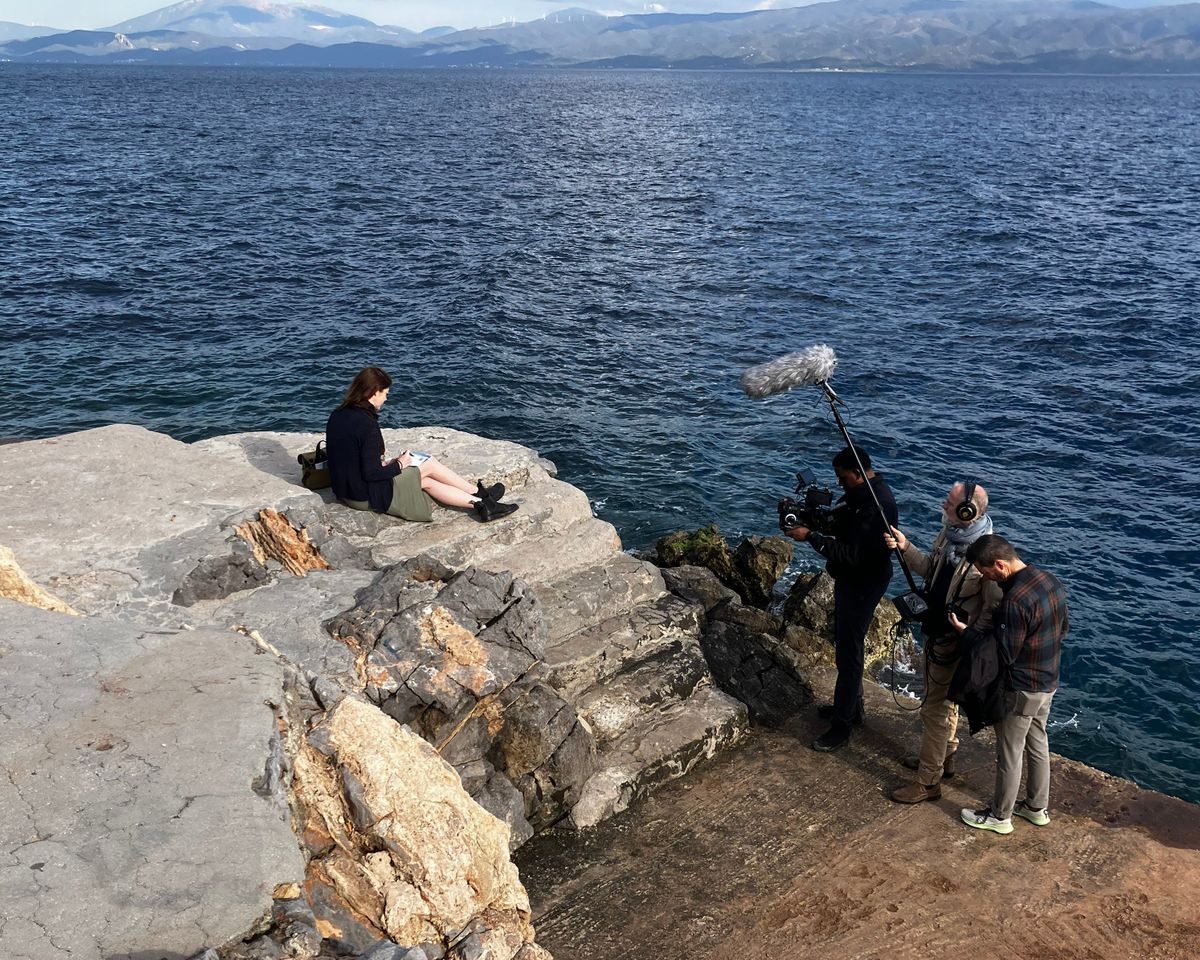
“Love, Eleanor” began to take shape while Pepiton and writer Damon Falke were in Greece working on another project. One morning, Falke hiked to the top of the island, looked down and saw a woman floating in the ocean a little further from shore than he thought would be comfortable. But to him, the woman looked like she was completely at peace, a moment that Pepiton said became the genesis of the film.
The film follows an art historian named Eleanor, who has traveled to a Greek island to document the icons at the island’s more than 350 chapels. She has also recently received a letter, in the form of a 30-page poem, from an ex-boyfriend.
“He says ‘I wrote this for you. You’re the best reader I know. What do you think?’ ” Pepiton said.
She is not quite sure how she feels about the letter as a whole, in which her ex-boyfriend says she is the source of all imagination and that love is imagination. An older woman acts as a spirit guide of sorts and helps Eleanor realize that love is an action, a clear, directed thing.
The film, which was shot on location in Greece in April, was directed by Pepiton, written by Falke and produced by Rebekah Wilkins-Pepiton. Darrien Mack was the director of photography, and the film features Kropf’s score.
The film stars Elizabeth Spindler, Dioni Sigala and Alexandra Kazazou.
Around the time Pepiton asked Kropf to work on the film’s score, Kropf was looking for ways to immerse himself in the local music community. He had a dream to help form a string orchestra and, after attending a few concerts around town, realized “Spokane is punching way above its size in terms of musical community.”
Kropf started talking with Moody about his idea for an ensemble, and he and Moody reached out to musicians they felt would be right for the group.
Luminia features violinists Moody, Hannah Reitz, April Martin, Jeanne Bourgeois, David Armstrong and Xu Duo; violists Nick Carper and Sarah Bass; cellists John Marshall and Kevin Hekmatpanah; and double bassist Kim Plewniak.
“Most ensembles are run very top down, but our dream for Luminia is to have a self-run ensemble,” Kropf said. “What you’ll notice in the concert is that, aside from the film score, the ensemble has no conductor. It’s a small orchestra where each musician is responsible for the leadership of the ensemble.”
Along with “Distant Sea,” Saturday’s concert will also feature a performance of Caroline Shaw’s “Entr’acte” and Gustav Holst’s “Saint Paul’s Suite.”
After the film premiere and Luminia’s debut performance, “Love, Eleanor” will receive more refining before Pepiton submits the movie to a few festivals. He then plans to connect with Falke and begin brainstorming for their next film project.
Pepiton does not know what the next project is just yet, but he knows he wants Kropf to be part of it, which Kropf is already looking forward to.
“Charlie is such an incredible builder of artistic community here in Spokane, and I’ve been grateful that he’s invited me into that community,” he said. “I think future collaborations are very much in my imagination right now in terms of the ensemble.”
Kropf imagines Luminia as a shape-shifting ensemble, able to grow or shrink based on the energy of the musicians and the needs of a concert. With “Love, Eleanor” as a starting point, Kropf hopes to see a lot of collaboration and atypical experiences in Luminia’s future.
“My dream and goal is that Luminia continues beyond this concert as a way of creating really unique and artistically committed musical experiences,” he said. “That’s the dream and the goal for this ensemble is creating a group of musicians who are always ready to go for the jugular and try out cool things and bring diverse musical experiences to our community.”