
The living and dead of Spokane’s rural cemeteries
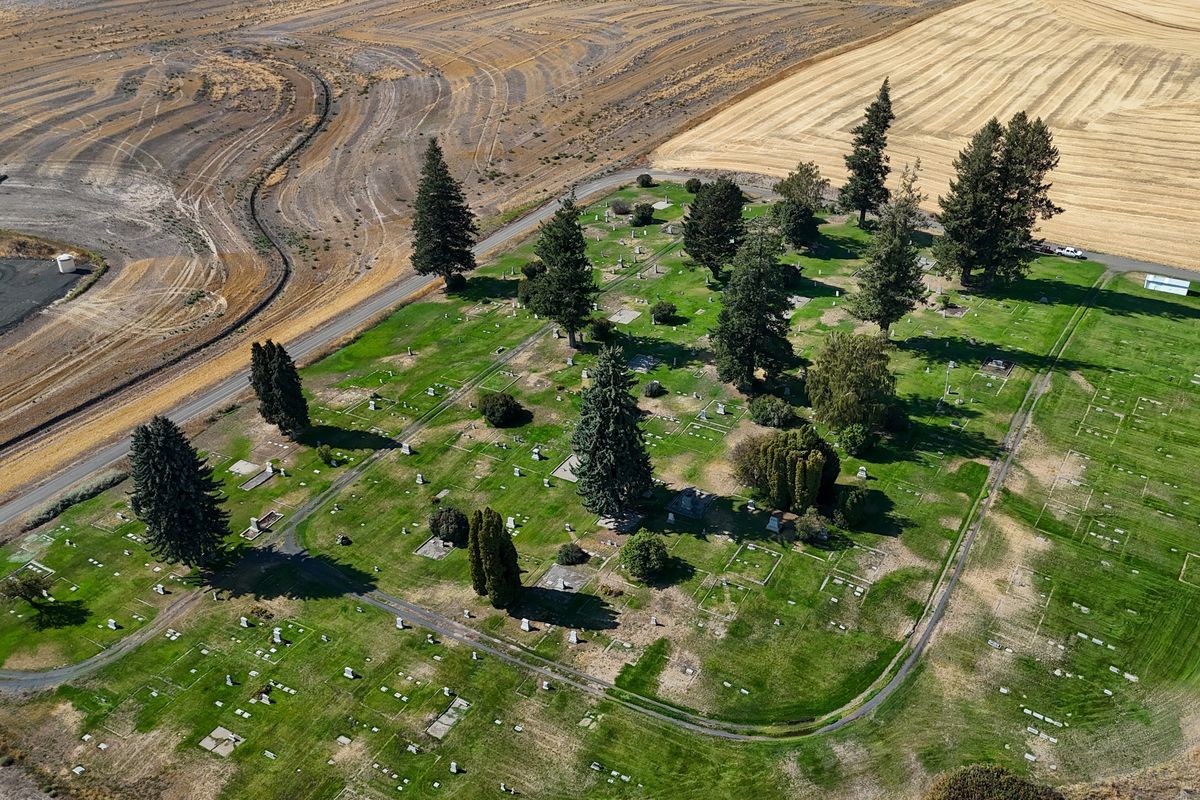
In a matter of life and death, half of Spokane County’s cemetery districts are run by retirees working to preserve the land where their families are buried.
There are six districts in the county, each containing one to two rural cemeteries managed by a group of three elected commissioners and a secretary. The board is responsible for maintaining the lands, selling plots and paying the bills.
Formed after the dissolution of townships in 1974, the cemetery districts required a petition from 10% of the voters in the regions to make it to a ballot, then a two-thirds majority vote to officially form. They are supported through property taxes in the districts.
In some districts, the management teams are robust and the cemeteries are well groomed. In others, commissioners are hard to come by and aging secretaries struggle to keep the lawn mowed. Two of the old townships – Mica and Valleyford – dissolved and did not form a board, leaving their cemeteries, without funding, to Spokane County.
Some secretaries and commissioners love the job of taking care of their cemeteries, having helped out since they were children and knowing personally many of the people buried in them. Others cannot understand why anyone would care to visit the land they so religiously upkeep. All of them hate the biannual state audit.
So, who are the living responsible for Spokane’s dead?
Spangle Cemetery
Robert Sievers twice asked The Spokesman-Review why it had any interest in the Spangle cemetery.
“We’re a Podunk cemetery that’s meaningless to anybody in the county except for the people that have loved ones here, I guess,” he said. “Nobody wants to do this kind of stuff, and so it’s very hard to even fill seats on the board or the commission or whatever you want to call it. I’m just curious.”
With green grass trimmed neatly around each headstone and shady trees scattered here and there across the 11-acre plot, the Spangle Cemetery stands out from the yellow, rolling farmland that surrounds it. A professional landscaping crew – Sanchez Landscaping – mowed the lawn as Sievers spoke in late September.
A no-till farmer, Sievers, 61, has lived in Spangle since he was 12 years old. He runs his family’s farm, Rolling Hills Farms Inc., growing wheat, lentils, barley and more. He has served as the Spangle Cemetery district’s secretary for the past 12 years.
“I got guilted into this job because my dad was on the board of this thing for like 30 years,” Sievers said. “I’ve got one set of great grandparents, both my parents and brother are buried here. I’ll be buried here. The three commissioners, two of them, their entire families are buried here. It’s just a traditional thing. You need to try to do the right thing.”
With the earliest birth dates of the dead stretching back to the early 1800s, Sievers said that these individuals were likely the very first settlers of Spangle, born in the years not long after Lewis and Clark made it to the Snake River.
Despite the well-kept lawn and headstones, Sievers said he hates his job, and said the other commissioners are not fans of their work either – largely due to the state’s involvement in their operations.
“I didn’t think it’d be that big a deal, but with the state being involved it’s just…” Sievers said, adding that he is by no means anti-government, but that “the common sense seems to disappear on these things.”
For instance, the state requires 12 board meetings per year for the cemetery. Without stable internet in Spangle for commissioners to host a Zoom meeting, Sievers said this means the multiple 60- to 80-year-old board members have to travel once a month – rain or shine – to say: “did we pay the Avista bill this month? Yep. Meeting adjourned.”
“I’d like to make a million bucks and just donate to this and then they can run off my money for the rest of my life and be done with the state,” he said. “But that’s not going to happen.”
A biannual state audit costs around $1,000 to investigate the cemetery’s spending as well, Sievers said. The cemetery’s annual budget sits at $10,000, and the cost of landscaping at around $12,000. The commission uses voter approved levies to meet the costs, with one to be featured on ballots for the Nov. 4 election.
Unpaid board positions and the declining population of farmers on the country’s west side make it hard to recruit new blood. Though he does not enjoy the job, respecting the community’s forefathers is important, Sievers said.
“We’re really trying to go out another 20, 30 years. Part of the problem is, I’m 61. (One commissioner)’s 80. We got another gal at 65,” Sievers said. “We’re all getting older and we need to replace with younger people and it’s really hard to get people to help. It’s just because our society’s changed, we don’t value things like we used to – which is understandable. So what’s going to happen? I don’t know.”
While the heritage of Spangle lives on in the names and dates inscribed on hundred year old headstones, the cemetery is running out of space for fresh burials. Sievers suspects they are 90% full, with the third party Find a Grave website putting the number of memorials at just over 1,600.
“What do you do with graves that are 170 years old? There’s no relatives anymore. Nobody’s ever going to come see them. What do you do? You just keep chugging along, I guess,” he said. “I don’t know the answers to these things.”
West Greenwood Cemetery
Rod Clouse has five generations of his family buried at the West Greenwood Cemetery.
A retired farmer and mechanic, Clouse, 68, has been on the cemetery board for over half of his life, recruited by a neighbor when he was around 30. He currently serves as a commissioner and is married to the district secretary, Brenda Clouse.
Surrounded by chain link fence at the end of North Gray Road, the cemetery stands alone, save the company of a one-room school house and a couple trees. Officially incorporated into Washington in 1896, the cemetery has more than 500 burials, the earliest taking place around 1881, Clouse said.
The small schoolhouse was used by the kids of the Greenwood township before it was absorbed. The township deeded it to the cemetery for preservation.
Clouse remembers his early days on the board, when West Greenwood was classified as a junior tax district, meaning state dollars did not make their way to the cemetery and they had to run on donation
He remembers burying his oldest brother, his parents and community members he has gotten to know from spending his entire life in the district.
Once in awhile, the board tries to dig a grave and finds someone in the spot already, so they have to move.
“It’s humbling, but yet at the same time we’re able to give them some comfort and make the process a lot easier than maybe having to deal with the big cemetery,” Clouse said. “My wife just says it’s more of a personal touch, you know?”
Only taxpaying members in the area or those with family already buried in the cemetery are eligible to purchase plots, which Clouse called “way too cheap.” 2025 has been a busy year for burials, with number six happening in November. Usually, the commission sees around three burials a year.
“We still got quite a bit of room to expand,” Clouse said. “We’re decent that way as long as we don’t just get inundated with people – which, we would not sell to them anyway.”
Looking forward, Clouse said that he is interested in setting up a columbarium, since the number of ash burials has increased. He and the commission are worried that kids might vandalize a tall structure if one pops up in the middle of a field, tough.
“There are starting to be some houses built closer, and so maybe they could kind of keep an eye on it a little better,” he said. “So we may visit that down the road.”
The cemetery is a piece of history, and Clouse doesn’t want to disrespect those who rest there. Though he doesn’t know what will happen after the current board of retirees step down, the $8,000 in funding they receive per year is enough to hire help and pay bills for now.
“I think we are blessed actually that we are in pretty decent shape, or able to take care of it for future youth and for the respect of those buried there already.”
Moran Cemetery
One of the first people buried in the Moran Cemetery was a 17-year-old boy who hit his head on a rock after falling off a horse in the late 1800s. Soon after, the namesake Joseph Moran was buried after being gored by his bull.
In the following years, the small cemetery at 64th and Regal has hit capacity, the 10 or so remaining graves with a wait list of about a dozen people, Secretary Judy Nessen, 79, said. There are currently just under 1,000 occupied graves.
“In fact, I’m meeting somebody up here Wednesday to show her a couple of spots that are available for her,” Nessen said last week. “She called and asked about availability in like 2021, so she’s one of the first ones on the list.”
A wait list is possible since some people buy graves for themselves and their family only to move or otherwise have plans change. Under the previous secretary, a couple of Eastern European majority churches bought around 40 plots for members.
“There was an influx of Russians and Ukrainians who came and they have very colorful graves. They do pictures on the stones,” Nessen said. “And when there’s a burial, I mean, I think they get every white flower three states around here because the whole grave is just covered with white flowers.”
The cemetery is laid out in four quadrants, separated by paved ground. People walk their dogs through the space and police sometimes have lunch in their car in the small central lot, Nessen said. Even with a pair of schools on the flip side of one wall, there have not been many problems with vandalism.
After the cemetery is full, maintenance will be all that is left. Taxes bring in anywhere from the mid $20,000 range to more than $50,000 in a year, per state audit records, and local churches volunteer to help clean headstones once or twice a year.
“They’ve got adults and good kids,” Nessen said of a Latter Day Saints’ church that volunteers. “The kids love to wash the headstones. They’ll wash the same headstone five times because it’s so much fun.”
Nessen, 79, became secretary in 2018 when her neighbor, the previous commissioner, asked her to serve. Though she wasn’t “one of those people who ever came up here with my boyfriend and sat in the car and made out” as some used to, the Moran Cemetery has been a fixture in her life since she was young in the district.
Though she enjoys the position, Nessen said that she would retire if she could.
“I think the hardest person to find would be someone to replace me,” she said. “I’m trying to teach the commissioners how to find the graves and how to mark them, but when you don’t do it a lot it’s easy to forget.”
The Moran Cemetery Secretary and Commissioners are all paid, making them the only district in the county to pay all positions on the board. Outside of taking care of bookwork, Nessen is the one funeral homes call up when there is a body in need of burying, and she manually marks the graves.
“It was supposed to be easy. It was supposed to be, like maybe 20 hours a month, but one of the things with (the previous secretary) is she was not computer savvy and I’ve had to learn several new things since I started doing it,” she said, adding that she just finished up a 3-year audit for the state. “It’s horrifying.”
But in the immediate future, Nessen does not see there being much change. The commissioners might want to manicure the land a bit more, she said, adding that she would prefer to keep it more rustic.
“I don’t know if you can call it homey, its just a nice place. A lot of people just want to be in a nice place that’s not too fussy, and we don’t have a yearly maintenance fee or anything like that,” she said. “But I do wish people would come and pick up their dead flowers.”
Elk Cemetery
Rebecca “Becky” Shannon, 49, is running for reelection as the chair of the Elk Cemetery board this year against Steven Queener, who described his campaign as a satirical and political one.
Politics is not really Shannon’s area, though. For the full time carpenter and mother of four, working the district is about serving the community. A fourth generation Elk resident, she has served as a commissioner on the board for the past five years.
“These are our ancestors and that’s important to keep up. I may not know every single one of them, but it doesn’t matter. They’re a part of our history. Look at all the veterans – look at them. How important is that to keep?” She said at the cemetery on Sept. 24. Flags and flowers adorned many headstones. “But everyone’s important, not just veterans, and to keep their memory alive is huge.”
The Elk Cemetery district has two cemeteries in it. The larger cemetery, on Elk to Highway Road, sports a hand-painted sign made by Shannon’s mother.
Shannon’s connection to the cemetery goes beyond her position on the board and her mother’s sign. As a child, she helped her mother dig graves by hand, at one point slipping a Star Wars toy in to rest with a deceased classmate.
“It was pretty emotional seeing my mom do all that, and I remember having my little toys, and I had my niece with me and she lost my little Ewok in there,” she said. “I was like, ‘You know what? That’s for them, they need that with them.’ ”
But Shannon is not the only one who pours her soul into the work. Community members volunteer, and Shannon describes the other board members as “a very community-minded group of people” with a collective 20 years of community service. Shannon herself has worked on the parks board and as a part of “Elk Strong,” a community group to support those affected by the 2023 Oregon Road fire.
“I feel like we do have some volunteers between the flags and, of course, the groundskeeper. He gets a little bit (of compensation), but I know he doesn’t give us half of this time,” she said. “Our groundskeeper, he will fix something until it runs into the ground. When you live in Elk, that’s what you do.”
The earliest recorded burial in that cemetery was in 1911, and the Find a Grave website puts the total number of memorials at around 670. Pine trees shade many of the older graves, while an expanded section of the cemetery is open for further development. Shannon and the other commissioners have been working to develop a plan for a columbarium with their yearly income of around $13,000, per the most recent State audit.
“There’s so many people that pass away and they don’t have anywhere to go,” Shannon said, referring to cremated remains. “The family can’t come anywhere, so that’s super important to me, I would love to see that through.”
She seemed almost able to see the columbarium as she spoke on Sept. 24.
“So people could put their plaques up there, put a small garden in front of it so you could sit down and see, ‘Oh, there’s Grandma over there,’ ” she said.
Milan Cemetery
The Milan township dissolved in 1974. Kathy Munk has worked at the Milan Cemetery since 1970.
“I’ve been secretary,” Munk, 75, said. “And then I went to groundskeeper, landscaper, ground caretaker, all that stuff over the years. I’ve been all the positions.”
Both her parents worked on the cemetery, and neighbors would gather to clean each memorial day. When she graduated high school and got married, she officially joined the maintenance team.
“They never had an income per se, but they took care of it for Memorial Day and that type of thing,” she said. “And whatever money was made from selling lots, which were $20 apiece, went for upkeep and fixin’ fences and whatever needed done that way.”
The cemetery is a small one, easy to miss for drivers coming down the winding Laurel Road. Pines shed their needles onto graves dating as far back as the late 1800s, and crickets chirped as she talked to a reporter the warm morning of Sept. 17. Munk’s own family has a plot right near the front entrance to the site.
Once county took ownership of the district in 1974, Munk remembers the funding fluctuating each year, from nothing to more than $1,000 and then back down again.. She said that she even personally paid the $39 property tax when the county charged it, just to keep from falling behind.
These years, the cemetery receives around $20,000 annually – an amount Munk said is enough to be comfortable, if they manage it carefully. A four person lot costs $300 for district residents and $600 for non-residents.
“You don’t want it to get too big and we don’t want to turn it into a city cemetery, because the people like the country aspect of it,” she said. “And it’s all these people’s cemetery, you know, they’re the ones that worked.”
Munk has records showing that some of those buried were those who worked in teams with horses, moving rocks for $2 a week to create the cemetery. Walking through the cemetery, she points to headstones and talks about the dead as though they were faces in an old school yearbook. This family paid $5 a lot, that father and son were killed in a 1903 hotel shooting. One grave, for reasons unknown, has a boot buried in it, courtesy of a family member.
Munk is among the last invested in the Milan Cemetery, though. She said she practically begged the latest commissioner to join the board after the previous two died, and the land only sees a handful of visitors each year.
“Most of the families have passed away or moved away,” Munk said. “And I have people that come that are probably in their 90s now, and they come every year and just drive through and remember. At least it’s there for them, and I talk to them when they come. When they quit coming, I pretty much know they passed away.”
In terms of upkeep, she is a bit at a loss. The community seems to have disappeared with the township, with no exception for prospective commissioners and secretaries. The current head commissioner, James Pittman, took over after the previous two died – Kathy’s best friend and husband. She had asked a number of people to join before convincing Pittman.
“The neighbors around here, I know him,” Munk said, gesturing to Pittman. “But I don’t really know anybody and I’ve been here since the 70s. I’ve talked to the people over there numerous times, and the people over there numerous times, but as to even know their last name – I don’t know. They just say hello, and how are you, and away you go.”
Munk believes that it is the lack of community spaces in Milan that have led to the cemetery’s neglect.
“It all comes down to a town. It comes down to churches. It comes down to the fire departments,” she said. “It comes down to a newspaper, to where a community is a community. And when we lost our post office and we lost our township hall and all our meeting places, people quit getting together. And this is what you end up with – a piece of property that nobody really worries or cares about.”
Pittman said he was interested in potentially starting a community cleanup day in the spring to get more community involvement.
After a Sept. 22 story by the Spokesman-Review went out about Milan Cemetery and Pittman’s race for re-election as a commissioner, Munk reached out via text and said that a Riverside High School history teacher was interested in having students help in a spring cleaning event – something that teachers had done in years past.
Waverly Cemetery
Melinda Haymond works full time in a security systems company, but took up the secretary and treasurer positions for the Waverly Cemetery in hopes of getting more involved in her community.
Unfortunately, four years into the gig, she has made little headway on that goal. A small cemetery in a small town doesn’t see much action, and when it does, the commissioners usually handle it. Haymond, 51, only attends one meeting in a year.
“The only thing I do is check the mail, deposit any monies that might come in and pay the bills,” she said. “Meaning the power bill and the water bill and the insurance bill.”
The Waverly Cemetery usually receives around $3,000 per year. With commissioners taking on all the maintenance, the funding is usually enough to squeak by. Most of Haymond’s hours are spent on the state audit or an annual report for Spokane County.
Without a physical office, the biggest struggle in Haymond’s eyes is the lack of ways for residents to support the cemetery beyond word of mouth.
“I think one of my commissioners actually gave me money at our last annual meeting that someone had just stopped by his house and handed it to him, and they didn’t even tell him their name,” she said. “But there’s no other way for people to really get hold of us.”
In such a small town though – the town of Waverly had 121 residents, per the 2020 census – help is never hard to come by. Some family members even mail in annual checks for “cemetery cleanup” if they are not able to contribute themselves.
“We’re all neighbors and everyone who lives here within Waverly, and probably anyone who lives in the district would be willing to help if we ask for help,” Haymond said. “Some of the people who live here – obviously we live in a farming community – it’s their ancestors that are up there.”
Haymond doesn’t particularly like her job, but she also wouldn’t hand it off to just anyone – not that anyone is “champing at the bit,” for it in the first place, she said. Further, since so many people in town are retired, the $1,000 secretary/treasurer annual salary could “mess up his retirement,” as Haymond said one commissioner put it.
Rural cemeteries are “kind of an unthought-of thing,” she said. Walking through, you can see an entire family’s history, children who lived for a year, month or hour.
“I don’t think that anyone realizes that the cemeteries are even there, or what it takes to run them or maintain them when you’re working in a rural area with no budget,” she said. “I wish that there was overall more funding to help take care of them, put a gate around them or do something. But then again, you can’t, you know – I get that.”