
Southern Resident Orca pushes another dead calf through Salish Sea
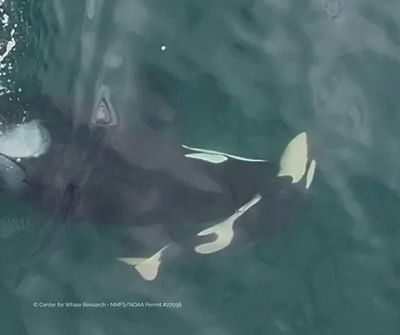
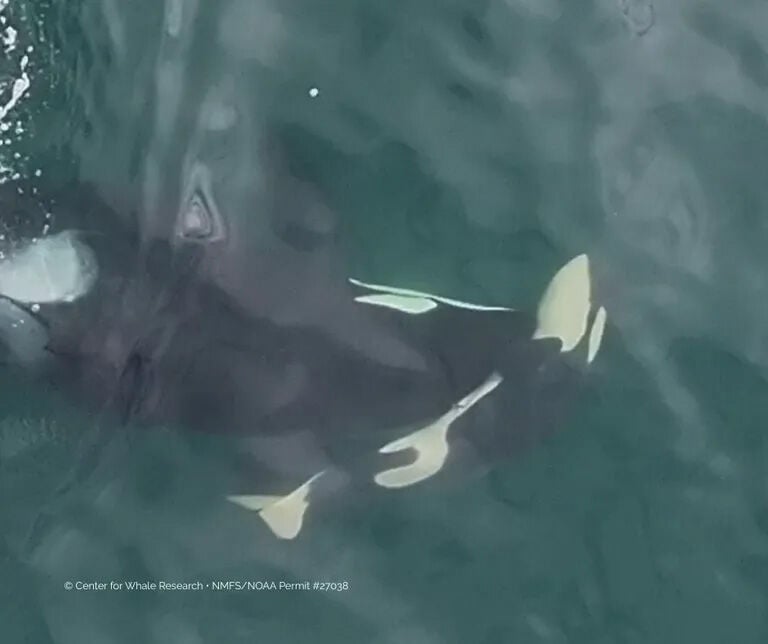
An orca calf born to J36, aka Alki, died within the past three days, the Center for Whale Research reported Saturday.
A southern resident killer whale from J pod was spotted pushing a dead calf through the water Friday morning in Rosario Strait, on the east side of the San Juan Islands, according to a news release. The calf was full-term or near full-term, the center said. It’s unknown whether it was a stillbirth or if the calf died shortly after being born.
Alki was pushing a deceased female neonate, with umbilical cord still attached,” the release reads.
Deborah Giles, a killer whale scientist with the SeaDoc Society, said Alki is 26 years old. She has had several miscarriages. She also had a calf named Sonic, aka J52, who died at age 2 in 2017, after he was reported to be “emaciated” in his final days. Her latest calf was a female orca.
“From a biological perspective, it’s challenging, because she’s put all this energy into gestating this calf that does not result in a viable offspring,” Giles said in an interview Saturday. “And then, (the) negative aspect is that we need to be having females being born and living so that they can go on to give birth themselves.”
Giles believes the act of orcas pushing their calves through the water is a sign of grief. In January, orca J35 Tahlequah broke the hearts of Pacific Northwesterners when she pushed her dead calf around for over two weeks and a distance of over 1,000 miles.
“She doesn’t have arms to hold it, so she has to keep carrying it, keeping it with her as close as possible,” Giles said. ” … As soon as she stops going to retrieve it, it will sink into the depths. But she cannot let it go yet. She’s mourning the loss of her dead baby.”
Southern resident killer whales are endangered. Their total population has hovered between 70 and 100 over the past half-century. Fewer than 75 were documented in 2024, according to the Puget Sound Partnership. Decreasing food supply, pollution in the water and disturbances to the environment such as congested boat traffic in the region — making it harder for orcas to echolocate and find food — have threatened their existence.
Alki is a member of J pod, a matrilineal group of 27 killer whales based in the Pacific Northwest for most of the year. The orcas are highly socially bonded, and males and females will stay with their mother for their entire lives.
A recent study suggested that about 69% of detectable pregnancies failed in the southern resident population, with about a third of those failing toward the end of pregnancy, and “that is at least in some part associated with these whales not getting enough to eat on a regular basis,” Giles said.
However, more research is needed. Southern resident orcas subsist on fish and prefer fatty Chinook salmon, a threatened population.
Unlike some other species of whales that can go without eating for longer stretches of time, “when a killer whale doesn’t eat every day, they start metabolizing their fat stores,” Giles said.
That leaves the mammals more susceptible to disease and early death.
Researchers were unable to retrieve fecal samples that could shed light on Alki’s health Friday, in part because they did not want to disturb her while she’s in mourning.
“There may be something else going on,” Giles said, “and that’s what we’re trying to determine.