
The White House is urging Idaho legislators to pass a law for local ICE partnerships. Law enforcement across the state have concerns

The White House is urging Idaho lawmakers to pass legislation that would deputize local law enforcement to do work for ICE, but sheriffs across the state say the proposal would be at odds with the state’s longstanding stance against giving up local control.
The new bill, S 1441, was brought by Idaho Republicans to require local law enforcement agencies to enter into agreements with U.S. Immigration Customs and Enforcement, which would essentially delegate local police and deputies to carry out parts of ICE’s duties.
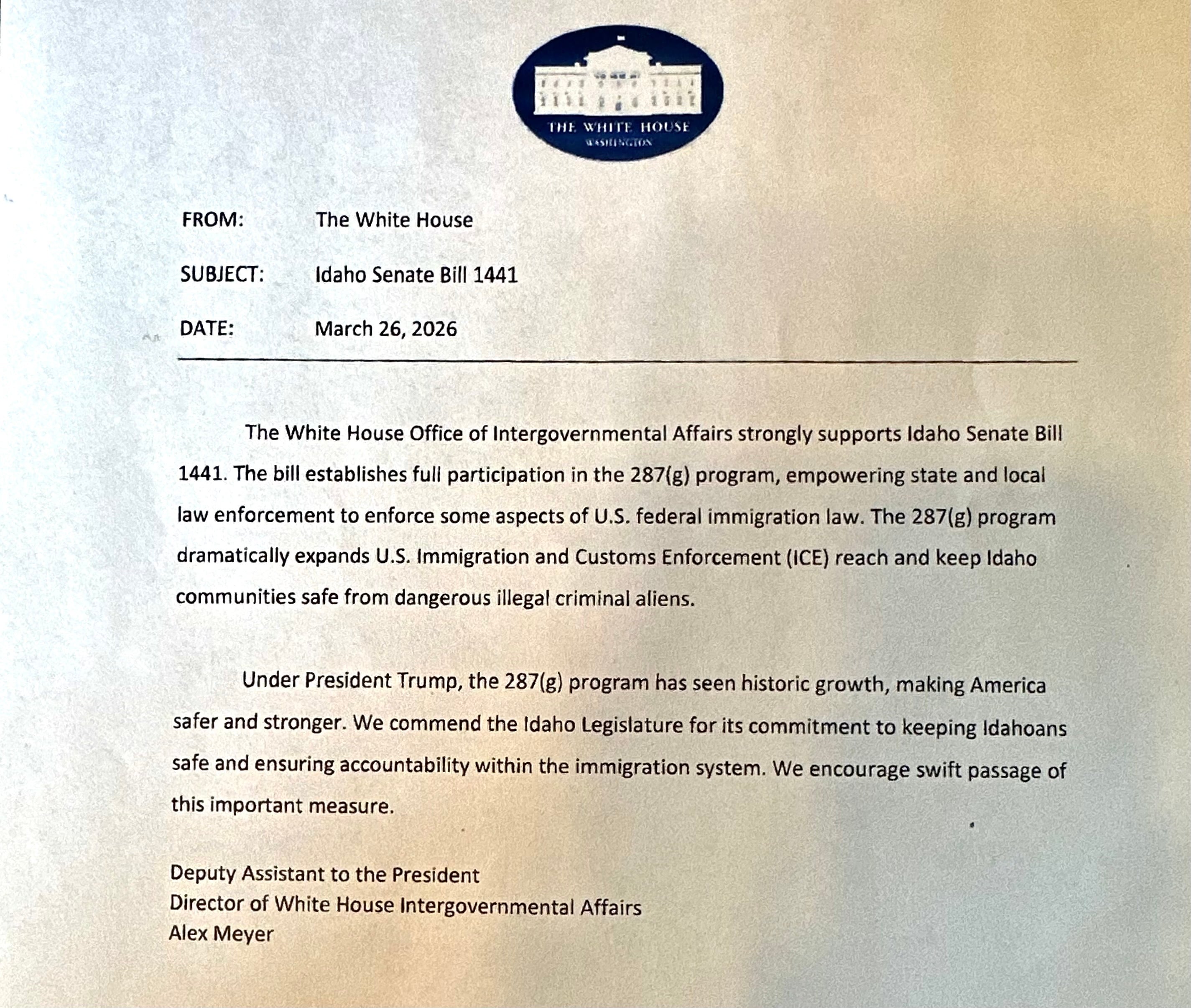
The Spokesman-Review obtained a copy of a March 26 letter from the Trump administration to some of Idaho’s senators, stating the White House’s Office of Intergovernmental Affairs “encourage swift passage of this important measure.”
It hasn’t come without criticism from law enforcement, especially those that have already established working relationships with ICE. The Idaho Chiefs of Police Association, the Fraternal Order of Police and the Idaho Sheriffs Association have publicly opposed the proposals for undermining their leadership authority, creating more duties for officers without adding resources and undermining local control, The Spokesman-Review previously reported.
“They are tying our hands and making us work for the federal government,” Ada County Sheriff Matt Clifford said, “but only with this administration’s goals in mind. I am flabbergasted this is even an idea in Conservative Idaho, and I think people forget that immigration law is federal law.”
The White House’s letter was part of a packet passed to lawmakers in Senate State Affairs this week when the bill was originally taken up. It was signed by President Donald Trump’s deputy assistant, Alex Meyer, who was one of Trump’s former campaign managers.
The letter commends Idaho lawmakers for their “commitment,” states the 287(g) program for local-federal enforcement partnerships has seen “historic growth” under Trump and that the measure will “keep Idaho communities safe from dangerous illegal criminal aliens.”
It is something that Democratic Sen. James Ruchti saw and thought, “This is weird.”
At first it didn’t really click, he said. It never came up in discussion. No one else received it but the people in that committee, either.
“A group that would bend over backwards to support law enforcement chose instead to support the White House as more important,” Ruchti said. “Historically, we have been a state’s rights kind of state. It’s driven a lot about our policy, that we don’t work for the federal government. That’s not what you saw here. It very much, in my opinion, says the White House wants us to work for them.”
The White House did not respond for comment.
Email records obtained by The Spokesman-Review show the U.S. Department of Homeland Security reached out to Idaho sheriffs in February of last year encouraging their agencies to apply to the program.
Clifford, who is part of the Idaho Sheriff’s Association’s legislative committee, told The Spokesman-Review the letter from the White House shouldn’t influence lawmakers to stray from what’s “best for Idaho.” He testified against the bill in a senate committee this week.
“They’re putting pressure on our local government,” he said during a phone call Wednesday. “In Idaho, we should be pushing back. I don’t care what the issue is.”
The first version of the bill died in committee earlier this month after a failed vote and harsh criticism from local law enforcement agencies. It was resurrected last week by Senate President Pro Tempore Kelly Anthon, who told a senate committee the bill was created to ensure that cooperation and communication with ICE is governed by the federal government.
“I don’t think it should be unusual for there to be a memorandum of understanding that is mandated, honestly,” Anthon said in committee Monday. “I think the truth is that Idahoans want to make sure we are cooperating. That isn’t to say we’re not. It’s to say this is to make a general rule that you have to.”
‘Back the Blue’?
Anthon told The Spokesman-Review in a text message the White House letter was authentic and that he contacted law enforcement about the bill. But Clifford said law enforcement was absent from assisting in working on it and only saw the bill after it was printed. Other law enforcement leaders said the same.
“If they are supportive of public safety, then to me that’s backing the blue,” Idaho Fraternal Order of Police President Sgt. Bryan Lovell said on Wednesday. “But if you are taking legislation and running it through, ignoring and avoiding public safety members that are affected by that because you’re trying to push an agenda … It’s hard to feel comfortable when you tell us you back the blue.”
Anthon did not respond for further comment via text or email. His House counterpart, Rep. Dale Hawkins, who had sponsored the first bill, declined to comment.
“They are printing it without even listening,” Lovell said. “They are so set in that direction, they aren’t hearing what we are saying.”
The new proposal instead allows police and sheriff agencies to “opt out” of the program if they do not have the resources for it, but with certain conditions. The only way the agency could opt out is if the county commissioners or city council issue a “finding of fact” that states the agreement would hinder a law enforcement agency’s operations if they agreed to it.
The “findings of fact” would then be sent to the U.S. Department of Homeland Security.
But being able to opt out does not sway law enforcement’s opinion it, most of them told lawmakers and reporters this week.
“The reframing of the bill doesn’t change the bill,” Canyon County Sheriff Kieran Donahue told a senate committee on Monday. “The federal government in local decision making, it moves away from local control for the state of Idaho. We are already working with ICE throughout this state and have been.”
Rathdrum police Chief Dan Haley said his concerns with the bill do not change, either. He is worried, as the chief of a small department, that there would be no reimbursement costs for training officers to take part in the program, he told The Spokesman-Review. Further north, Bonner County Sheriff Daryl Wheeler said the legislators are now “working for the White House” instead of the “people of Idaho.”
Currently, nine agencies in Idaho are active in at least one of the 287(g) programs, government documents show.
Clifford, whose agency has always worked with ICE, believes Idaho Republicans won’t want to participate in the agreement should a Democratic president win the next election.
A different administration could change the program, and the law would still be in place, which may prompt lawmakers to change it once again.
Anthon acknowledged in committee this week he wanted the bill to be sent for further amendments before bringing it to a vote. Some amendments were suggested by Idaho Counties Risk Management Program attorney Michael Kane, who said the Idaho Tort Claims Act does not cover any federal officers when they are being sued. If a local officer was acting as a federal agent, a lawsuit may complicate that.
The bill was on the Senate’s agenda for Wednesday but was never taken up.
“We tend to stay in our lane,” Clifford said of law enforcement speaking out against legislation. “But this does undermine the office of the sheriff and others. It’s a slap in the face.”