Pivotal year awaits at WSU as Jon Haarlow takes charge alongside president Elizabeth Cantwell | Commentary

Approximately 30 minutes into the news conference Monday to formally introduce Jon Haarlow as Washington State’s 16th athletic director, the money quote arrived – and its author was not Jon Haarlow.
The comment came from President Elizabeth Cantwell, who was seated next to Haarlow, and took the form of a single sentence.
Asked why she promoted Haarlow from interim AD to the permanent post, Cantwell referenced their partnership.
“That’s crucial as we go into this coming year – that we are not just us linked at the hip,” she said, “but working so the sum of Jon Haarlow and Elizabeth Cantwell together is more than the sum that each one of us would be accomplishing alone.”
That’s it, folks.
That’s the bedrock underneath Cantwell’s decision to eschew outside candidates and elevate Haarlow, who spent four months in the interim position after Anne McCoy’s dismissal.
Sure, Haarlow made a savvy football hire with Kirby Moore.
And yes, he proved adept at engaging constituents and getting multimillion-dollar projects across the finish line and steering the Cougars into the rebuilt Pac-12.
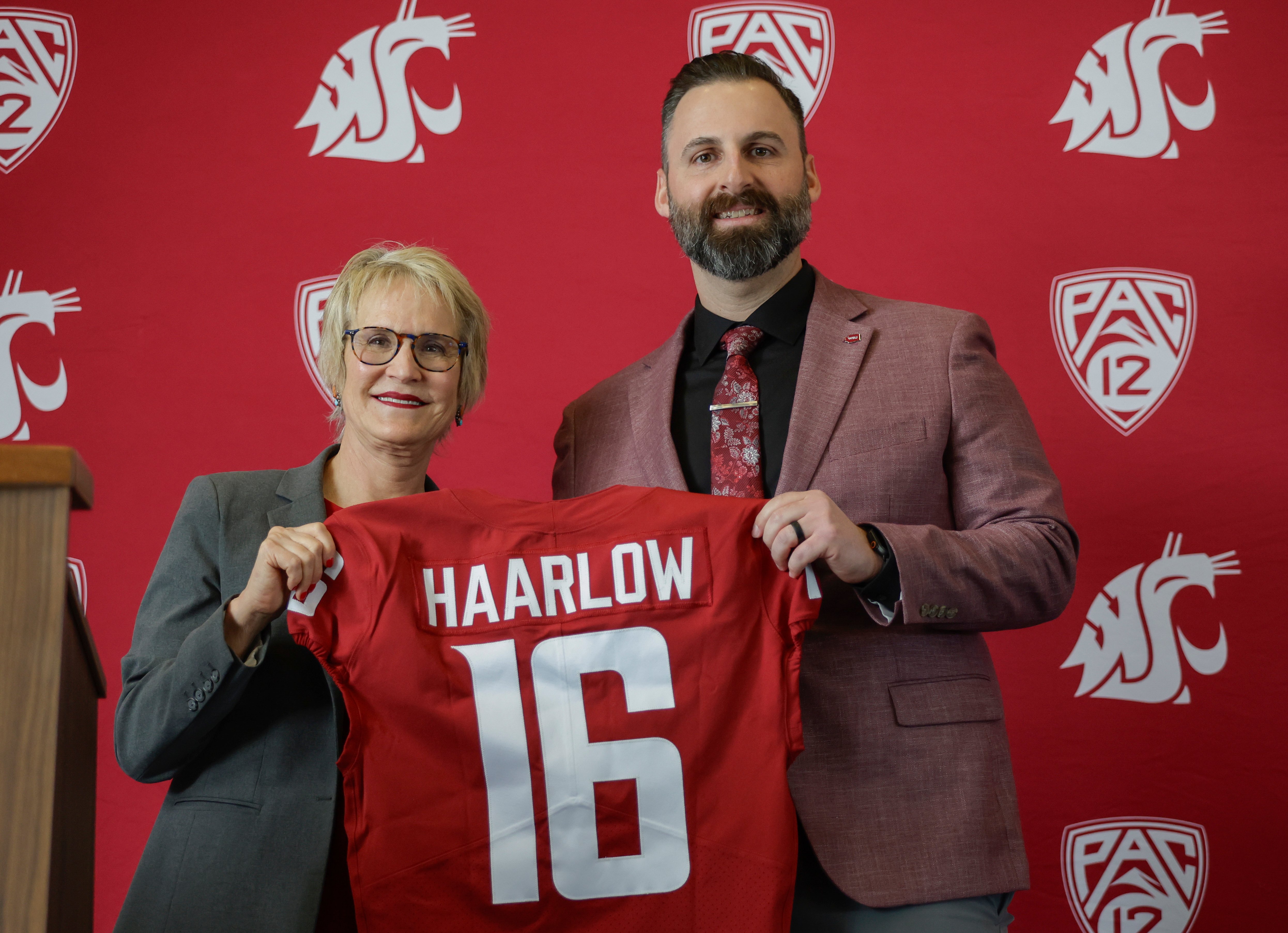
But Haarlow’s most important qualification (by a factor of two bajillion) was his ability to work well with Cantwell, who plans to be heavily involved in Cougar athletics.
Without mutual trust and a shared vision, the alignment would be something less than seamless. And anything less than seamless would be trouble given the unique nature of WSU’s athletic existence.
The Cougars have been cast down a tier in the college sports hierarchy as a result of the Pac-12’s implosion and are facing competitive threats from their peers in the reconstituted conference.
Boise State and San Diego State will arrive this summer with plans to win the football championship and participate in the College Football Playoff. Gonzaga and Utah State are eyeing the Pac-12 basketball title and berths in the NCAA Tournament.
They don’t care that Washington State and Oregon State have tenure – that the Cougars and Beavers spent 14 pressure-packed months saving the conference.
The newcomers are in it to win it and reap all the accompanying benefits.
If the Cougars start slow, the ground they lose might be lost forever.
“This fall is arguably the most important fall in the history of Washington State athletics,” Haarlow said.
Meanwhile, the Cougars have an athletic director who has been on the job for four months; a football coach, Moore, entering his rookie season; a men’s basketball coach, David Riley, struggling for traction ; and too many empty seats in the stadium and arena for comfort.
Their revenue has been greatly reduced as a result of swapping roughly $27 million in media rights from the Pac-12’s previous agreement for about $7 million annually under the terms of the new deal.
Yet the debt service payments for capital projects undertaken a decade ago – to the tune of $11 million annually – have not gone away.
And now, courtesy of changes to the NCAA economic model, the Cougars must share revenue internally with athletes and offer name, image and likeness externally through business opportunities in the community.
But those are just the pressures Cantwell and Haarlow must navigate within athletics.
Don’t forget: As a university, Washington State is under financial pressure, as well. State budget cuts feared to be in the $11 million range were negotiated down to about $1.5 million, but the enrollment issue remains front and center for the university.
In the spring of 2020, enrollment at the Pullman campus was 19,200 students. This year, it’s 14,780, the lowest in two decades, and reclaiming those students will be immensely challenging.
Universities across the country are facing the so-called enrollment cliff caused by a drop in birth rates in the late 2000s, during the Great Recession. As a result, the competition for students – especially the out-of-state variety who pay full-cost tuition – is beyond fierce.
Cantwell envisions Cougar athletics, with football carrying the banner, as an efficient means of helping grow the Washington State brand regionally and nationally.
“Often, athletics is the only way that a lot of people know who we are and what we do,” she said. “They are not Cougs. They didn’t go to school here. They don’t work here. But they know about us, and they know about us because of our athletics program …
“It represents who we are in a way nothing else does.”
The media exposure provided by a single football game, aired for three hours on broadcast or cable television, would cost Washington State tens of millions to achieve with a traditional marketing firm.
The engagement opportunity offered by football cannot be matched by any branch of the university.
How many constituents are coming to campus on Tuesday afternoon to watch a political science lecture?
How many alumni are donating to the university because of the latest showings at the art museum?
With both words and actions, Cantwell has effectively eliminated the wall between central campus and athletics.
But in order for the machinery to work in totality, the Cougars must win consistently.
They cannot win consistently without organizational support and roster resources.
And they cannot construct those vital pillars unless the president and athletic director are working so seamlessly that “the sum of Jon Haarlow and Elizabeth Cantwell together is more than the sum that each one of us would be accomplishing alone.”
Under different circumstances, the alignment would not be as vital.
With a different president, the alignment would not be as vital.
But as the Cougars prepare for life in a new conference, with all the pressures on both athletics and central campus – and with the college sports landscape shifting by the month – the partnership between Haarlow and Cantwell means everything.