
Olympic adventure: How Sandpoint’s Rebecca Dussault masterfully navigated the 2006 Winter Games in Italy
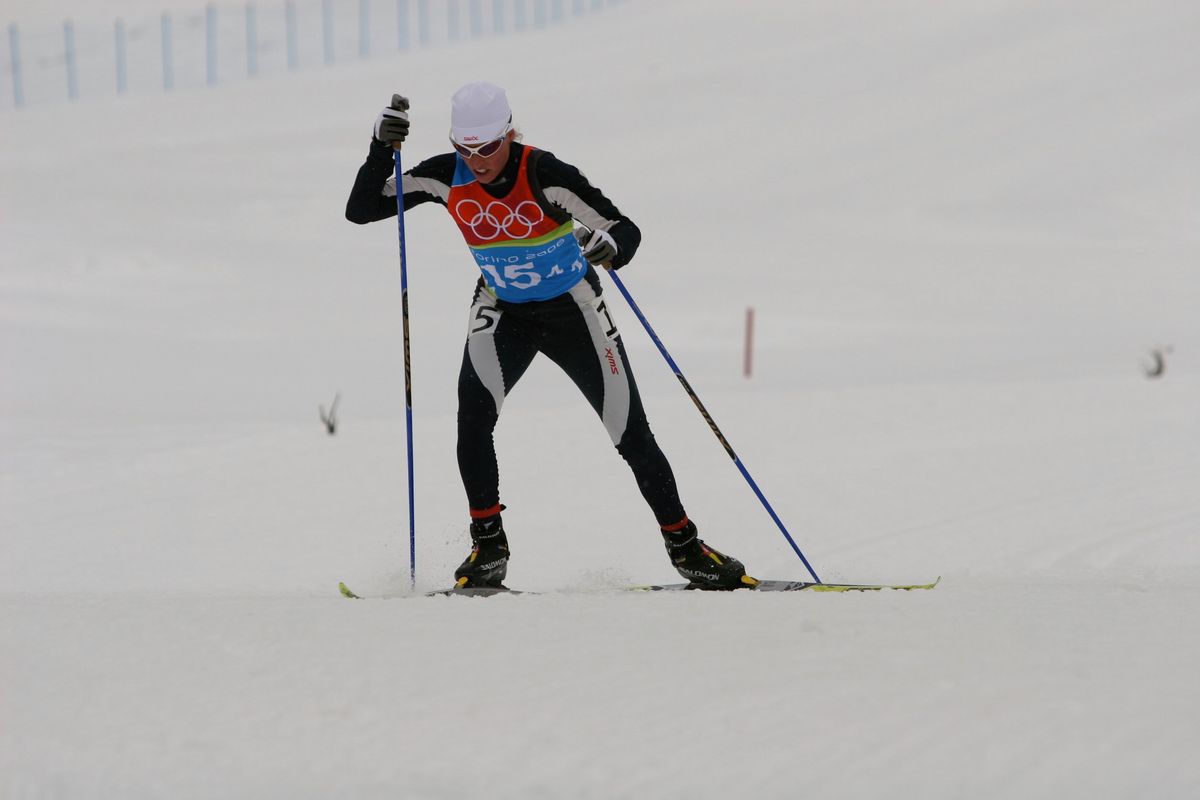
Rebecca Dussault doesn’t dwell on the races she skied at the 2006 Winter Olympics in Italy.
She took 48th in the 15-kilometer skiathlon, 43rd in the 30-kilometer freestyle and anchored a United States relay team that finished 14th.
She wanted better results, but she doesn’t live in regret. There’s so much more to remember.
There’s the town of Pragelato, near the border with France, and the stone house she stayed in with her family.
There’s the time she spent with people who knew Pier Giorgio Frassati, then a blessed and now a saint in the Catholic church, whose name she had engraved on her Olympic ring.
There’s the moment she spotted her husband, son and mother in the crowd at opening ceremonies, right above the tunnel she walked through.
“Those are the moments more so than the races which are marked upon my soul as so special,” said Dussault, who lives in Sandpoint. “What we were able to do as a family. Those are the results I was chasing.”
A lot has happened in the past 20 years. Dussault’s racing career continued, netting her plenty of hardware. She won the American Birkebeiner 50K twice. In 2010, after being left off the team for the Vancouver Olympics, she went to Europe and captured the United States’ first individual world title in winter triathlon. Wherever she went, she was competitive, even on dry land.
Her family kept growing, and now includes eight kids. She retired from professional racing for good in 2014, and settled in Sandpoint in 2016.
She’s now 45. She runs a faith- and fitness-focused coaching service for women, called Fit Catholic Mom, and she’s been involved with the local Nordic ski scene through the Sandpoint Nordic Club.
This winter, after coaching the club’s development team for several years, Dussault revived its race team, a 10-member squad that competes in races around the region.
It had been dormant for a few years. Now it’s coached by an Olympian. Claude Goldberg, the club’s executive director, said Dussault’s experience has proven invaluable, particularly when it comes to designing training plans that result in actual progress amid less-than-ideal weather conditions.
“She brings the expertise to the table from such a high competitive level but is able to translate that to these kids, and have them kind of grasp onto it and run with it,” Goldberg said. “It’s been amazing.”
Now the Olympics return to Italy, where the U.S. women’s cross -country ski team will compete on a course a few hundred miles east of the one Dussault skied in 2006.
The team has improved dramatically in the past 20 years. It’s now led by Jessie Diggins, a three-time Olympic medalist and the top-ranked skier in the world. In 2018, she and Kikkan Randall – who competed alongside Dussault in 2006 – won the first U.S. gold medal in the sport, ending a decadeslong medal drought.
Dussault said the U.S. team has the most momentum in the sport going into the Games. More medals are a real possibility.
“I can’t even tell you how far off that seemed 20 years ago,” Dussault said. “We couldn’t even conceive in our minds that amount of success.”
Dussault’s path to the Olympics started in a fairly typical way. She grew up in Colorado, started cross-country skiing at age 9 and started traveling to races around the state when she was 15. It was clear early on that she was elite.
“I just really took to training and racing,” she said.
She was home-schooled, which gave her more time to train, and she took advantage. By 17, she was competing around the world and doing well. A possible future was coming into focus. College skiing programs had taken notice. Becoming an Olympian was a realistic goal.
Then life pulled her in a different direction. At 19, she left the ski racing world. Dussault is a devoted Catholic, and she said there was a lot of “moral friction” between her and her fellow skiers, and even her coaches. She had just gotten married to her husband, Sharbel, and she felt she needed to step away from the sport.
“It was heartbreaking because I really loved the sport,” Dussault said. “I just felt like my motivation for going to the heights of the sport was different maybe than that of my teammates.”
A couple of years later, she gave birth to her first son, Tabor. She started skiing for the fun of it again, going out with Tabor strapped to her chest.
“I would just ski. I’d ski with friends, I’d ski with my mom,” she said.
The competitive itch never disappeared, though. When a regional college ski competition came to her town in Colorado, she noticed there was an open race – one she could join. She signed up, giving herself a chance to compete with elite NCAA skiers.
She found herself at the front of the pack. Even with so much time away, she could hang with the best. She took it as a sign.
“It really was the pivot moment, where it was like, ‘Wait a minute, I’ve got a lot still to give in this space,’ ” Dussault said.
A few months later, she was finding sponsors and a team and training to return to the professional race circuit. This time, it was a family affair. Sharbel and Tabor went everywhere she did.
Over the next two years, she skied in races all over the country, and she ended up on the podium often. During one race series, she won 10 of 16 contests. She had her eyes on the 2006 Olympics.
In 2005, her dominance in the U.S. continued at first. She skied well early in the season but was slowed later by a persistent illness.
She skied well enough to be selected for the Olympic team, but she was in pain.
“I thought my lungs were being torn in half, being cut by knives at the end of every qualifying race that winter,” Dussault said.
Women’s cross-country skiing in the U.S. was in tough shape at the time. The team wasn’t seen as a threat on the international stage, having never won a medal at the Olympics. The U.S. Ski Team had not even named or funded a women’s cross -country team in 2005.
That meant there was no dedicated women’s coach in the run-up to the Games, and no formal women’s squad for international competition until the organization tapped Dussault and six others to go to Italy.
“By the time we’re at the Olympics, we’re picking up the busted up fragments of U.S. women’s skiing,” she said.
On top of that, Dussault’s professional team had just switched ski manufacturers, so she had been learning new sets of skis. She showed up with 18 pairs of skis from two different companies.
There were other stresses, too. Because she brought along Sharbel and Tabor and wanted to stay with them, she couldn’t stay in the Olympic Village, and so they had to shop for lodging on their own.
The house they stayed in was across the street from an entrance to the ski arena that she could use but was off limits to her husband. She had to work hard to wrangle permission for him to use that entrance.
“These sorts of things wore me out,” she said. “It’s a fight worth fighting, but also taking from the reserves, the little reserves an athlete has left after they’ve qualified and made the team.”
The results the team posted weren’t spectacular. Randall, then a rising star in the sport who was at her second Olympics, had the best individual finish, earning ninth place in one of the sprint races.
Dussault was disappointed in her results, but not the experience.
“I can’t even tell you how cool it is to be kitted out in the U.S. uniform, to walk into the opening ceremonies,” she said.
Opening ceremonies were held in Stadio Olimpico Grande Torino, a soccer stadium that had been sitting empty before the 2006 Games. When she saw the crowd of 35,000, she was certain she’d never spot Sharbel and Tabor.
Then there they were, sitting about 15 feet above her. Sharbel joked about throwing Tabor down to her.
Away from the race course, she shared the story of Frassati. The Turin-born Catholic activist was known as an outdoorsman and for his acts of service. He died of polio at age 24 in 1925.
She encountered his story before the games and felt a genuine connection to him. She told the Washington Post that she considered him the “patron of her journey.” While in Italy, she met with his relatives. She had Bl. Frassati engraved on her Olympic ring.
The ring disappeared after they moved to Sandpoint, apparently filched by whoever ransacked their camper while it was being stored in Butte, Montana.
A few years ago, a Helena jeweler called her. He said he had her ring.
“I had no idea,” Dussault said. “Just before being gone forever, Frassati finds me again.”
This past summer, Dussault and her husband took their six youngest children back to Italy, back to Pragelato.
They stayed in the same little stone house they’d rented in 2006. It’s still owned by the same family. They’d all become friends during the Games, sharing meals at the same table.
Two decades on, it was clear they hadn’t forgotten the Dussaults.
“They still had pictures of us on the walls,” Dussault said.