
Intake Dam bypass channel revives Lower Yellowstone River fishery

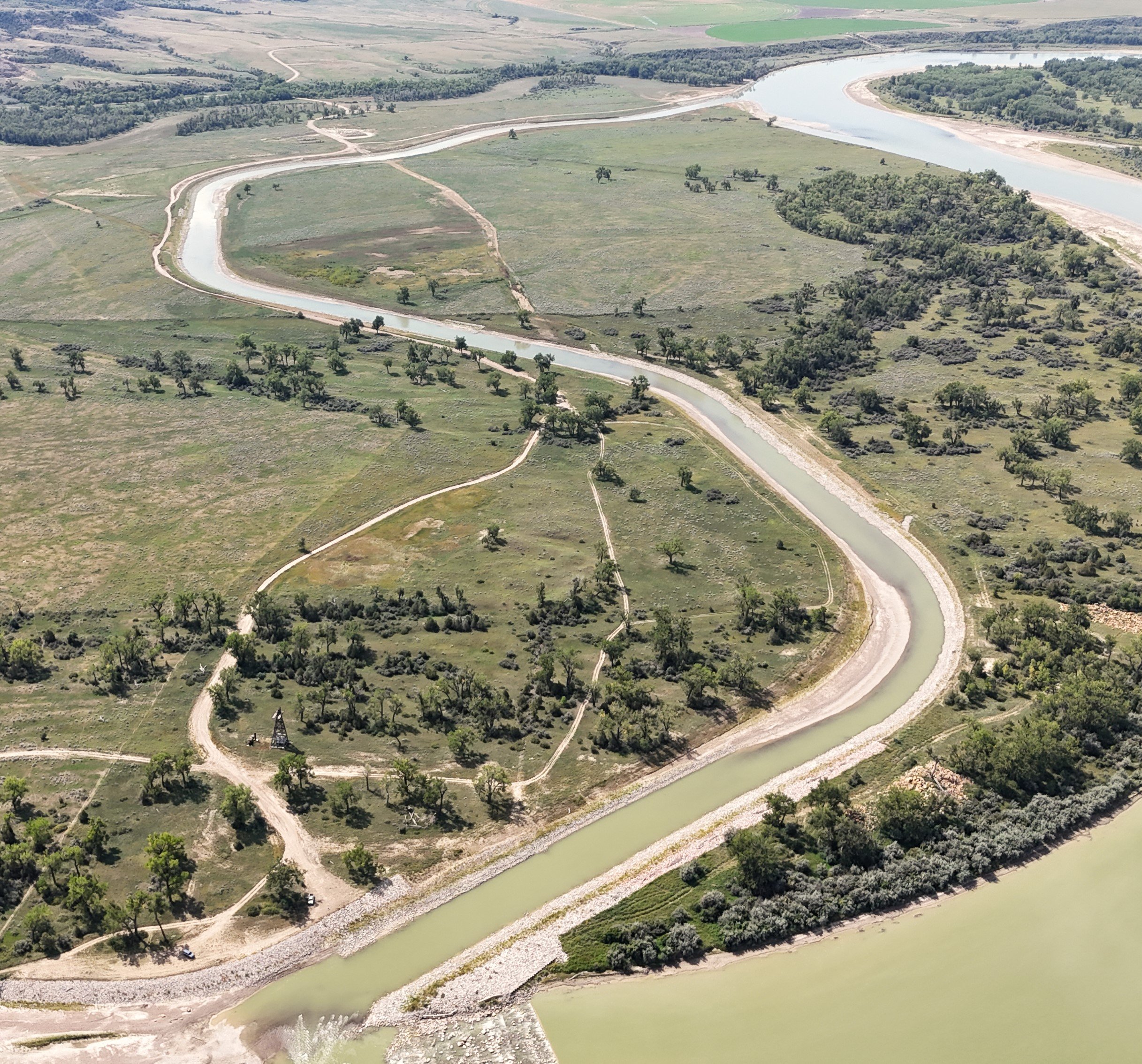
For roughly 700 miles the Yellowstone River gushes, gurgles and sighs from the mountain meadows of Yellowstone National Park before crossing Eastern Montana’s prairie grasslands and joining the Missouri River.
In that distance the river loses more than 10,000 feet in elevation and transforms from a coldwater fishery prized by anglers for its cutthroat, rainbow and brown trout to a warmwater ecosystem that is home to the descendants of ancient species like paddlefish and pallid sturgeon.
For a fraction of the river’s journey, less than 1% of its entirety, a portion of the mighty Yellowstone flows through a 2-mile-long side channel, located between the communities of Sidney and Glendive.
This tiny stretch seems insignificant in the scope of the stream’s entirety, yet in just four years it has proven to be a historic, life-giving – and maybe life-changing – capillary.
Opening a fish capillary
Opened in 2022, this manmade bypass channel that weaves around Intake Diversion Dam has helped thousands of fish move between two portions of the river that had been largely separated when the Intake Diversion Dam was constructed to divert irrigation water 110 years ago.
The bypass’s main function was to ensure endangered pallid sturgeon would be able to move 160 miles farther upstream – hopefully to spawn and possibly restore reproduction in the wild. Since the dam was built, the fish have been artificially sustained by thousands of hatchery-raised pallids that were released into the river.
The large fish, which can trace its ancestors back 78 million years, were listed as an endangered species in 1990 after their population was estimated at about 125 fish between Fort Peck Dam and Lake Sakakawea.
Yet the channel has also funneled walleye, sauger and paddlefish upriver to the benefit of the fish and the anglers who pursue them, while also highlighting the importance of the fishes’ access to the Tongue and Powder rivers, tributaries to the Yellowstone that the fish can now reach.
A career event
Mat Rugg, a fisheries biologist with Montana Fish, Wildlife & Parks, has spent 13 years working on the Yellowstone River, his career bracketing studies the agency did prior to the bypass channel’s construction and now after its completion to analyze fish passage.
“This is at a scale that, you know, I’ll probably never see a project this big in my career again, as far as habitat restoration,” he said.
Ten years of planning by the U.S. Army Corps of Engineers went into the structure, which included scale models built to assess water velocities and channel depth. Construction took 36 months with the entire project costing about $44 million.
“So definitely when you’re talking millions of dollars in a project of this scale you’re nervous about how it might work,” Rugg said. “And I can really say that this pretty well exceeded what my expectations might be.”
Engineering success
The engineering project to create the channel was unlike any other because of its size and the fact that it was installed on an undammed river capable of high flows and destructive ice jams.
“So when we were designing that channel and kind of coming up with depths and velocities, there’s never been a project of this scale to kind of model it after,” Rugg said.
Data from natural side channels was used to assess the right mix of water depth and velocity, he said. After the bypass was built, parts of the channel haven’t met those standards yet fish are still using the waterway.
“They will actually use it in a little bit shallower depths than we originally had set, and potentially a little bit swifter velocities than we had for the upper limit,” Rugg said.
“So we’re learning as we go that those physical criteria definitely aren’t as important as the fish passage themselves, and there may be some potential in the future to kind of adjust those physical criteria to match more what we actually know now that fish pass through,” Rugg said.
That the bypass channel works as designed has been a huge relief for the many people and agencies involved, including Rugg.
“I feel pretty lucky to have been a part of it, to see it all unfold.”