
‘Symbiosis’ invites visitors to look at nature in big and small ways
There are a variety of ways in which one can interact with nature.
On a big scale, you can take in the towering trees that cover the region, the grandiose mountains that stretch above the horizon.
On a small scale, you can stop and smell the roses – literally. Admire the leaves as they change color in the fall or the meadows blossoming in the spring.
On perhaps the smallest scale, you can zoom in, really noticing what, for example, a flower petal truly looks like.
You can also merge the natural world with manmade elements, creating a new kind of coexistence between the two.
In “Symbiosis: The Living Language of the Inland Northwest,” which runs through Jan. 31 at the Terrain Gallery, artists Lauren Adams, Tricia Kleinot and Joanna Shippam examine the many ways in which people and nature are interconnected.
Adams contributed five large scale drawings of native conifers – ponderosa pine, Douglas fir, Western larch, Western hemlock and Western redcedar – to the exhibit. Alongside each watercolor and ink piece is a drawing of the branch, bark and cone of the tree.
These intricate drawings were inspired by similar works she created while writing and illustrating a book that explored the tree species and natural history of a property her alma mater Whitworth University is connected with.
She illustrated the conifer and deciduous trees on the property as well as wrote about the history of the area, including its logging history, for the book. The book was primarily printed for student use, though Adams is hoping it receives a reprint so others can see her work.
For “Symbiosis,” Adams wanted to focus on how each tree forms and the different ways one would identify it.
“How do you make sense of your world? Well, you can draw it,” she said. “How do you become connected with the things that you see on a daily basis? Well, you can study it. And the best way to study something is to try to replicate it.”
With her work, Adams hopes to make people more aware of their surroundings. When you’re aware of something, she said, you care about it. And to care about nature means engaging with it in a way that feels right for each person, just like she, Shippam and Kleinot did for “Symbiosis.”
“Tricia’s is like the human and natural aspects together, and Joanna’s are these super zoomed in views of nature that are beautiful and colorful,” Adams said. “Mine are almost zoomed out, so I think they balance each other well.”
At first glance, it’s not immediately obvious that Shippam took inspiration from nature. Her pieces are, as Adams mentioned, colorful and abstract. But when you read the label next to each piece, you start to see where her inspiration has come from.
Pieces like “Consider the Lilies,” “Rubrication” and “The Build Up” were created using acrylic as well as natural pigment, red ochre and copper oxide, rock pigment and flower and acorn ink, respectively.
The inspiration for “Rubrication” specifically came after Shippam read a book that told of how rubrication, or the act of adding red ink to a text to emphasize certain passages, was done in red ochre.
The piece has spots of deep red ochre on top of pink, blue and beige paint and pigments.
“I thought it really went beautifully with the theme ‘symbiosis,’ to celebrate our connection to the land, but also an invitation to faith and to pray and how the world can invite us into that,” she said.
Shippam, who said her parents would send her to bed as a toddler with crayons and paper, only used all natural pigments in her early work but found over time that “the magic happened” when she mixed those pigments with paint. With that combination of supplies, she examines the minute features of the natural world.
“I love to hone in on details in nature, whether it be color or texture or shape, and focus in on them and almost create a topographical map of those details,” she said.
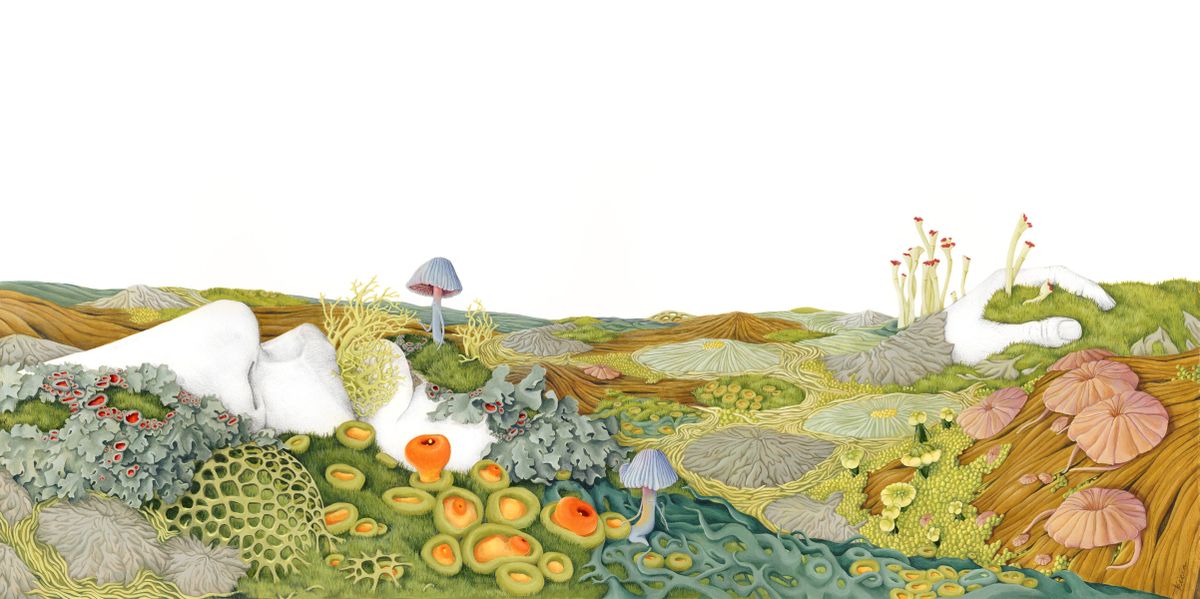
Kleinot’s pieces also focus on the details, specifically those of the world of fungi. In her pieces, part of her “Fruiting Bodies” series, Kleinot imagines what it would be like if the fungi world met human experience.
One piece in the series shows mushrooms and fungi sprouting through the keys of a computer keyboard. Kleinot made the piece, called “Fruiting Bodies: Interruption,” during the pandemic in response to being forced to sit still after work dried up and the world went still, allowing nature to take over.
Kleinot began working on the “Fruiting Bodies” series seven years ago, following a move from the East Coast to Spokane and her journey into motherhood, two big moments she considered acts of disconnect and immense change.
To help heal, she began hiking and spending more time outdoors, which put her in a more creative state of mind. While hiking, she observed the micro worlds of fungi. As an illustrator, she became interested in creating stories that could take place in those micro worlds.
The first pieces in the series turned various mushrooms into characters called, among others, the Gatherer, the Nurturer and the Whisperers. Kleinot’s other works in “Symbiosis,” both acrylic and ceramic, feature mushrooms, lichen and moss resting in the palm of a person’s hand and sprouting out of an ear.
“Seeing them do these takeovers in nature and what their roles are in the ecosystem was fascinating to me, and I thought ‘How can I represent what nature’s done for me?’ ” she said. “Nature’s medicine in a way. Then also ‘What would the fungus world do if it were to meet this human world, and how would they do what they do in the ecosystem to humans and all of our physical pain, our emotional pain?’ ”
A common thread among the three artists is the desire for those viewing their work to be inspired to spend more time with nature. The more time spent outside, the more one cares about the environment.
“When I make these pieces, I hope to spark curiosity in people,” Kleinot said. “The world around me melts away, and I get immersed in this world. It gets you to question different things. Specifically, the mushroom and the fungus world are really fascinating. Start with ‘Fantastic Fungi,’ or I tell people ‘Get curious, get outside, explore the fungus world.’ It’s endless inspiration.”