
‘One exhibit you will not want to miss’: Museum unveils truly Spokane-centric Lego display of iconic landmarks
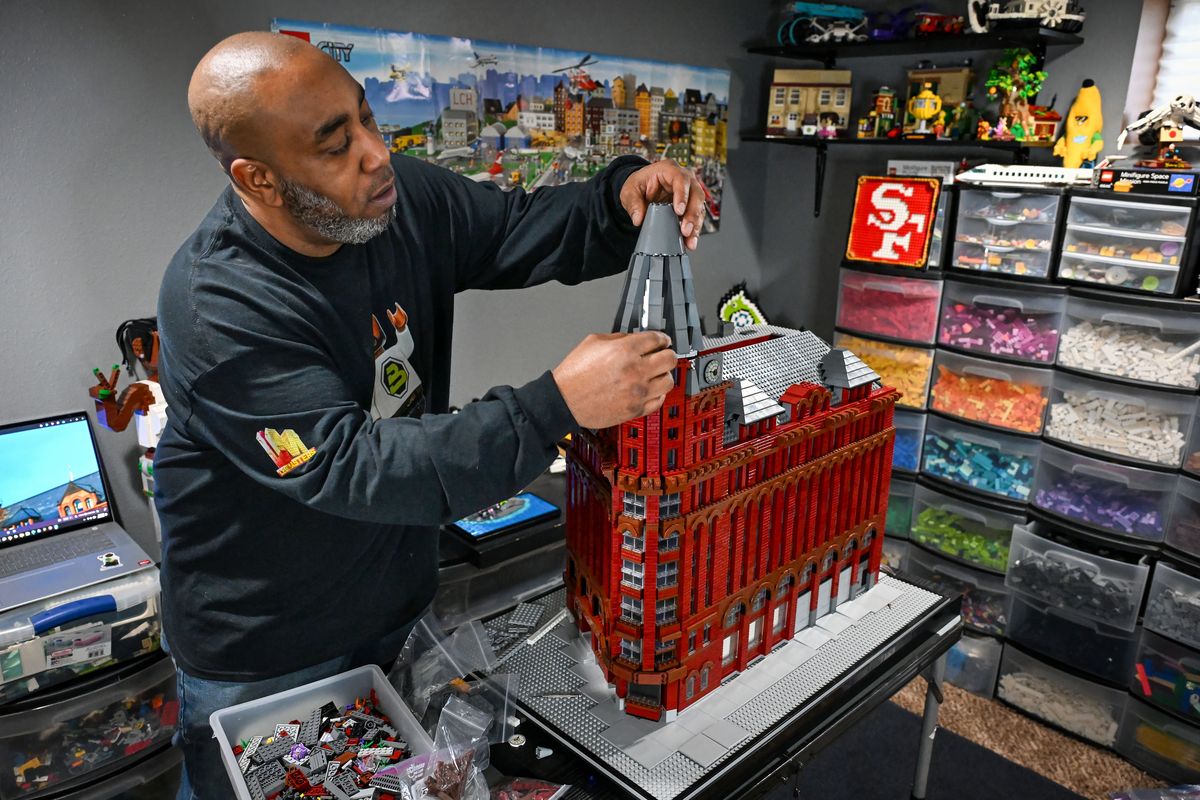
Like the start of a grand heist, or Samuel L. Jackson in a Marvel movie, Bryce Colvin knew he needed to build a team.
Last April, the co-owner of Lego resale shop Brick Buy Brick received a request from the Northwest Museum of Art and Culture to help put together an exhibit showcasing Spokane’s most iconic landmarks, made entirely of the little plastic bricks he loves.
If the idea wasn’t lofty enough, Colvin was given just six months to pull it off.
“I already knew a couple of builders in the back of my head,” Colvin said.
MOC, or My Own Creation, is a phrase commonly used in the Lego builder community to describe custom designs sprung from artists’ imaginations, and Spokane has a bevy of builders who specialize in MOCs.
Colvin’s Avengers assembled, to assemble some plastic architectural feats, including the Spokane Falls and Monroe Street Bridge, the original iteration of The Spokesman-Review Tower and a bustling Davenport Hotel. The museum unveiled those Lego models on Saturday and several others as part of its exhibit “Brick by Brick: We Built this City,” which runs till mid-June.
Colvin said it was a challenge to put together – his model and the exhibit as a whole. But he’s proud of the work he and the team did, and he looks forward to seeing the Spokane community connect with the city they love in a newfound way. The exhibit provides a much-needed spotlight on an under-the-radar craft, and the talented crafters who call Spokane home, he said.
Colvin said as a hobby, Lego building is more of a personal thing, something you do “in your room, by yourself.”
“That’s how a lot of us Lego MOC builders start off, building modestly in our rooms by ourselves. We build our little build, we might show our parents, put it on our shelf and call it good,” Colvin said.” It kind of continues on into your adult life, where you build these really cool things. You might take a couple pictures and you show a couple people, but it’s a pretty modest hobby.”
“This exhibit provides a real opportunity,” he added.
Colvin’s lineup of artists includes a former FOX competition show contestant, a University of Washington architecture student, a medical lab technician and a Veteran Affairs dietary aide, just to name a few. The range of builders highlights the widespread appeal of the hobby, and museum education director Rob Worstell said he hopes it inspires many of the visitors to the exhibit to explore their own hidden talents.
He also hopes it fills visitors with a sense of pride, in their town, its landmarks and its community members.
“I want them to see their environment in a different way; there’s some very special places included,” Worstell said. “I grew up here, lived 30 years in Boston, and sometimes, until you go away and come back, you don’t really notice certain things, or appreciate it.”
While Worstell hopes the exhibit provides a perspective change to visitors, it’s already had that impact on the builders behind the models.
Joseph Perkins, the aforementioned 19-year-old student, said he recalls staring at the Spokane County Courthouse every time he drove by during his upbringing in Spokane. To be able to bring it to life in Lego form was an honor, he said, but his favorite part was learning more about the building’s history.
“There were so many unbelievable stories I found out by going through the articles, photos, all these different write ups that were in the downtown library archive,” Perkins said. “And I’ve always admired that building.”
Those stories included the controversy surrounding architect Willis Ritchie, who at 29 years old, designed the French-chalet style building before eventually facing accusations of fraud. Or how the old gallows were located behind the building, the gates which were reinstalled in 2017 after they were discovered buried in debris at Plante’s Ferry Park after decades of being lost to history.
While the sheer scale of the courthouse model was a challenge in itself, he said the elaborate facades of the building gave him the most strife.
“Honestly, the most difficult thing was being able to capture all the beautiful details of the courthouse,” Perkins said. “It’s so iconic and on such a small scale, it was really difficult, particularly around the windows and the little turrets on the side.”
Perkins used a widely available digital design studio to set the schematics for his build, based off his research, reference photos and a couple tours he took of the building. He used the same program to iron out his MOC that received international acclaim last year, and he said it’s been a useful experience as he continues his studies and picks up architectural planning programs.
For now, he’s just proud to be featured alongside so many talented Spokane artists, he said.
“I hope the people of Spokane can enjoy the showcase of our entire city,” Perkins said. “This is definitely one exhibit you will not want to miss.”
Colvin, like a seasoned head coach assigning positions, said he did his best to match the builds with builders and their skillsets. While he took on the largest build, the Spokane Falls and Monroe Street Bridge, Perkins was a natural fit for such a unique architectural design, he said.
Christian Gill, a medical lab technician and fellow shop-regular, matched well with the hefty challenge of bringing the St. John’s Cathedral to life, Colvin added.
Gill is an avid collector of the Lego Group’s “City” line, which features sets that collectors use to build expansive metropolises. Gill said the city he’s built in his basement over the last five years measures 8 by 10 feet across.
“It started with the Lego city, and it grew pretty, pretty exponentially from that point – that love for making buildings and detailing different things,” Gill said. “And truly I never made anything as detailed as this set. It was just the constant, frequent trips to Brick Buy Brick that caught Bryce’s attention.”
Gill said he’s always been more of a MOC builder, even at a young age. He’d toss out the boxes and instructions, leaving him with a pile of bulk bricks and his own imagination to build something.
“That’s kind of where that creativity, I guess, was born,” Gill said. “Just out of necessity. I wanted to make a spaceship, but I don’t have instructions, so I got to make it how I see it in my head. That kind of thing.”
Gill’s cathedral model is expansive. So much so that he had to build it while in a plexiglass box in the museum over the last few months to ensure it would make it to the exhibit in one piece. Using reference photos alone, Gill managed to reflect the intricate designs of the landmark’s windows and iconic tower.
In true Lego Group fashion, he included a designer’s Easter egg. He, his wife Kaylee and their newborn Rowan are depicted in minifigure form on the worship hall’s front steps. He said he hopes the build inspires young and old visitors alike to celebrate human creativity, especially as artificial intelligence continues to expand into the arts.
“I want them to know that in the day of AI, that it is very possible to still be able to use that creative brain, to do it from scratch simply from images and to be able to say I want to make that,” Gill said.
For Eddie Gooden, a former contestant on the TV show “Lego Masters,” participating in the project was another reminder of the heights the hobby has taken him to, and the joy he derives from it.
“It’s an honor,” Gooden said. “I’ve never looked at Lego as anything more than a hobby, ever, and it’s landed me on national television and now we’re headed to a museum. There’s no words to describe it, really.”
Gooden was tasked with the Review Tower, a landmark he’s long dreamed of putting together. The project provided a unique opportunity to do so without the hurdles of time and parts, and like Gill, Gooden relied on his own reference photos and eye for design to complete the build.
There were some challenges, like with ensuring the roof slopes matched, but Gooden said it clicked together as smoothly as the bricks themselves.
“One of my favorite sayings is, ‘Sometimes the builds build themselves,’ ” Gooden said. “And this was definitely one of those.”
It’s an art form, Gooden said.
“I equate building with Lego the same way a carpenter builds a desk, or builds a nightstand,” Gooden said. “There’s detail to it, there’s craft, there’s your own personal touch that you try to add to it.”
“And what I hope people get out of the exhibit itself, after seeing all these builds, is that they know that Lego isn’t just the Lego car or the Lego building. You can literally do anything you want with Lego if you have the eyes to make it happen,” he added.