
The great Divide: How a small, nonprofit Nordic ski club has thrived in the Palouse
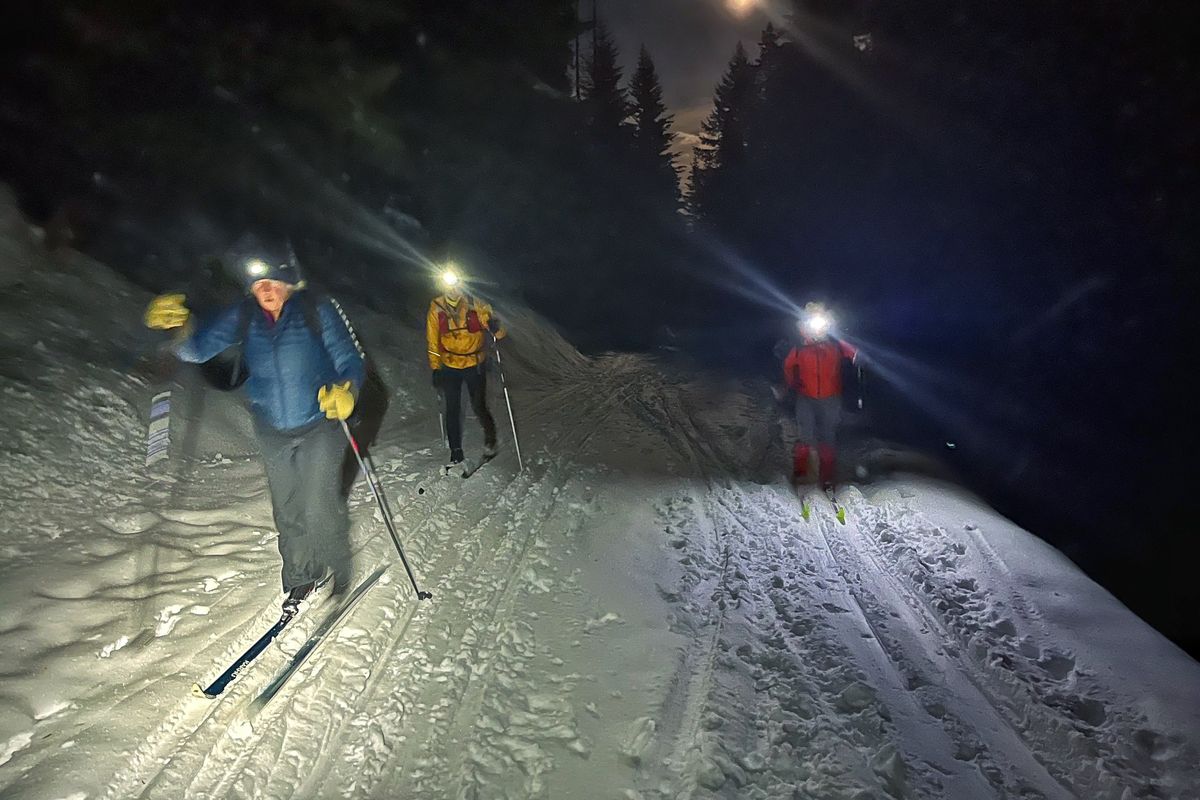
If it’s a nice day and there’s snow on the ground, the Palouse Divide Nordic ski area is probably the happiest place in Benewah County, Idaho. There’s a buzz in the parking lot, anticipation at the trailhead and cheerful banter on the trails.
Located atop a significant ridge 39 miles northeast of Moscow, Palouse Divide straddles Highway 6 between the hamlets of Harvard and Emida. Most of the ski area’s 20.25 miles of trails are on the east side of the highway, so that’s where most folks head for skate skiing or classic, diagonal-stride Nordic skiing. There are two nice trails on the west side of Highway 6, but logging operations on behalf of the Idaho Department of Lands have soured the aesthetics.
While it’s easy to appreciate the joy of self-propelled skiing, most visitors don’t realize how much energy, effort and expense is required to operate a little cross-country ski area. In a typical season from December through March, the Palouse Divide Nordic Ski Club grooms roughly 650 miles of trails. Overall, volunteers contribute around 900 hours to maintain the trails, staff the special events, keep the equipment running and ride herd on the club’s finances.
It’s a major undertaking, so here is a glimpse into what goes on behind the scenes at a small, nonprofit, all-volunteer cross-country ski area.
Giving time, giving money
“We’re a pretty robust club, primarily because of the people who live on the Palouse,” says club president Jesse Spohnholz. “The Palouse has an active community of people who like to do things outdoors.”
In a typical year, the Palouse Divide Nordic Ski Club collects dues from about 500 members; memberships range from $20 for an individual to $30 for families. Because many of the memberships are for families, the actual number of members is well in excess of 500. Some of those members are willing to lend a hand, Spohnholz says, adding that dedicated volunteers are the beating heart of the club.
In addition to membership dues, the club holds fundraisers and receives significant donations and matching funds from members and nonmembers. The club also gets a thick slice of the proceeds from Idaho’s Park N’ Ski program. In fact, the Palouse Divide Nordic Ski Club is among the most-rewarded beneficiaries of all 14 Idaho Park N’ Ski areas, says Rebecca Honsinger, registration supervisor for the Idaho Department of Parks and Recreation.
Last year, the club received $6,775 from Idaho’s Park N’ Ski program. Most of that money goes toward maintenance and gasoline for the club’s four snowmobiles and grooming equipment, but it also pays for a porta-potty at the trailhead and plowing the parking lot. Spohnholz said Idaho Parks and Rec has supported the club at every turn, even awarding grants to buy chainsaws and two-way radios for the grooming crews; the U.S. Forest Service, particularly the Palouse Ranger District in Potlatch, also has been a good friend to the club.
The club was incorporated as an Idaho nonprofit back in the 1990s, according to Spohnholz, who became president in 2019. The lack of federal nonprofit status hampered its ability to raise funds, so Spohnholz pushed for federal nonprofit status as a 501c(3). “The goal was to be financially stable so that if we had a major piece of equipment die, we could still provide grooming,” he said.
The club is frugal and efficient with its money, adds Treasurer Paul Hill, noting that only $244 has been spent on administrative expenses since August, 2022.
Outreach, events and education
Most folks simply drive to Palouse Divide, step into their skis, and do their own thing with family and friends, but the club also provides a wide smorgasbord of programs and activities.
“When I became president, my goal was to lower the barriers for people to join in winter activities in our region,” Spohnholz said. “We have really taken it on as a mission to reach out to people who haven’t done winter activities in the past.”
Though it was cancelled this year due to lack of snow, Free Ski Day has long been a fixture on the calendar. Because the club receives public funds from the Idaho Park N’ Ski program, Free Ski Day is a state-sponsored event. Hyperspud Sports in Moscow has long donated the use of equipment for Free Ski Day, and this year the University of Idaho’s Outdoor Program also pledged to supply equipment.
Free Ski Day is just the tip of the iceberg for club events. When there’s enough snow, ski instructor Elise Stacy coordinates a cadre of volunteers who offer free lessons and instruction for novice skiers.
Ski lessons are typically offered twice a month, said Spohnholz, adding, “some are open invitation, and others are for specific groups. We’ve done it for scouting groups, church groups and international groups.” For instance, the International Program Office at the University of Idaho steers a lot of foreign students to Palouse Divide.
Another club mission is to promote community and a sense of fellowship among those who already know how to ski. To that end, the club organizes multi-day ski trips to a Forest Service cabin in the Blue Mountains, state-owned yurts in the Idaho City area and other overnight opportunities near McCall, Idaho and the Methow Valley in Washington.
Depending on one’s appetite for suffering, the highlight of the club’s event calendar could be the 18-mile Bald Loppet race, which is typically held in late February. Participants ski on familiar trails for several miles before embarking on a long, gradual climb to a fire tower atop Bald Mountain – where a party atmosphere prevails at the turn-around point. Most participants remove their skis and relax for a few minutes as they gulp down hot drinks, hot soup, and snacks before hitting the trail back to the finish line. The Loppet, as it’s known, is a highpoint for mirth and merriment.
In the end, all of the programming and events further the club’s fundamental goal of getting people of all abilities into the winter backcountry.
Spohnholz, who is a history professor at Washington State University, takes particular pride in watching people progress from newbies at Free Ski Day, to avid learners receiving instruction, to going on overnight trips with the club, to finally coming full circle and giving ski lessons to a fresh batch of newcomers.
“It’s certainly true that living on the Palouse means winters are dark and long,” Spohnholz says, “and that’s why we’re helping people get outside and enjoy the snow.”
Grooming trails, breaking things, getting grubby
No volunteer ski club can operate without groomers, who arrive early, work hard, and leave late. Their day begins at the Palouse Divide Lodge, where owner Shirley Hathaway graciously allows the club to store its snowmobiles and collection of tow-behind grooming devices.
Keeping all that equipment in working order chews up a lot of bandwidth for Jon Fabricius, who is the club’s vice president and trail manager. An extremely capable man, Fabricius is a retired farmer and former bareback rider who isn’t afraid to modify a snowmobile’s electrical system to accommodate a fussy piece of grooming equipment. His resourcefulness is a huge asset for the club.
In addition to himself, Fabricius can call upon a dozen or so others to groom the trails. Since most of the trails are on Forest Service land, all groomers must be federally certified to operate snowmobiles and chainsaws.
At its best, grooming is a 7-9 mph meditation in which snowmobile drivers carefully pilot their sleds down forest roads, deliberately swinging wide on the turns to provide an open, even track. Typically operating in pairs, one sled goes first with a simple drag unit – a large roller, or heavy metal sled with an upturned leading edge – and the second groomer follows with the actual grooming device.
The club owns two grooming units, both made by Yellowstone Track Systems; when new, they sell for around $6,000 apiece. Each groomer has a set of wicked-looking “knives” that chop up icy snow and leave a smooth corduroy surface for skate skiers. The Yellowstone groomers also have track setters that press down into the snow to create two perfectly parallel tracks for diagonal-stride, Nordic skiers. Thanks to switches installed by Fabricius, snowmobile drivers can raise and lower the knives and track setters when the sleds are in motion.
At its worst, grooming cross-country ski trails is a descent into the seventh circle of hell. Clevis pins wobble loose, electrical connections go dead, snowmobiles tip over, and drag units get bogged down in deep snow. Since the elevation is less than 4,000 feet, the snow is frequently wet and sloppy – which makes for frustrating and uncomfortable working conditions.
After a powerful windstorm and subsequent wet snowfall, a trio of groomers recently encountered dozens of fallen trees across the road. Nimble skiers were threading their way through or around the downed timber, but the groomers were forced to dismount, grab their shovels and chainsaws, and do battle with the fallen forest giants.
It was ugly work as the saws occasionally threw their chains, forcing the groomers to remove their gloves and coax the oily, grubby chains back into position. Time and again, oily and wet fingers went back into clean, dry gloves until the gloves, too, were wet and oily.
Being a groomer means never getting to wear nice clothes.