Going small has paid big dividends for No. 6 Gonzaga amid frontcourt injuries: ‘Their whole identity has changed’
Gonzaga spent months workshopping a jumbo lineup with Graham Ike and Braden Huff before springing it on Saint Mary’s last March at the West Coast Conference Tournament.
The Zags played through their advantage down low, nullified Gaels forward Paulius Murauskas and won 58-51 in a game where Ike and Huff combined for 29 points and 11 rebounds.
Saint Mary’s probably doesn’t care to watch film of the WCC title game in the first place and it may not even help while preparing for Saturday’s matchup with No. 6 Gonzaga at McCarthey Athletic Center (7:30 p.m., ESPN).
The Gaels will encounter a vastly different Zags team playing an entirely different brand of basketball in potentially the last meeting between the longtime WCC rivals in Spokane.
The last time Saint Mary’s saw Gonzaga, Ike, who’s listed at 6-foot-9, was starting alongside the 6-foot-10 Huff for the first time. Huff (knee) is expected to miss his fifth straight game on Saturday and even if Ike (ankle) does return, the Gaels could get an extended look at a lineup where Gonzaga’s biggest player is 6-foot-7.
How Saint Mary’s adjusts to the latest lineup wrinkle could determine who takes the first of two regular-season meetings between the teams that have accounted for every WCC title since 2000.
“Coach (Mark) Few’s like a chameleon,” San Francisco coach Chris Gerlufsen said after his Dons lost 68-66 to the Zags last Saturday in the Kennel. “He figures it out depending on what his personnel is. Them being smaller, their whole identity has kind of changed on both sides of the basketball and they did a really good job of disrupting us with their switching and getting out in the passing lanes and kind of discouraging some of our entries. That had us on our heels in the first half, for sure.”
Ike’s status remains unclear after ankle soreness kept him out of games against Seattle U, Pepperdine and USF. The senior forward wasn’t wearing a walking boot last Saturday, was active in Gonzaga’s pregame mosh pit and could be trending toward a return, especially with seven more days prior to the team’s next game.
If Ike is cleared to play against Saint Mary’s, it’s highly possible he’ll be on a minutes restriction. If he’s cleared without a restriction, Gonzaga still needs a way to fill the 10-15 minutes he isn’t on the court – stretches of the game Huff would normally occupy.
Gonzaga could plug in 7-footer Ismaila Diagne, who’s been a liability on the offensive end but provides solid rim protection and could be a good counter to 7-foot Saint Mary’s centers Harry Wessels and Andrew McKeever.
The other, possibly more likely alternative? An up-tempo, switchable, small-ball lineup with senior wing Jalen Warley occupying the “5” spot.
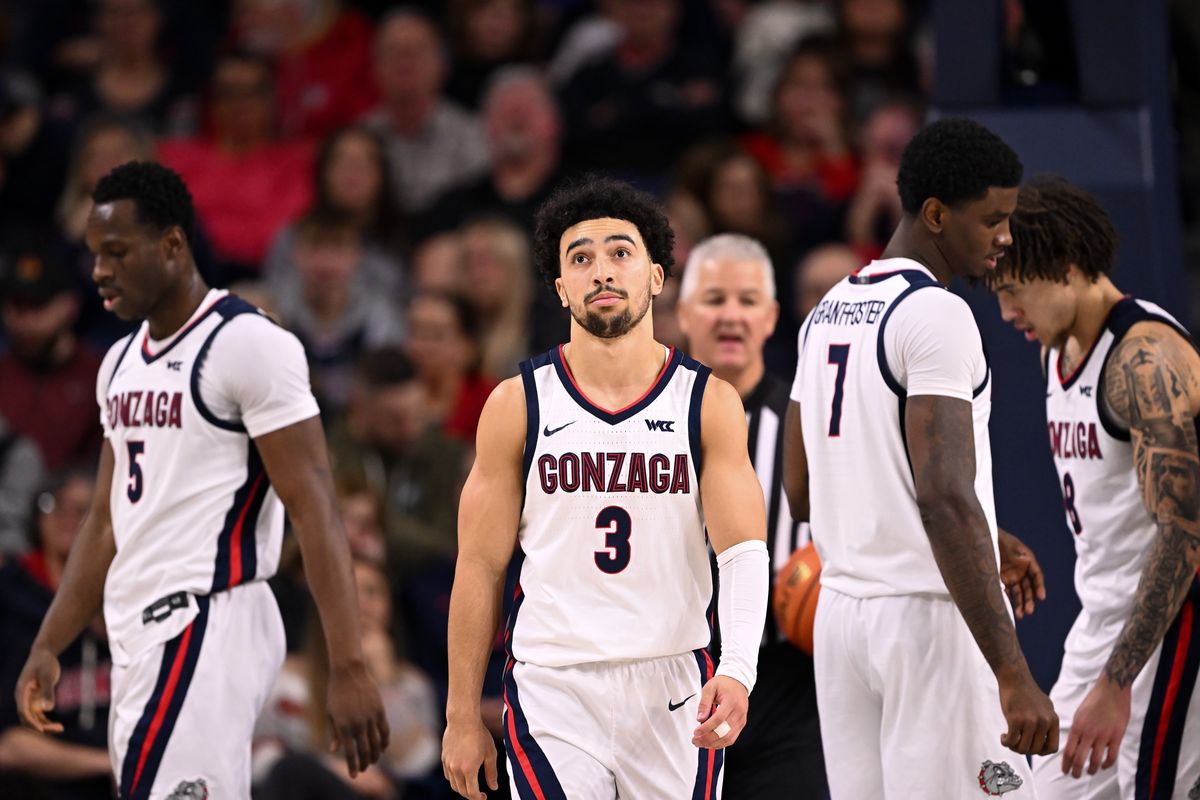
Without a traditional power forward/center, Gonzaga’s “small” lineup is still relatively big across the board, often featuring the 6-7 Warley alongside 6-7 Tyon Grant-Foster, 6-7 Davis Fogle, 6-5 Emmanuel Innocenti and 6-4 Mario Saint-Supery.
With almost no time to test it out, Gonzaga debuted the small-ball lineup against Seattle U, one day after the team learned Ike would miss time.
“No, we haven’t worked on it at all really, which is a credit to our coaches and the guys being able to adjust,” Warley said. “Those couple days before Seattle, we were putting in a lot of new stuff and we’re in the middle of January. I feel like we really embraced it and learned from it. So yeah, a lot of these reps have been in the game, kind of learning on the fly.”
Going small has paid off in a big way.
Gonzaga’s guard- and wing-oriented unit got decent run in games against Seattle U and Pepperdine, then stayed on the floor 32 minutes against San Francisco.
Advanced analytics could provide a more comprehensive look, but basic box score totals offer a good sense of what’s happening when the Zags switch to a small-ball lineup.
Point total is the first and most obvious indicator. Gonzaga averaged 91.1 points in the 19 games where at least one or both of Ike and Huff played, but the Zags have dipped to 74.3 points since both were sidelined. Without the gravity created by Ike and Huff, a Gonzaga team hovering at 35% from the 3-point line has made just 25% of its looks in the last three games.
Without 36 ppg from two All-American frontcourt players who command as much attention as Ike and Huff, the offensive regression is expected. The Zags can afford it, considering what’s transpired at the other end of the floor.
A much-improved Gonzaga team was allowing 67.7 ppg through the first 19 games, but Few’s small-ball lineup has turned the intensity up in three games since, allowing just 58.5. Longer, athletic wings give GU the ability to switch all five positions and opponents are struggling to get quality looks at the rim, if they get looks at all. Four straight WCC foes have committed at least 15 turnovers, with GU forcing 16.2 per game during that stretch.
It takes a number of things to make this work, but none have been more important than a small-ball center capable of handling bigger bodies in the post. Warley’s first challenge on that front was a Seattle U team featuring 7-foot Austin Maurer and 6-10 Houran Dan.
Seattle U capitalized on a few post-up opportunities, but the smaller Warley mostly held his ground and created enough chaos that the Redhawks eventually abandoned their bigs entirely and matched Gonzaga’s small-ball look the rest of the way. Warley’s ability to lead Gonzaga’s fastbreak offense was another key factor.
“They were trying to go to Maurer and you’re like, ‘oh no,’ ” assistant Brian Michaelson said. “Then next thing you know, (Warley) rips it away and we’re off to the races for a lay in. Then they had to go small and I haven’t seen them to do that. Then that obviously matched exactly what we wanted.
“So it was pretty cool that our small lineup worked enough to make them make the adjustment.”
San Francisco followed suit last Saturday, pulling 6-9 forward/center David Fuchs off the floor when Gonzaga sent Diagne to the bench. The Zags and Dons exclusively used small-ball lineups in the second half and Fuchs, who’d averaged 24.8 minutes in WCC play, registered a season-low eight minutes against GU.
The real litmus test will be Saint Mary’s, which gets 13.5 combined points and more importantly, 14.4 combined rebounds from McKeever and Wessels. The towering centers play 39.9 minutes per game, meaning one is on the floor at all times.
Gonzaga’s double-big look dictated many of the tactical changes Saint Mary’s made in the WCC title game. Struggling to score against Huff at one end and prevent him from doing so at the other, Murauskas, the league’s newcomer of the year in 2024-25, played only 14 minutes.
Ike’s health, first and foremost, will determine whether the Gaels see Gonzaga’s small-ball group on Saturday and for how long. Mark Few is scheduled to speak with reporters late Thursday afternoon and could provide more clarity on the forward’s status then.
If needed, the Zags will have the small-ball unit at the ready, with much more experience and comfort in the scheme than they did 12 days ago.
“I feel like we just embraced it and we’re getting better at it each and every day,” Warley said.