
A piece of wood and a string: Spokane-area bowyer teaches craft of traditional bow building
The first traditional bows David Young built blew up on him.
He was living in Moscow, Idaho, trying to learn how to turn a piece of wood into a functional hunting weapon in his one-bedroom apartment. But his first solo attempts bent when he pulled the string, sometimes exploding into a bunch of splintered pieces.
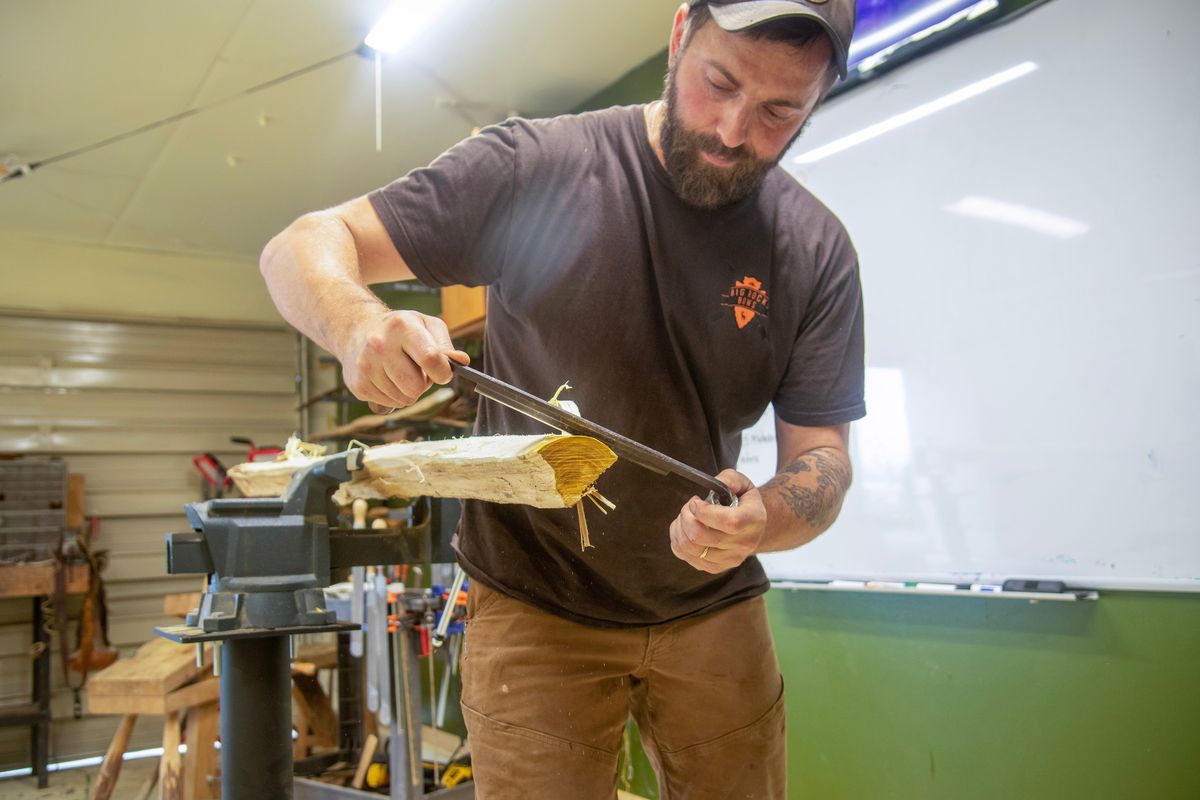
He had a lot to learn about letting the wood fully cure, about getting the design right, about letting a draw knife skate on a log to chase a growth ring. He had to learn how to not break the grain in the wood and let the bow tell him what shape it wanted to be.
“I wasted so much wood trying to figure this stuff out,” Young said.
Figure it out he did. Now, he wants to help others do the same.
Young is the bowyer behind Big Rock Bows, a bowmaking operation based near Valleyford where he makes 30 to 40 custom bows a year.
It’s also where he teaches bowmaking classes. Students come to the Big Rock Ranch and work in his shop, learning the process from someone who has scraped enough wood to become a master.
“You can blow through forums online and still not really understand it,” Young said. “There’s no replacement for having someone who knows what they’re doing looking over your shoulder.”
Young, 32, has been making bows for more than a decade. He was big into skateboarding when he was growing up on the South Hill but got into hunting after his mother married his stepfather and the family moved to the Valleyford area.
After graduating from Freeman High School, he worked a few years as a diesel mechanic. Then he decided to go to the University of Idaho to study wildlife ecology.
By the time he moved to Moscow, he’d been hunting with a compound bow for years. He got a job with the Idaho Department of Fish and Game, which is where he met Clay Hayes. Hayes, who now runs a popular hunting YouTube channel, introduced Young to the idea of shooting a traditional bow, and later the self-bow – a bow made from a single piece of wood.
Hayes has been making his own bows since 1999. He helped Young get started, both by giving him wood to work with and helping him understand the physics and geometry of the craft.
He said Young picked it up quickly. He also remembers how enamored Young was with the process.
“He … kind of went crazy with it and just started making bows out of everything he can find,” Hayes said. “I don’t know how many bows he made that first year, but it was a lot. It seemed like he was making bows every few days.”
For Young, the work of shaping a single piece of wood into a functional hunting tool just never got old.
“There’s no end. Just keep going,” Young said. “Every one you make for a while is just going to be leaps and bounds better than the one you made before. And then you get to the point with the design that you like or the style and you become a master at it.”
Naturally, Young also became a committed user of the bows. He hunts elk with them. He shot a bison with one, sending an arrow clean through the animal. Last year, he brought one to the Beaufort Delta in the Northwest Territories, where he was one of 10 contestants to appear on the most recent season of the History Channel survival challenge show “Alone.”
History is part of the appeal of the traditional bow. It’s the same kind of hunting tool that has been made for thousands of years.
Simplicity is also part of the appeal. A compound bow is a complex mechanical system using pulleys. A self-bow is just a piece of wood and a string.
Young’s students usually twist up their string from modern materials, which isn’t a knock against the natural options. He has made and used plenty of bowstring out of elk sinew. Thin fibers stripped from the stalks of stinging nettles work, too.
The wood starts as a stave, usually a quarter or half of a log. It can be cut from a variety of trees. Young has hundreds of staves drying in a shed next to his bow shop. Some are Pacific yew. Others are black locust. Some are osage orange, which he cut on a trip to Illinois with his family.
He’s always looking for more.
“If you’re smart, you cut a whole bunch so you never run out,” Young said.
The first thing his students do is pick a stave. Then they bring it into the shop, where the instructions they’ll complete are written on a whiteboard. They’ll strip off the bark, chase a growth ring, shape the edges and more.
It’s a slow process, especially for beginners. The shortest class Young offers is two full days. He also teaches three- and five-day courses. He is trying to schedule one class per month, and has one on the books for August.
Students stay overnight at the ranch while they work on their bows. When the work is done, they can test their bows on an archery course at the ranch. Before they leave, they sign their names on the shop wall.
Young still has a day job, working as a construction project manager. He doesn’t expect to make big money as a bowyer. But he likes being in the shop, and he likes helping others figure the process out.
“It’s a labor of love,” Young said.