How the 1994-95 Zags turned an 0-6 conference start into a WCC Tournament breakthrough | West Coast Conclusion

On a busy Saturday evening with tipoff time approaching, the Gonzaga Bulldogs set off for their pre-game meal – which was to be the usual 15 plates of pasta.
This goes back 31 years now in Santa Clara, California – before the West Coast Conference basketball tournament was a fixture in Las Vegas or the Zags became a fixture in the NCAA bracket. Trainer Steve DeLong was the Bulldogs’ travel czar in those days, and on this night he steered the team to a pho restaurant not far from their hotel.
“We always made fun of this, but you don’t mess with Steve-o,” recalled Scott Snider, a post player on the 1995 Zags. “They brought out just this nasty-ass pasta – I mean, it was horrible.”
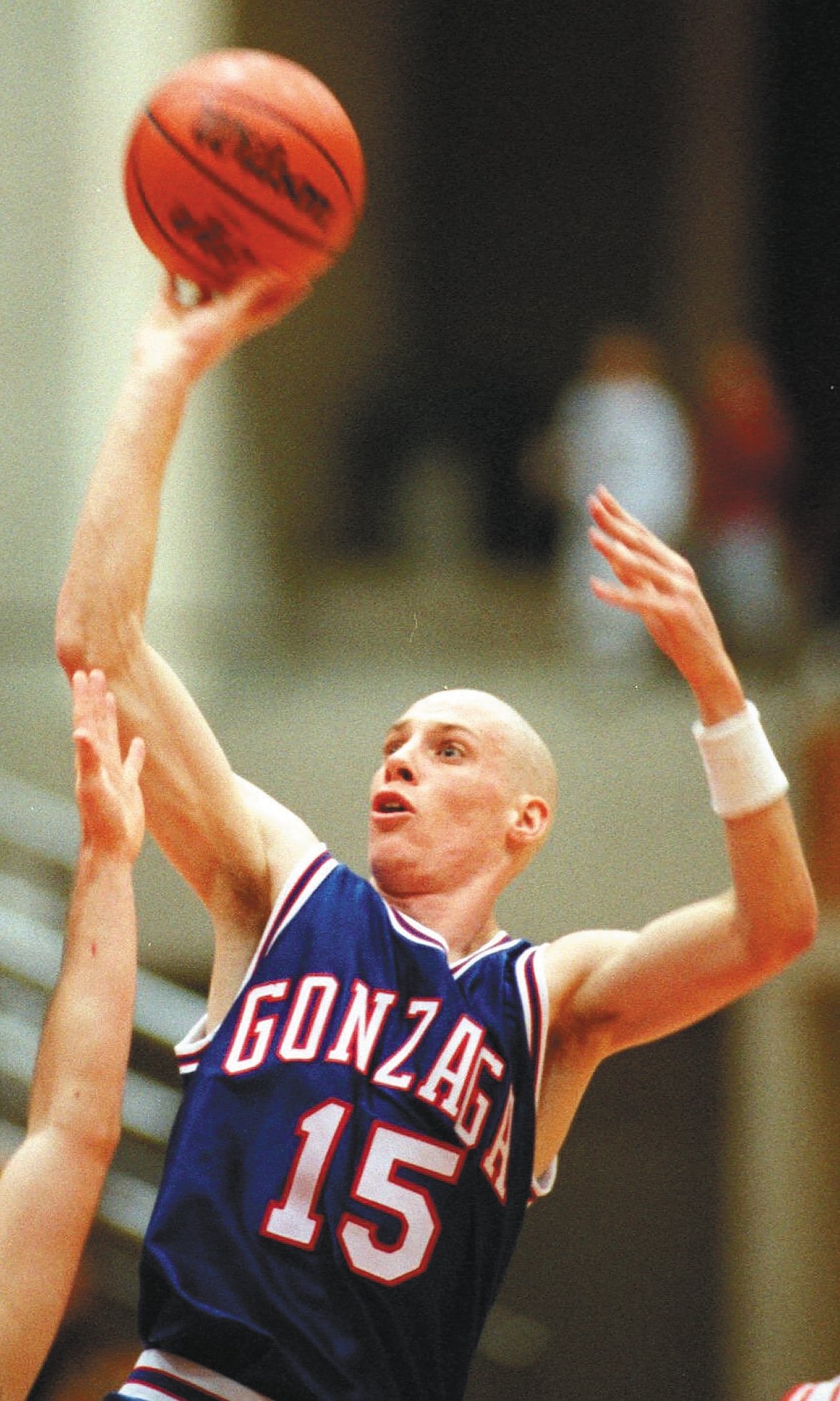
After which the Bulldogs motored over to what was then Toso Pavilion and saw bald-but-beautiful John Rillie go off for 32 points – making 8 of 12 shots from beyond the 3-point arc – in a 74-57 romp over San Diego in the first-round nightcap.
“So of course we’re stuck going back to that place three days in a row for pregame,” Snider said. “We were superstitious and didn’t want to change what was working.”
Fueling up for history, you take no chances.
•••
So it’s here – Gonzaga’s true basketball farewell to the WCC, 47 seasons after joining the lodge. Forty of those have concluded with a tournament to decide the league’s automatic entry to the NCAAs. The inaugural began with first-round games at campus sites (the Zags upset by Pepperdine that year). Then there was an uncodified rotation of hosts, which too often became what former GU coach Dan Monson derided as “the Santa Clara Invitational.” At last, neutral ground was found at the Orleans Arena in Las Vegas – which more often than not actually became the Gonzaga Invitational, the Zags having won 12 of 17 there, and 22 in their history.
But there’s never one like the first. And, truly, there’s never been a Gonzaga season like 1995.
There is a segment of Bulldogs fandom that assumes the school didn’t field a basketball team until 1999, when the magical run to the NCAA Elite Eight put Gonzaga in the national consciousness – and the local consciousness, too, for that matter.
“I know a lot of people think the Gonzaga thing happened overnight,” said Snider, who served as an assistant coach on that ’99 team. “But there’s an evolution to these things.”
At GU, it’s a winding one – from modest days in the Big Sky Conference, to the late 1970s and early ‘80s when the very notion of Division I athletics on campus was in financial peril, to the true foundational seasons when the Zags reached the WCC title game for the first time (1992) and then won the 1994 regular season championship – by four games – with a senior-laden lineup. But those Zags were upset in the WCC semifinals.
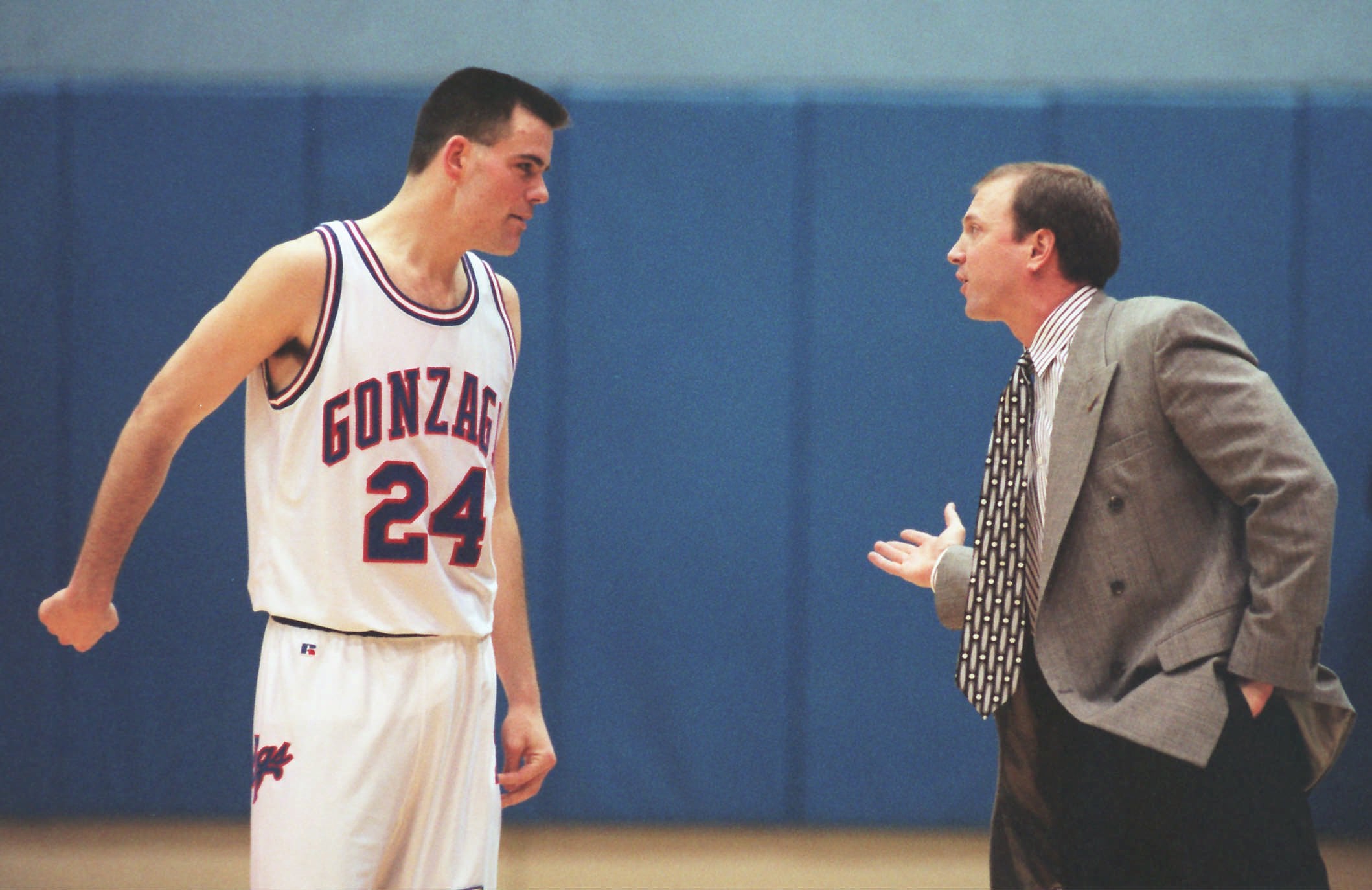
“That was going to be the team that would break through and make the NCAA Tournament,” said Jon Kinloch, a sophomore and the first guard off the bench in 1994. “There weren’t a lot of expectations for us the next season.
“But we had a group of guys with enough pride that we didn’t believe that to be true. We wanted to carve our own niche.”
And they seemed to be on their way, blitzing through the nonconference season 11-1. Granted, it was nothing like Gonzaga’s latter-day pre-New Year’s schedules – welterweights, rather than heavyweights. The most notable victim was Canisius, an eventual NIT semifinalist.
“And then we kind of fell off the edge of the earth,” said Jason Rubright, a captain in 1995.
To put it mildly.
The Zags came apart in the second half at San Diego in the league opener. They gave up 106 points at San Francisco. They saw a 34-game home winning streak undone in overtime against Santa Clara. By the time the calendar flipped to February, Gonzaga was 0-6 in WCC play.
Oh-and-six.
Naturally, this was a test on all sorts of levels. The Zags had led in each of the first four losses with seven minutes to play, so the c-h word was being heard, and not in whispers. Built around 3-point shooting – not the usual Gonzaga construct – the Bulldogs were connecting on just 27%. Head coach Dan Fitzgerald whipsawed from hang-tough support to gallows humor to grim hangman.
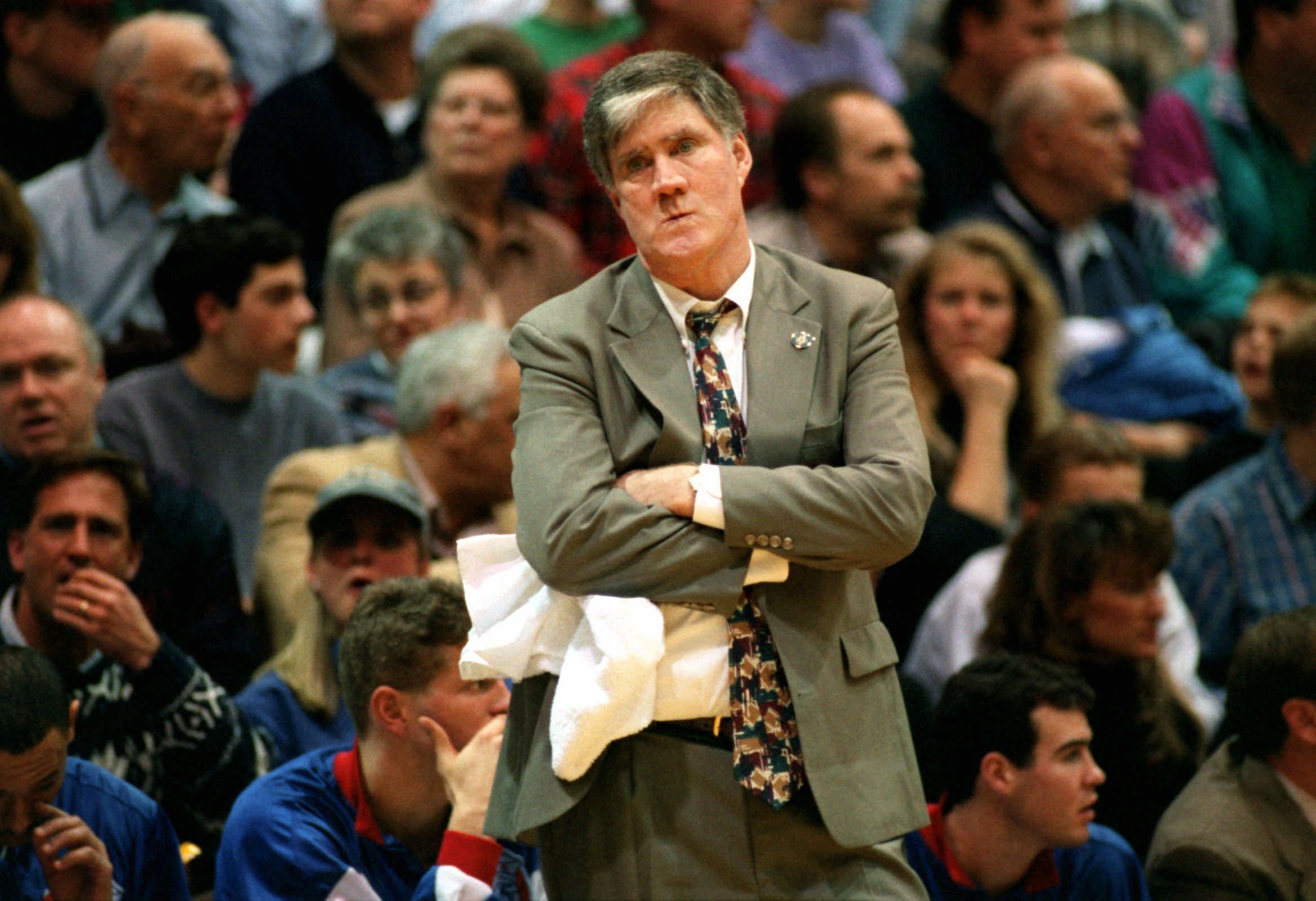
“I remember Fitz looking back at the year,” said Kinloch, “and saying, ‘I tried to hang myself and the rope broke.’ ”
“And I remember in the locker room after we lost the sixth game him telling us we were the worst Gonzaga team he’d ever coached,” Rubright laughed.
They weren’t. But with four starters graduated, role players were evolving into regulars. Snider and Paul Rogers, a talented Aussie unearthed by assistant coach Dan Monson’s father, were trying to fill the large shoes left by WCC player of the year Jeff Brown. The WCC schedule had been front-loaded with the best opposition. And trying to run the show was a junior college point guard from Oregon who’d actually quit the team in the fall.
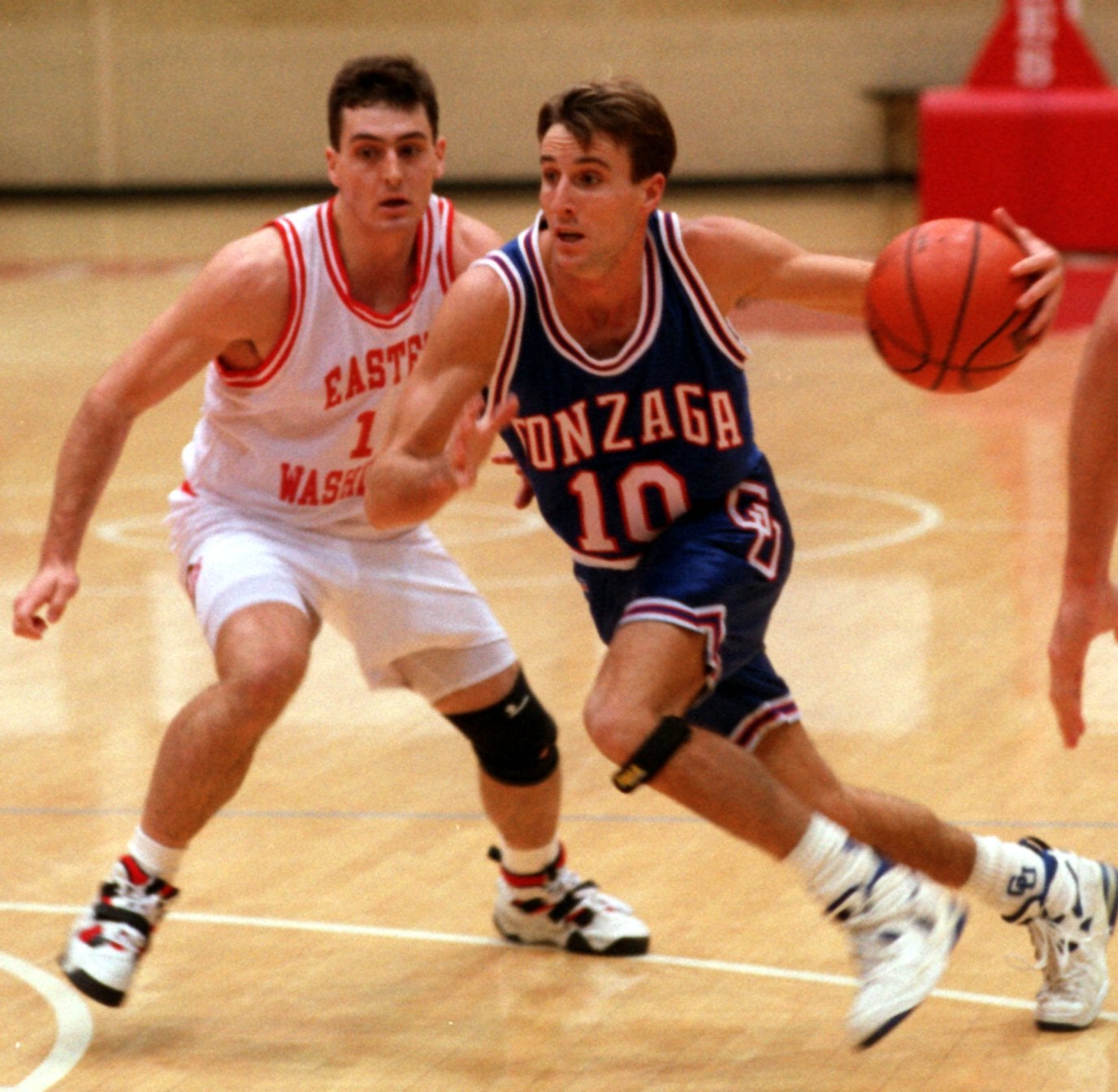
“Yeah, I bailed – took off back to Sisters,” said Kyle Dixon – who would crash the starting lineup and become an all-WCC player. “I was homesick and I wasn’t much into school. When I showed up at home four hours later my parents said, ‘Your coach has been calling for you.’ They gave me a day to get back.”
Fitzgerald even resurrected his ‘Bomb Squad’ notion that he’d first tried back in 1987 – subbing in the end of the bench line-change style for a two-minute shakeup.
“Which kind of embarrassed me because I was the sixth man and he’d run in seven through 11,” Snider said. “When he’d send the starters back to the scorer’s table to check in again, I’d be the only guy left on the bench.”
But the ‘95s did have something common to all Gonzaga teams.
“The word ‘culture’ gets bandied around a lot,” said Rogers, “and that place just has it. And that’s people, really – integrity in the coaching staff, the right guys recruited, standards. I remember Steve Hertz, the baseball coach, coming into the locker room after games and giving a cap to the player who showed the most fight. I had Goosebumps when I got one. That was something worth fighting for.”
When it all finally kicked in for the Zags, it came with the force of a mule. They won seven of their last eight, none of the wins particularly close. The true danger sign for opponents was the night GU made 22 3-pointers in blowing out USF – one shy of the NCAA record at the time, which would have fallen had Fitzgerald not told his guys not to run any more specials to get open 3s. Rillie had seven of those, and reserve David Cole six.
But Kinloch has a better memory of Rillie’s wanton 3-point itch – and the coming storm.
“Wendy’s used to sponsor the giveaway – free burgers for seven or eight 3s,” he recalled. “We fed a lot of students that year. Well, one game we were up 10 or 12 points – enough that the starters were still in but the game was on ice – but we hadn’t hit the threshold yet. It’s the last possession and the other team is just going to bring the ball in and run out the clock, except John steps in front of the inbounder and steals the ball, dribbles it out and shoots a turn-around 3 for burgers.
“That crowd had stuck with us and they just went wild.”
So did whatever part of America was watching a week later when the Rillie turned up on TV after that 32-point WCC Tournament opener and ripped it up for 30 in a semifinal win over Saint Mary’s and 30 more in the championship blitz of Portland. That was a record 96 points in three days, on 20-of-28 shooting from deep.
“I’d get a rebound a few feet from the rim,” Snider said, “and think, ‘Where’s John at?’ ”
The question is, why didn’t teams just start face-guarding him?
“They did, a little bit,” said Rubright. “The thing is, John kept scooting back. It wasn’t like it is now with guys shooting well beyond the NBA 3. They weren’t used to seeing someone with range like John.”
The Zags, of course, were very used to it – and how he’d honed it. Fitzgerald had to ban Rillie from playing noon ball with professors and grad students on game days. Rogers recalls his countryman showing up to practice with a black eye he’d sustained in a rec league game in town. Rillie could be found at midnight after games in the gym with manager Drew Dannels tracking down his rare rebounds.
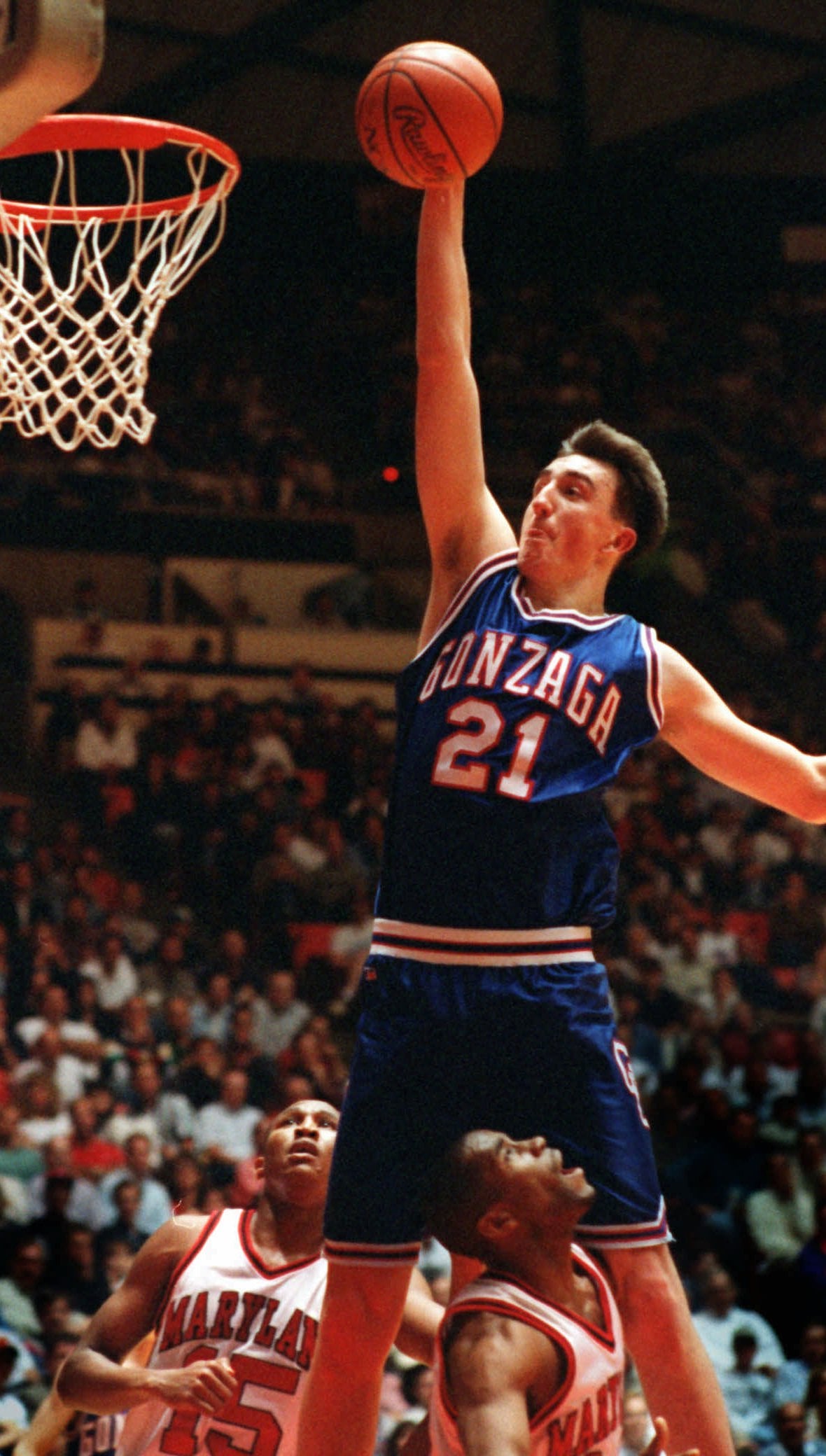
Though the Zags returned to a delirious campus rally that saw students hanging out of Desmet Hall windows, in some ways it took years to realize what had been accomplished. At the time only eight other schools with D-I roots stretching back at least 35 years hadn’t made it to the NCAAs (three of those – Army, The Citadel and William and Mary – still haven’t, in 86 years). That GU’s stay in the Big Dance was predictably short – as a 14-seed, they lost to Maryland in the first round – surely had an impact. Losing a title game rematch to Portland the next year was a sobering factor.
“I thought we had a better team and would win it again,” said Kinloch. “So enjoy those moments when you get them.”
•••
Rillie is now head coach of the Perth Wildcats in Australia’s National Basketball League. Rogers has been a long-time high school coach and helps with the women’s pro team. A couple weeks ago, the NBL held its MVP event at the Crown Casino that drew 1,500 people.
Rogers was getting dressed for it and, on a whim, decided to wear his WCC championship ring – just to show off.
“When I got home,” he said, “I couldn’t get it off.”
Even when Gonzaga joins new company next season, some Zags might find they have the same problem.