
‘Truly historic’: The Washington House approved an income tax on millionaires after a marathon debate
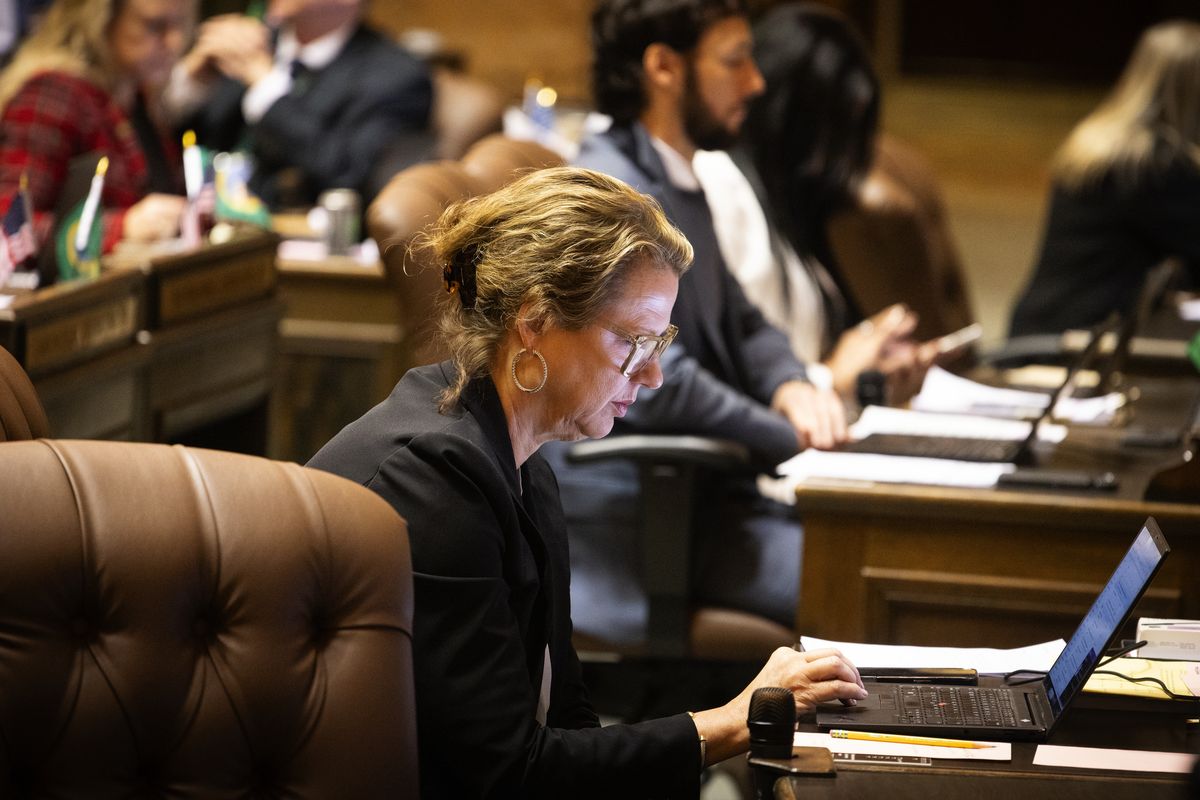
OLYMPIA – The faces of lawmakers were almost evenly split between excitement and despair Tuesday evening.
Ahead of the vote on an income tax on millionaires, state Rep. Matt Marshall, R-Eatonville, said it was a “dark day in Washington’s history.” Meanwhile House Majority Leader Joe Fitzgibbon, D-West Seattle, said state residents have waited too long “for a tax code that works for all of us.”
Washington is one of only nine states that doesn’t have an income tax, which supporters say leads to a “regressive” system in which residents of all income brackets make up for it with the same sales tax rate.
But as the clerk of the House announced the passage of the bill after more than 25 hours of debate a parade of nearly 80 amendments, the look of relief that the process was over was also apparent among just about everyone in the House chamber.
The legislation passed the House of Representatives on a 51-46 vote, with eight Democrats opposing alongside the 39 Republicans present in the chamber. The bill now returns to the Senate for confirmation since changes to the legislation were made in the House.
State Sen. Noel Frame, D-Seattle, told reporters the final vote in the Senate could take place as soon as Wednesday.
If it clears the finish line, the bill would impose a 9.9% tax on income starting on 2029 on joint filers or individuals above $1 million, with the money used to cut some other kinds of taxes, as well as boost spending.
Gov. Bob Ferguson, who announced last week he supported the framework lawmakers passed on Tuesday, watched from the wings of the House of Representatives as the bill cleared the chamber. The governor was greeted with jubilation from Democratic representatives as he walked into a closed-door meeting with the caucus shortly after the floor session ended.
Speaking to reporters after the meeting, the governor said it was an “exciting day.”
“What I shared with my colleagues is that it’s not too often in this line of work that you have a vote that’s truly historic,” Ferguson said. “And by any definition, that’s what this was.”
Ferguson said the extended debate on the legislation was “good for the people of our state to see.”
“Debate wasn’t cut off. I kept getting up in the middle of the night, every couple of hours, and they were still going,” Ferguson said. “And it’s also an example of what democracy looks like, and I appreciate that. I watched as Democrats and Republicans shared their perspectives, and I think the people appreciate that.”
The governor noted that less than 0.5% of residents would pay the tax, and that a “significant portion of the revenues” would go back to residents in the form of rebates and tax cuts.
Ferguson cited many of the provisions – including an expansion to the Working Families Tax Credit, universal free school meals for K-12 students, sales tax exemptions on diapers and over -the -counter medicine, and an increased tax cut for small businesses – as pieces of tax relief that “got me to the place of supporting it.”
As Republican lawmakers spoke on the House floor Monday into Tuesday, one of the most frequent concerns they raised was that the threshold for the tax will be ultimately lowered in the future. Ferguson said Tuesday he’s “not a big believer in the slippery slope argument.”
“I’ve been very clear that the million-dollar threshold is important,” Ferguson said. “That’s an important threshold to me, and it’s also one reason why I supported it.”
State Rep. Natasha Hill, D-Spokane, said ahead of final passage that similar taxes imposed in other states have improved infrastructure and state services without concerns of capital flight or a stagnant economy coming true.
“I vote yes for fairness, for economic justice, for the wheat farmers in Eastern Washington to the oyster farmers on the hood canal,” Hill said. “Yes for working parents who need affordable child care.”
State Rep. Jenny Graham, R-Spokane, who recently announced she would not seek re-election, said she plans to soon move out of state, in part due to cheaper medical care for her uncle, though she did not specify in her remarks where she would move to.
“I love this state. I hope the best for the state, for businesses, for people and for the future of Washington state. And I will be watching and praying,” Graham said. “I can’t support this today, based on the messages I’ve gotten from the people I represent. So, on behalf of them, I’m voting no on this policy today.”
Graham’s concerns over the legislation echoed similar remarks by other Eastern Washington representatives. State Rep. Suzanne Schmidt, R-Spokane Valley, said she had received more emails and comments about the tax than any other piece of legislation, with several constituents saying they would relocate across the border to Idaho.
State Rep. Hunter Abell, R-Inchelium, raised concerns the tax was unconstitutional and would “only cause economic damage.” State Rep. Joe Schmick, R-Colfax, said he’s worried the bill “will be the last straw.”
“And that we’re going to expedite that movement out of our small towns along the borders,” Schmick said. “And I guess the biggest thing I’m worried about is that, will this give a perception that business is welcome in Washington state, with the jobs that brings, or will it not?”
The vote followed a parade of discussion that began just before 6 p.m. Monday and ended just after 6 p.m. Tuesday. State Rep. Julia Reed, D-Seattle, said Tuesday that “however long it takes is however long it takes.”
“It is a big, historic change for our state. And like with any historic change, as badly as the majority party wants to accomplish this, the minority party wants to stop it,” Reed said. “And wants to retain the tax system we have, which is inequitable and unfair.”
Reed said Democrats had tools that would curtail debate and speed up consideration, though they have not used them, and would not do so unless a previous agreement was reneged on.
“We think that it’s really important; it’s important to the people of Washington. We feel confident that the people have our back, we don’t need to force the debate, we can let people have their say,” Reed said.
State Rep. Peter Abbarno, the House Republican caucus chair, said Tuesday morning the intention of the extended debate was to raise awareness of “the flaws of the bill.”
“The Democrats wanted to bring the bill up at night, knowing there were 80-plus amendments, and a bunch of them, 20 of them, were Democratic amendments. So, they weren’t all Republican amendments,” Abbarno said. “I think the point is to point out there’s lots of flaws in this bill, and flaws in the process.”
Abbarno said that the intention wasn’t to stall, but “if you’re going to bring up probably the largest piece of policy, tax policy, in the state of Washington in probably 100 years, you’ve gotta try to make it better or at least let the public know what’s in it.”
Abbarno said House Republicans received word late Monday morning that the debate would be brought up later that day.
“There was no notice, so there wasn’t any preparation,” Abbarno said. “I think the people in our district send us here to do a job, which is to make sure we talk about the bills and issues that are really important to them. And this is by far the most important one coming for southwest Washington.”
As the debate stretched into its 16th hour, lawmakers said they did not recall one of similar length.
“This is by far the longest debate I’ve ever been a part of,” Reed said. “I would guess that it’s the longest debate most of the members in the chamber have been a part of.”