
City, county announce plan to get clean water to those impacted by PFAS contamination near airport
Spokane city and county have announced a plan to get drinking water free of hazardous PFAS chemicals into the hands of West Plains residents near Spokane International Airport.
The Department of Ecology ordered the City of Spokane and Spokane County in February to provide uncontaminated drinking water to those people affected by the airport’s PFAS contamination. The two governments jointly own the Spokane International Airport, which had contaminated nearby groundwater with PFAS-laced firefighting foam.
Under the plan announced last week, the city and county will provide all affected residents access to the city’s clean water fill station on Garden Springs Road. Large food-grade plastic containers will also be provided for residents to transport the water from the station to their home.
Known as “forever chemicals,” perfluoroalkyl and polyfluoroalkyl substances are a set of human-made chemicals used in thousands of products over the decades. High levels have since been linked to cancers, heart disease, high cholesterol, thyroid issues, low birth weight and other diseases.
The presence of the hazardous chemicals in West Plains residential water after years of runoff from firefighting foam at the airport and nearby Fairchild Air Force Base has been the subject of an ongoing cleanup effort.
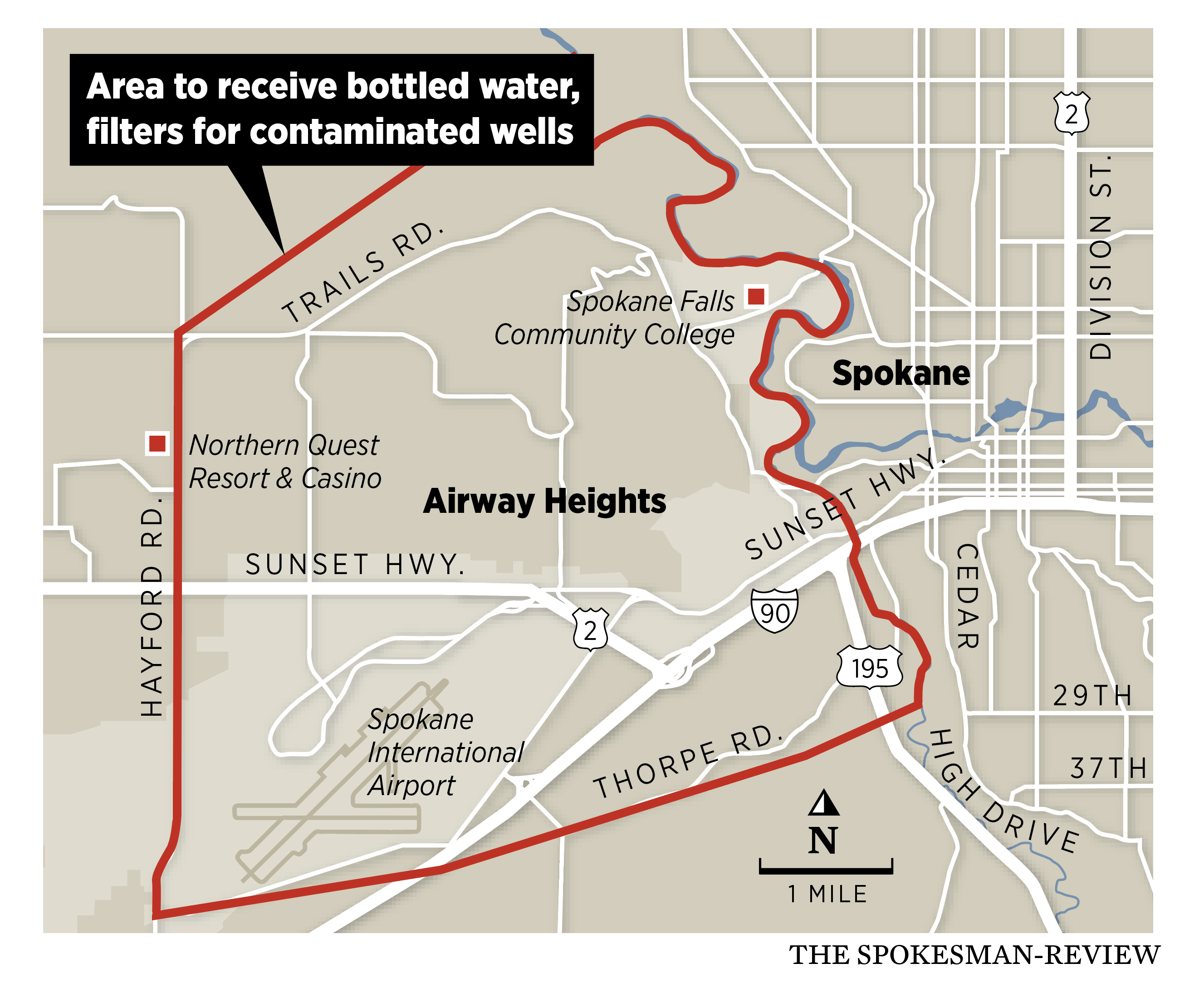
A test showing PFAS contamination on the resident’s property will not be required. Anyone who lives within the PFAS-contaminated area determined by Ecology is eligible. That area runs from west of the Spokane river and east of Hayford Road, north of Spokane International Airport and mostly south of Trails Road.
According to the city and county, approximately 900 parcels of land have been identified within this area. Properties with active wells there will also be eligible for PFAS testing, if they have not yet been tested.
In a statement, Spokane International Airport CEO Dave Haring called the plan a “meaningful step forward” in the PFAS cleanup.
“While we continue to work towards a longer-term, data-driven approach, we also recognize residents’ concerns and desires for access to clean water,” he said.
Spokane Mayor Lisa Brown said in a statement that her administration is working with the county and airport to implement the plan.
“With this plan, we are prioritizing public health and safety for members of our community who need clean water,” Brown said in a statement.
In a presentation to City Council on Monday, Public Works Director Marlene Feist said the water fill station would be a “bridge” towards the instillation of point-of-entry filtration systems on the properties of affected homes and businesses.
These filtration systems will be provided through a $7.5 million state grant to the county and implemented by June 2027. The county also plans for further testing to determine which homes have contaminated well water.
Spokane County Commissioner Al French said instillation of these filtration systems will begin later this year.
“By expanding sampling of private wells and providing clean water options, we are reducing exposure risks while gathering the data necessary to understand the extent of these ‘forever chemicals’ in our groundwater,” French said in a statement.
The plan still has to be approved by Ecology. According to the latest order, the agency has determined the PFAS contamination had impacted nearby groundwater at “levels exceeding safe drinking water standards.”
West Plains Water Coalition President John Hancock said the proposed plan is “very impressive” but gives the credit to Ecology more than the governments announcing it.
“This is just a follow-through to confirm the order that has been negotiated for the past couple of months,” Hancock said. “But I’m really impressed by it, and ecology has really put the hammer down on the airport to get serious about the implications on the whole 900 homes nearby. It’s really a serious remedy.”
Hancock also noted that these actions could have happened much sooner if the airport had not fought Ecology’s cleanup order.
“The airport has still not admitted they did anything wrong,” he said. “They make excuses and continue to ignore the neighbors.”
Hancock noted there has been much greater communication from the city and county.
Feist said she expects Ecology to approve or ask for modifications to the plan in coming weeks. Once approved, residents can call 311 to set up an account with the water fill station.
When this interim action is in place, another plan to eventually remove the contamination is ongoing. But a long-term fix is many years away.