
February 21, 2010 in Business

Spokane Valley business vacancy rates rise as city struggles to develop a growth plan
By The Spokesman-Review
 

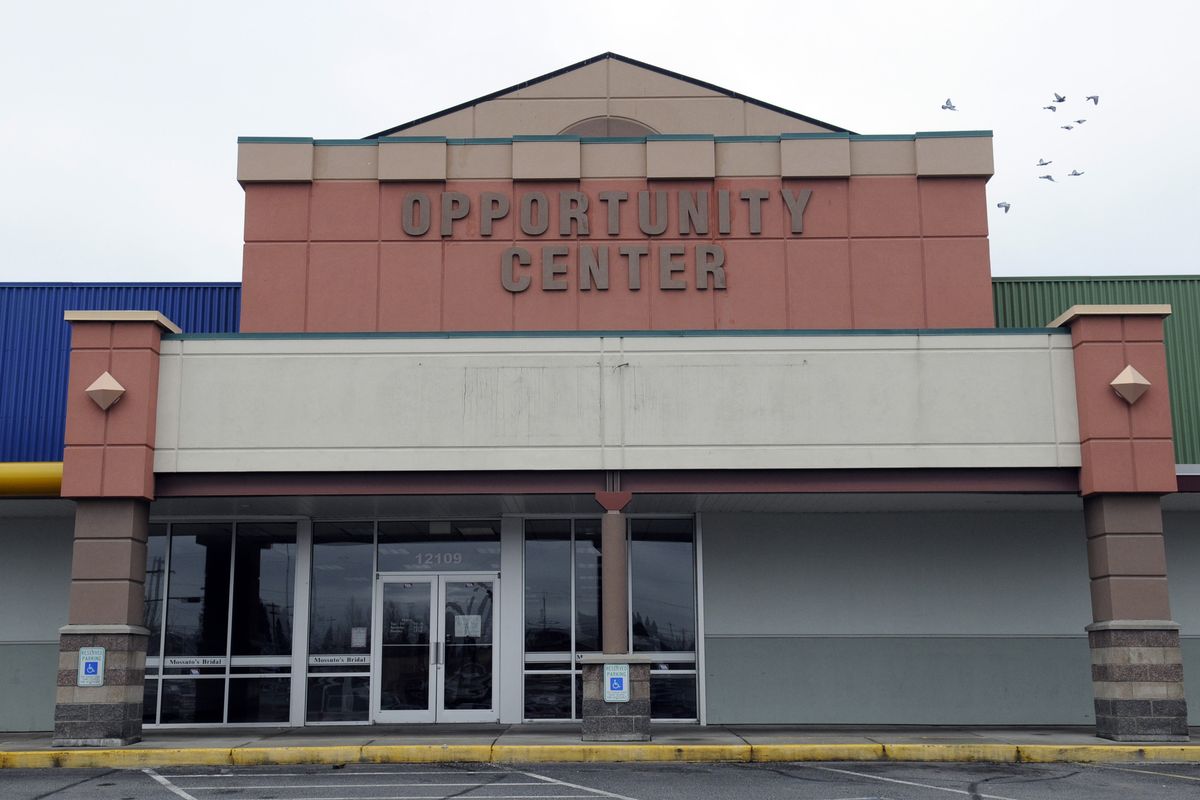
Pigeons circle over the half-vacant Opportunity Center strip mall at the corner of Pines and Sprague in Spokane Valley.
(Full-size photo)(All photos)

Map of this story's location
ADVERTISEMENT
Advertise Here

‘For lease” signs dot both sides of East Sprague Avenue in Spokane Valley like dandelions springing from the sidewalks.

The former National Golf store has been empty for more than two years. The old China King Buffet across the street is vacant and for sale. KFC recently closed one of its two stores on the business strip. The former Old European Breakfast House, Jo-Ann fabrics, Complete Suite Furniture and Albertsons locations – all empty.

Property owners, leasing agents and real estate experts agree that the vacant storefronts and offices are a reflection of a historically bad economy – but many believe that isn’t the whole explanation.

Spokane Valley’s retail vacancy rate is higher than anywhere else in the county except for the West Plains, which has a small amount of retail space, according to data from Auble, Jolicoeur & Gentry, a real estate analysis and appraisal company in Spokane. Last fall, Spokane Valley’s rate was just under 11 percent, compared with just under 6 percent on the South Hill and 9 percent on the North Side. Another study by Spokane real estate company Kiemle & Hagood Co. found that the vacancy rate for office space in the Valley was nearly 22 percent last year, versus about 12-13 percent in the south, north and west areas of Spokane.

Some of the reasons cited for the disparity include lower population per acre than, say, the North Side and an explosion of newly constructed retail and office space in the Valley over the past decade. At least as important, though, is the uncertainty surrounding the direction of the city of Spokane Valley, a number of people interviewed say.

Future of revitalization plan in doubt

For some Sprague Avenue businesses, the uncertainty began before the city of Spokane Valley was incorporated in 2003.

Spokane County’s construction in 2000 of a couplet that turned Sprague one-way between University Road and Interstate 90 was largely opposed by businesses within the one-way zone and largely supported by commuters.

Then last year the Spokane Valley City Council formally adopted the Sprague-Appleway Revitalization Plan after three years of work and around a half-million dollars in consulting fees.

The plan originally sought to turn Sprague back into a two-way thoroughfare, although it was later modified. It also adopted controversial new zoning along the entire Sprague Avenue corridor, designed to make its “shabby visual character” more attractive and pedestrian-oriented. Critics claimed the plan “down-zoned” many properties, converting them from commercial to residential or mixed uses, and that although current uses were grandfathered in, hundreds of businesses became nonconforming, making it potentially harder to attract tenants or obtain bank financing and insurance.

Now, a new City Council majority elected in November has put the future of the revitalization plan in doubt. Dean Grafos, one of four new council members, has proposed scrapping the plan and rolling back zoning changes to the zoning in place in 2003, when the new city came into being.

Grafos says he’ll introduce those ideas in upcoming council meetings.

‘Don’t leave me in limbo’

All of this activity has some business people saying, enough.

“Give me certainty,” said Carlos Landa, part-owner of a strip mall at Sprague and Pines that has several empty storefronts. “Just make a vision and stand by it.” Without certainty, he added, retailers are “going to go look for less risk” elsewhere.

Although a supporter of the revitalization plan, Landa said he could live with another strategic direction as long as he knew what to expect.

“Don’t leave me in limbo like you have for the last 10 years,” he said of the City Council. “If I’ve lost the retail and I need to redevelop that center for another use, I can do it. But don’t leave us up in the air for another four years.”

Longtime commercial real estate broker Marshall Clark, who represents several vacant spaces on East Sprague, didn’t support the revitalization plan and welcomes the new council majority.

But he said much the same thing as Landa regarding Spokane Valley.

“Ever since they formed the city they’ve been unsettled … . All the cities are struggling, but they are struggling the worst because they don’t know what they want to be when they grow up,” Clark said.

Said Jim Magnuson, a Coeur d’Alene lawyer whose family owns University City shopping center, “Any time you’ve got uncertainty as to the direction of municipal or governmental regulations, people are not going to want to invest money in growth.”

Let the free market develop

Grafos said he understands the frustration; he’s a Valley business owner himself.

“You need to give property owners and citizens a sense that if they invest today, their investment is protected 20 years from now.” Unfortunately, he said, “there really is no way of doing that.”

He believes the best thing the city can do is roll back the changes that have been made and get out of the way of businesses.

“I feel that the free market should develop those properties,” Grafos said.

But Dick Behm, like Landa a member of the Spokane Valley Business Association, which supported the revitalization plan, said changing course now would create a lengthy disruption.

“Those things don’t happen overnight,” Behm said. “It has to go back to the planning department, you’ve got to have public meetings, comment periods – it would take a year to do it.”

‘Mom and pops’ favor East Sprague

No matter the political outcome, any improvement in the economy is expected to fill at least some of the vacancies along East Sprague.

A loosening of credit could make money available to start-up businesses as well as to building owners for use in sprucing up tired properties, said Scot Auble, of Auble, Jolicoeur & Gentry.

East Sprague, once the Valley’s business center, has become a magnet for smaller, local “mom and pop” businesses since the Spokane Valley Mall opened in 1997, said retail real estate broker Carl Guenzel, of Kiemle & Hagood.

“They still like to be on Sprague because it’s a little closer to the population,” he said. They also typically weren’t able to afford rents in the pricier spaces in or near the mall, but that’s changed because of the down economy, Guenzel said.

“Rental prices are coming down everywhere,” he said. “There is a domino effect.”

Rusty Barnes, whose family owns the building at Sprague and Farr that used to house National Golf, said he doesn’t know what it will take to fill his space. He thought WinCo opening a grocery store across Farr would be a draw, but “nothing, nothing at all.” As a real estate agent and investor, Barnes said he’s used to “brutal” market conditions, but he has found Spokane Valley especially grim.

“We just keep sinking further and further behind,” he said.

Jayne Singleton, director of the Spokane Valley Heritage Museum on East Sprague, said whatever it takes to revive Sprague, it can’t come soon enough.

Looking at the gaps in the once-thriving business district “kind of gives you a sick feeling in your stomach,” she said.

14 comments on this story so far. Add yours!
  • zelda on February 21 at 1:01 p.m.

    Very good story, Addy. Thank you. By odd coincidence, last week I told some friends in California that my next dystopian photo series will be the “Urban Decay Tour 2010” of East Sprague. (A companion piece to photos of foreclosed houses in my neighborhood and things people leave behind or choose to strip.) The area east of Pines has a stark, creepy, derelict vibe that speaks volumes about Spokane Valley’s economy and lifestyle. It used to be that blight crept eastward, displaced by urban renewal. Now it’s one long strip of decay.

    A couple of issues not mentioned in the article: 1) the types of businesses that do occupy many E. Sprague properties – seedy pawn shops and payday loan operations, 2) retail troubles that existed long before the Great Recession, specifically University City and 3) the possibility that Spokane Valley is simply over-stored relative to the income of its residents.

    Mom-and-Pop stores may be all well and good, but the ones I’ve seen make me wonder if they’re front operations for some other kind of activity. Even when empty stores are eventually occupied, the types of businesses are several steps down from the former retailers. What was once Valley Best Buy Hardware is now the Union Gospel Mission Thrift Store and what once was Red Wing Shoes is now a bead store and some other outfit with an indecipherable homemade sign. In the middle of this scene of blight sits a Chase Bank branch, which once was Washington Mutual.

    Valley incorporation’s vision for the future had only an economic upside and no flexibility to manage a downturn of small proportions, much less one of this magnitude.

  • killq on February 21 at 2:32 p.m.

    Biggest mistake in a long history of mistakes for the Valley. Not going to argue whether incorporation was a good or bad idea…I think the jury is still out on that one…but the Appleway cutlet was the dumbest thing ever done in this county. It single handedly destroyed every business on Sprague Avenue. The inmates run the asylum in this town…voters, take note…the council and the commissioners need to be run out of office until people who understand business are in charge.

  • westerly on February 21 at 3:16 p.m.

    The area is still “Dishman”. Just huge demographic, social changes that are happening in Spokane Valley and Spokane. Poverty, no jobs, grand visions by Valley leaders who believed futuristic renditions of the valley. Many hundreds of thousands of dollars spent on these back east urban prophets to make the Spokane Valley council feel good, warm and fuzzy. It will never happen untill major companies that employ thousands come here….don’t hold your breath.

  • edmitch on February 21 at 3:40 p.m.

    Zelda - excellent observations and comments on the Spokane Valley situation. I agree.

  • zelda on February 21 at 3:43 p.m.

    “…major companies that employ thousands” are a thing of the past. If they have thousands of employees the people most likely are in China or India. There are zero incentives for U.S. companies to have large numbers of employees.

    Better for Spokane to develop itself as a center of expertise. What that expertise is — beyond power generation — is beyond me. But I’d rather they look to researchers from our state-funded funded universities for ideas instead of paying private consultants for dreamscapes that they’ve probably sold to a dozen other gullible towns.

    I forgot to mention tattoo shops and nail salons. Those are other burgeoning, mainly cash mom-and-pop industries along E. Sprague. It’s an economy built on taking in each other’s laundry.

  • actionjackson on February 21 at 3:51 p.m.

    Mrs. Jayne Singleton singlehandedly screwed up access to THREE businesses with her ugly, pathetic “fence” that she had installed at the Museum…I will never go there again and am angered every time someone has to either wait for someone to go through the alley or back up to let someone through…What a terrible waste of either taxpayer or museum trustees’ money…What a pathetic waste…She said, “…whatever it takes to revive Sprague, it can’t come soon enough.” I think the first step to reviving Sprague would be to remove the fence.

  • yahoo98 on February 21 at 4:42 p.m.

    In addition to the businesses Zelda Krup mentions, adult entertainment shops also seem to be thriving on Sprague. Why do we give these types of businesses a free pass to post vulgar advertisements on their signs? This can’t be good for maintaining a family oriented climate in the valley. East Sprague Avenue will always have a reputation as a seedy part of town as long as these shops are allowed to exist. At the very least, they need to be pressured to clean up their signs.

  • HankTingler on February 21 at 5:15 p.m.

    Another result of the Obama economic stimulus package?

  • SPOKANITE on February 21 at 9:07 p.m.

    The disinvestment in that corridor is astounding. Six miles of commercial nothingness. The uncertainty Mr. Grafos has interjected into the market by attempting to mothball the revitalization plan will only ensure one thing: investment will be elsewhere.

    As a resident of Spokane I want to thank the new Spokane Valley City Council and especially Mr. Grafos as I’m sure we’ll capture some of that investment and the future sales tax revenue that will come with it.

  • zelda on February 21 at 9:55 p.m.

    Maybe this is proof that Spokane really can aspire to be like Seattle. Now we have our own version of Aurora Avenue North.

  • vistadome on February 21 at 10:23 p.m.

    Hey..I remember back in the 70’s in the valley, you drove down Pines road south, then you made a right turn on sprague and hit all the stores, U-city, you name it. It was all there. Then construction boomed east on sprgue to Sullivan and then north to the Valley mall. Now we make a left turn on Sprague and head east and north on sullivan. Will U-city and East Sprague ever come back to what is was? No….never will…look at Francis avenue up north…still ugly with all the old store fronts. Unfortunately when the new Spokane Valley city was born, we really did not have a city, or a city downtown. We just had urban sprawl..it’s kinda like old 99 north in Seattle….how could you make a city out of that area??
    Good luck to the “city” council..they have nothing but an uphill battle to resurrect East Sprague and the U-city area.

  • palouse509 on February 21 at 10:30 p.m.

    Most of the problem is Taxes are too high, Prope3rtry owners charge too much for space rent, Spokane salesa tax needs to be lowered by 1%. Or Spokane needs a total rebuild so business will come and attract the people. To be quite honest I hate Spokane because it is too hickish and outdated.

  • lbbnjsharpe on February 22 at 5:15 a.m.

    I think the ” free equal speech ” corporatism should gain honorable mention. Big W. and Costco strive to sell goods near cost. Costco capitalizes on membership.
    How does the little guy or gal compete with the big volume sellers & their lobbyists ????

  • Pat O'Leary on February 22 at 4:50 p.m.

    Nice try tingler. Spo Valley has been pretty much under the thumb of the repugs for many years. City council, county commission, and yes, I’ll even throw in Shrub. Obama didn’t create this mess….mostly caused by lousy zoning decisions over a period of many years. The citizens didn’t want a city out there…oh God no….no curbs, no sidewalks, no intelligent zoning, and this is what you end up with. A giant mess that there appears to be no easy or cheap cure for.

You must be logged in to post comments.
Please create a profile or log in here.