
Putin’s anti-NATO attitude backed by much of Russia

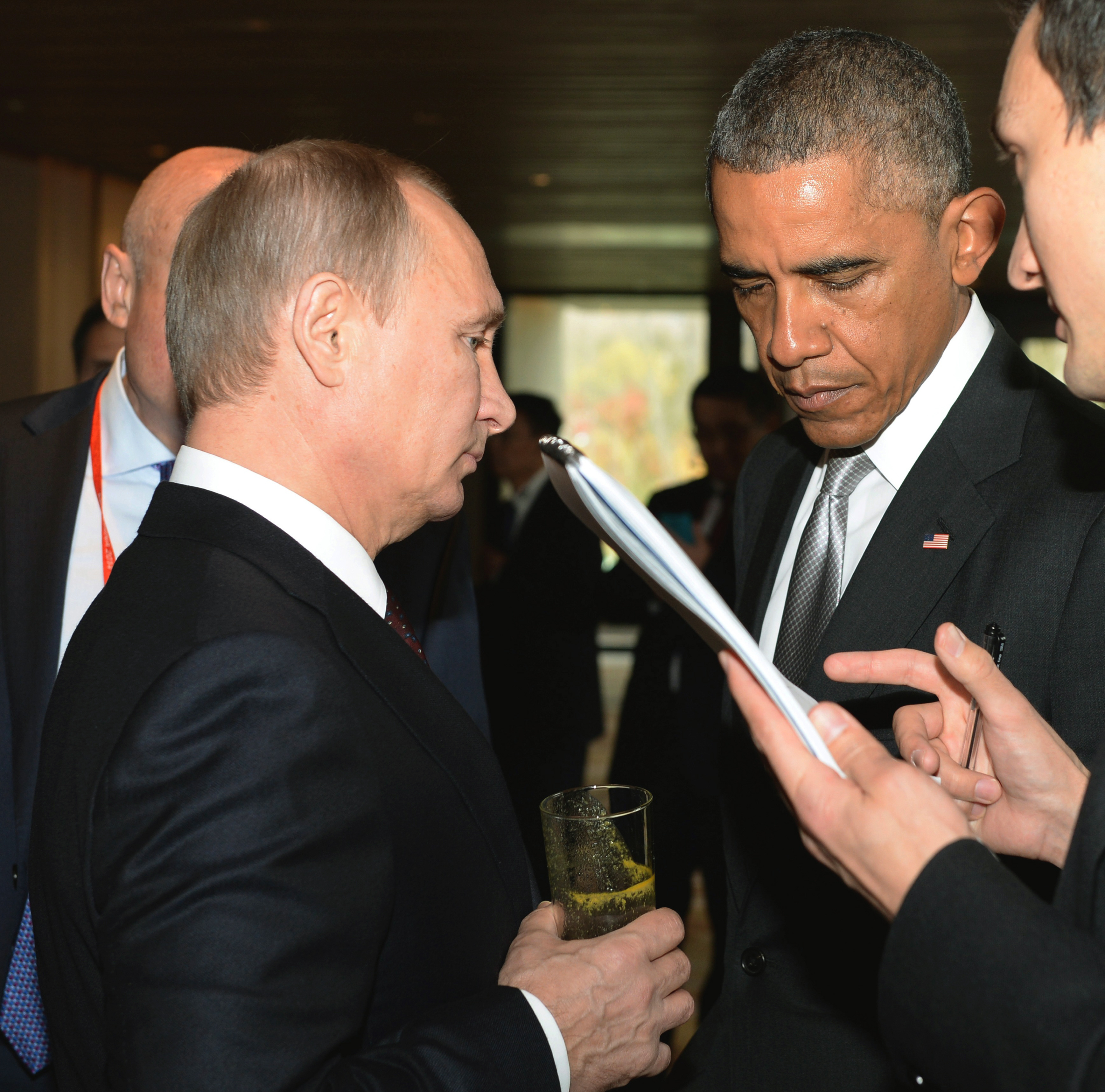
Russian President Vladimir Putin had an opportunity to lobby for easing international sanctions against his country last month when European and Asian leaders gathered for a summit in Milan, but for his most crucial meeting – a sit-down with German Chancellor Angela Merkel – he showed up four hours late.
He’d been in Serbia watching a parade.
Putin also missed the welcoming toast for a dinner of more than 50 leaders, striding in at the middle of the European Council president’s opening remarks.
Putin has been behaving lately like a man who has lost faith in diplomacy, who is convinced that the world has realigned itself into a shape fundamentally hostile to Russia.
NATO expansion
Key to the Russian leader’s increasingly adversarial dealings with the West, analysts say, is the deep sense of betrayal Putin felt when NATO reneged on what Moscow believed was a promise never to extend into the former Soviet sphere of influence in Central and Eastern Europe.
Not only have the former Soviet republics of Latvia, Estonia and Lithuania now joined the greatly expanded Western military alliance, but another former republic, Georgia, is in line for membership.
The Kremlin was outraged last month when Bulgaria signaled it was contemplating the purchase of European-made jets to replace its aging Russian-made fleet.
Bulgaria, Russian Deputy Prime Minister Dmitry Rogozin said on Twitter, had decided “to once again betray Russia … in favor of second-hand eagles.”
Backed into a corner
Putin has been lashing out on the political and security fronts, the analysts say, because he despairs of getting European or U.S. officials to consider the post-Cold War strategic realignments from the Kremlin’s point of view.
He expressed his disdain for United Nations and Western views on his support for separatists in eastern Ukraine by ignoring their warnings that Nov. 2 elections for leadership of the occupied “republics” were a breach of international law and likely to intensify fighting. Fresh incursions by Russian armored columns into Ukraine were reported last week by NATO and neutral monitors of the Organization for Security and Cooperation in Europe.
And on Wednesday, Putin’s defense minister announced that nuclear-capable long-range bombers would resume patrols off the U.S. Atlantic and Pacific coasts.
A proud nationalist committed to protecting Russians who now find themselves in neighboring countries, Putin may have given up on playing by rules written, in his view, by gloating adversaries who consider themselves the Cold War’s victors and Russia’s historic sphere of influence their spoils.
“Russia has been pushed into a corner, and that is a most dangerous situation,” said Anna Vassilieva, a scholar of Russian and Ukrainian history at the Monterey Institute of International Studies.
Putin is “showing the world that he’s in control,” she said, “warning everyone not to think that the bear is asleep.”
Self-fulfilled fears
Ironically, the moves Putin has made to thwart Ukraine’s drift toward the European Union have spurred a crisis of insecurity throughout the former Eastern Bloc and brought to Russia’s doorstep exactly what Putin views as the most serious threat to his nation’s interests: the North Atlantic Treaty Organization.
Polish President Bronislaw Komorowski early this month signed into law a fundamental shift in defense policy that will redeploy forces from the country’s western regions to its border with Russia. The move was cast as a necessary response to Russia’s aggression against Ukraine.
War games last month in Poland and the three Baltic states that were once part of the Soviet Union brought 700 NATO soldiers and state-of-the-art armored fighting vehicles to Russia’s northwestern border in what alliance officials said was a reminder to Moscow that any attack on members of the alliance would be fiercely repelled.
Ukraine realignment
Perhaps most unsettling for Russia, former ally Ukraine is now openly seeking membership in NATO, in search of reliable defense against its newly hostile neighbor. A majority of the deputies elected Oct. 26 to Ukraine’s parliament ran on the message that force had to be met with force.
But the calls for beefed-up defenses from alarmed nations in what used to be the Soviet orbit threaten to undermine post-Cold War agreements, signed and informal, that promised respect for sovereign borders and restraint in deploying military forces in a threatening manner.
The confrontation between Russia and the West is the result of a “clash of perspectives,” said Joshua Shifrinson, an associate professor at Texas A&M’s Bush School of Government and Public Service. “The United States and its allies believe NATO can expand, that the Western sphere of influence can expand, and as long as conversations with the Russians and diplomacy continue that the United States can have its cake and eat it, too.”
Shifrinson has researched recently declassified documents that he says show that U.S. and European leaders, during 1990 talks on German reunification, offered assurances to Soviet leader Mikhail Gorbachev that NATO wouldn’t expand eastward.
“Once the USSR went the way of the dodo and the United States was the only superpower standing, it had strong reasons to see the deals of 1990 as having been overtaken by events,” Shifrinson said.
But Putin genuinely feels encroached upon and done wrong by the West, a sentiment that is real whether justified or not, he noted. NATO extended membership to former Warsaw Pact allies Poland, Hungary and the Czech Republic in 1999, and five years later inducted the former Soviet republics of Latvia, Lithuania and Estonia, as well as former East bloc allies Slovenia, Slovakia, Bulgaria and Romania.
The last straw for the Kremlin was Ukraine’s plan last year to enter an association agreement with the European Union, which Putin saw as the precursor to joining the neighborhood’s stampede to rival NATO.
“Russia did not have the right to dictate Ukraine’s alliances. At the same time, can you imagine how the United States would react if Russian or Chinese forces suddenly set up in Canada or Mexico?” Shifrinson asked.
The West’s refusal to see the Ukraine conflict through Moscow’s eyes threatens to leave the aggrieved Kremlin leader with a sense of having nothing to lose by flexing his muscle elsewhere, Kremlinologists warn.