
Hillyard brownfield receives federal grants
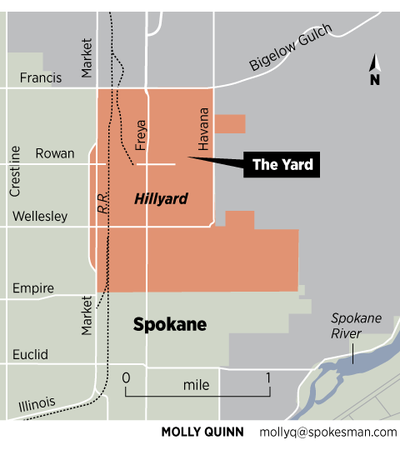

The city of Spokane got another big infusion of federal funding toward its effort to clean and redevelop industrial land in the Hillyard area, a former railyard that has sat polluted and nearly abandoned for 50 years.
Two U.S. Environmental Protection Agency grants totaling $400,000 were awarded to the city Thursday for petroleum and hazardous substance testing in an area known the Yard, a 500-acre site in northeast Spokane. The city and the Northeast Public Development Authority are attempting to redevelop it into a new heavy and light industrial center.
“Right now is really an exciting time as we look to the future of northeast Spokane and the Yard, in particular,” said Mayor David Condon in a statement. “The opportunity to clean up and reuse brownfields is huge. We are confident these grants will help jump-start redevelopment in the Hillyard area.”
The grants awarded Thursday are part of $54.3 million in EPA funding headed to almost 150 communities nationwide. Spokane still is waiting to hear about a $300,000 grant for the Yard aimed at environmental assessments and planning.
The Yard generally is north of Garland Avenue and east of Market Street, near the uncompleted North Spokane Corridor. The area sits near a Class 1 rail line and U.S. Highway 395, a designated North American Free Trade Agreement corridor. The city anticipates the area will be attractive to heavy freight users when the freeway is complete and is attempting to remove contamination and build the infrastructure needed for industry.
Anthony Carollo, chairman of the Northeast Public Development Authority, applauded the grant, calling it a first step toward outfitting the area with basic services.
“The infrastructure is really lacking: streets, sewer, water,” Carollo said. “Businesses don’t want to locate on a dirt street without sewer or water.”
The grants come less than three months after another $200,000 EPA grant was awarded to the city for the same area and with the same purpose of cleaning up brownfields.
Teri Stripes, an assistant city planner with the city, said the grant awards show that Spokane is on the right path with its planning for brownfields, which are sites suspected of contamination with potential for economic development.
“It is blighted, it is depressed and it needs to redevelop and create additional jobs,” Stripes said. “That’s the neighborhood’s vision. That’s the city’s vision. And that’s why it’s been received so well at the state and at the federal level.”
Earlier this month, the City Council unanimously supported the creation of the Hillyard Industrial Area Brownfield Opportunity Zone, the first of its kind in the state. The new designation will help guide cleanup efforts in that area.
The area serves distribution centers for Safeway and URM Stores, plus Philadelphia Macaroni Co., Food Services of America Spokane and Powers Candy & Nut Co. Stripes said the city didn’t intend to lure just one large employer there. Instead it aimed to host many more businesses and create up to 10,000 new jobs.
According to the state Department of Ecology, cleaning a brownfield site can take up to five years, and one job is created for every $15,000 to $59,000 spent on remediation.
Carollo said he believed a redeveloped Hillyard industrial area would replace what has long been lost.
“The railroad used to provide somewhere in the neighborhood of 5,000 jobs, historically. Kaiser-Mead probably had something like 5,000 jobs,” he said. “That whole northeast center has been hammered by job loss, without any job creation. We think this industrial area certainly has the potential to provide what was lost.”