
Inside Trump’s decision to deploy the National Guard in D.C.
Even before he took office, President Donald Trump had an informal playbook for how he would use the powers of the presidency to take control of the District of Columbia, with options prepared for him such as deploying more federal law enforcement officers or taking over the entire municipal government.
The only questions, according to two people briefed on White House deliberations, who spoke on the condition of anonymity to detail private conversations, were which option he would choose and when he would opt to implement it.
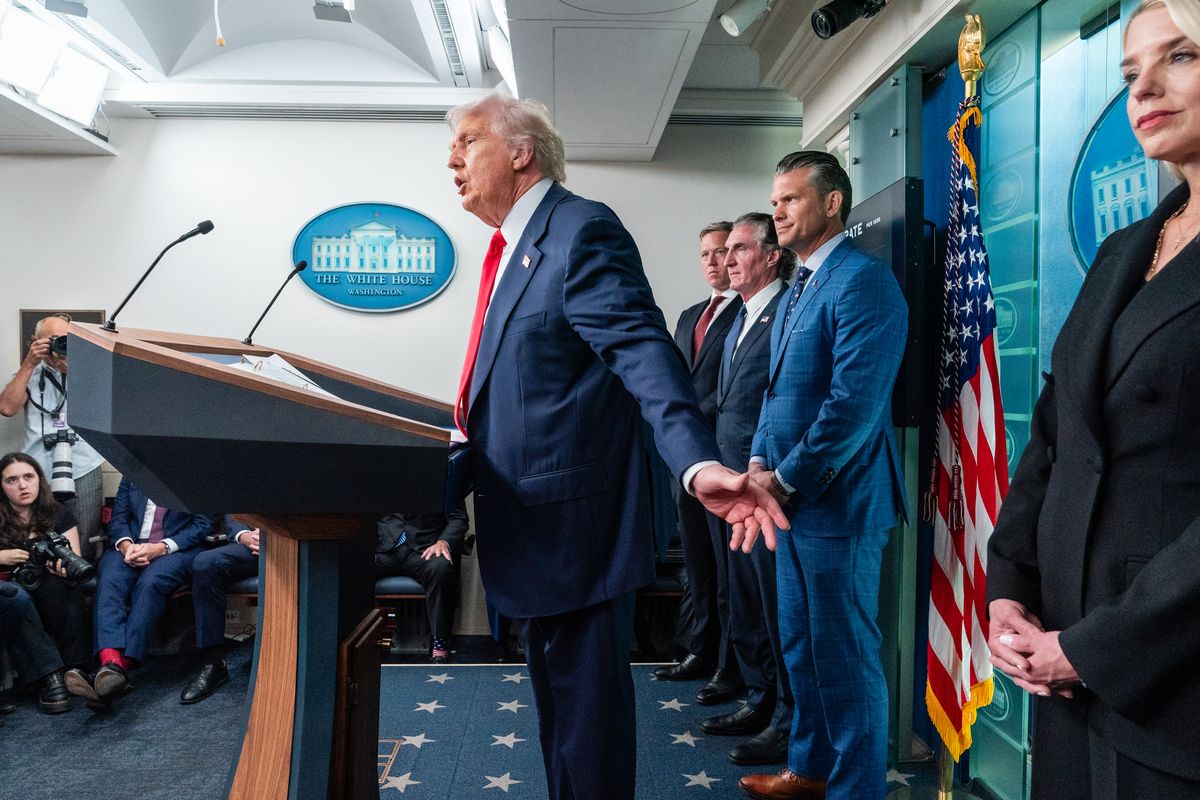
Those questions were answered Monday morning, when Trump federalized the D.C. police department and authorized some 800 National Guard troops to patrol city streets alongside its officers. Speaking to a packed White House briefing room, he gave them a far-reaching mandate to clear homeless encampments, make arrests and “to do whatever the hell they want” in curbing crime - an exertion of executive power never before attempted by any U.S. president in modern history.
In many ways, Trump’s directive, backed by several signed executive actions, was the culmination of years of complaints about the nation’s capital and a stated desire to rescue D.C. “from crime, bloodshed, bedlam and squalor, and worse,” despite a dramatic drop in incidents of violence year-over-year. But in a more narrow sense, it appeared to be a response to one specific crime, an attempted carjacking that took place in the early hours of Aug. 3.
The victim in that incident was Edward Coristine, a protégé of Elon Musk and former U.S. DOGE Service staffer known by the nickname “Big Balls.” Coristine had become well known among top White House officials, including Deputy Chief of Staff Stephen Miller, and the attack on him quickly resonated throughout the West Wing. A frustrated Trump posted a bloodied picture of Coristine to social media in the aftermath, raising what might happen to D.C. if it didn’t “get its act together, and quickly.”
In the eight days that followed the attack, Trump refocused his attention on D.C. He enlisted Attorney General Pam Bondi to oversee the D.C. police and Defense Secretary Pete Hegseth to call up the troops. Jeanine Pirro, who was recently approved as the District’s U.S. attorney, was prepared to increase prosecutions.
“We will have full, seamless, integrated cooperation at all levels of law enforcement and will deploy officers across the district with an overwhelming presence,” Trump said Monday during a lengthy news conference.
A White House official, speaking on the condition of anonymity to offer additional context, said that the attempted carjacking of Coristine underscored the importance to what had been a long-standing promise from Trump to address crime in Washington.
He had walked up to this line before, threatening a takeover during the summer of unrest in 2020, but D.C. officials talked him down with warnings that such a heavy-handed and unprecedented approach would only exacerbate tensions in the city.
This time, his administration was less candid with city leaders.
He had returned to office with plans well in hand for how to meet such a moment, according to the two people. That playbook for asserting more control ranged from leveraging federal resources to ending home rule altogether. Federalizing the police was seen as a middle-of-the-road option.
Trump had openly opined about a takeover for years, remarking in 2023 during a visit for the CPAC convention in the National Harbor that “the roads and highways were littered with trash like I’ve never seen before.”
“It looked like somebody just took their garbage and just threw it all over the highways, the Beltway. It’s so disgraceful, so disgusting,” he said, complaining at the image it sent to visiting foreign leaders and floating the idea of the federal government taking control of the city. “I always made it a point as president, when I saw the highways were dirty, or that the homeless encampments were starting to form to take care of the problem immediately.”
During the Republican National Convention, he referred to the District as “a horrible killing field,” and the party’s national platform included promises to “reassert greater Federal Control over Washington, DC to restore Law and Order.”
But in the first few months, the relationship between Trump and D.C. Mayor Muriel E. Bowser (D) was surprisingly strong. He complained about some of the homeless encampment near the E Street Expressway leading to the White House and State Department, and she promptly responded. She had the city paint over the bright yellow letters spelling out the words “Black Lives Matter” that she had ordered painted on the ground just steps from the White House during his first term, another act that earned good will.
Still, Trump’s interest in reforming the city remained, according to multiple White House officials. Frustration grew within the administration as city officials were seen as not sharing enough information with federal law enforcement, one of the people said, and not getting rid of every homeless encampment as Bowser had promised.
About a month after Trump took office, he again said the federal government should take over the city: “I like the mayor. I get along great with the mayor, but they’re not doing the job,” he told reporters on Air Force One. “Too much crime. Too much graffiti. Too many tents on the lawns of these magnificent lawns, and there’s tents.”
Because D.C. is a federal district, the D.C. National Guard is appointed by the president and can be deployed without the consent of city officials.
The law allows Trump to take over the city’s police force for 48 hours and extend it to 30 days if he notifies the members of Congress who oversee D.C. affairs. He would need congressional approval to extend that emergency any further. Because the law is broadly written, all Trump had to do was determine that “special conditions of an emergency nature exist.”
While overall crime has been down, several high-profile incidents have distressed Trump.
Trump on Monday referred to the killing of a 21-year-old congressional intern in June by a stray bullet near the Walter E. Washington Convention Center. He mentioned Michael “Mike” Gill, 56, a former D.C. election official who was shot and critically wounded last year in downtown Washington during an hours-long crime rampage in the District and Maryland.
Trump also remarked about a staffer for Sen. Rand Paul (R-Kentucky), who was nearly killed in a random attack in D.C., and a 3-year-old girl who died on the Fourth of July weekend.
“It’s becoming a situation of complete and total lawlessness, and we’re getting rid of the slums, too. We have slums here,” Trump added, without providing details. “I know it’s not politically correct. You’ll say, ‘Oh, so terrible.’ No, we’re getting rid of the slums where they live.”
Last week, days after Coristine’s attack, Trump ordered federal law enforcement agents from several agencies to be deployed throughout D.C. and called for more juveniles to be charged in the adult justice system. In the days leading up to Monday’s announcement, the FBI began dispatching agents in overnight shifts to help local law enforcement address carjackings and violent crime.
Still, D.C. officials, who had been working for months to coordinate with the White House, were caught by surprise by Trump’s announcement, said Bowser, who at a news conference described pleading her case to Trump personally. In their first meeting after Trump took office the second time, she said, they spoke about the city’s improved efforts in combating crime.
“In every conversation I have with him, we’re always briefing the president on our progress,” she said Monday. “We went over the crime trends. We went over how we’re seeing decreases. So the president is read in on our efforts.”
Bondi has not met with the police chief, but had been expecting and prepared for Monday’s announcement, according to two people familiar with the matter, who were not authorized to speak publicly. Terry Cole, the head of the DEA and the newly named commissioner of the D.C. police, met on Monday evening with D.C. Police Chief Pamela A. Smith.
Cole told Smith that “the federal team involved in this know that they don’t know the city, and they are looking for [the D.C. police department] to lead” the effort, said a D.C. police official who was not authorized to speak publicly. An administration official disputed that Cole had said federal officials did not know the city and that D.C. would lead the partnership, but said that he had relayed a desire for a collaborative relationship.
Smith tasked her No. 2, the widely respected Executive Assistant Chief Jeffrey Carroll, to lead the relationship between D.C. police and their federal partners, the D.C. police official said.
An influx of arrests could hamstring an already understaffed U.S. attorney’s office in D.C., which has seen dozens of prosecutors leave this administration. The U.S. attorneys office said Monday that it would be able to handle all incoming cases.
The mayor said Monday that she had one call over the weekend that indicated Trump would deploy the National Guard but did not have reason to believe that the president would place the D.C. police under direct federal control.
“I’m going to work every day to make sure it’s not a complete disaster,” Bowser said at the Monday news conference, as she sought to downplay the impact of the takeover. “So we are going to work, every day, to get this emergency put to an end.”
She paused briefly and added, “I’ll call it the so-called emergency.”