
Trying to bring back ring glory
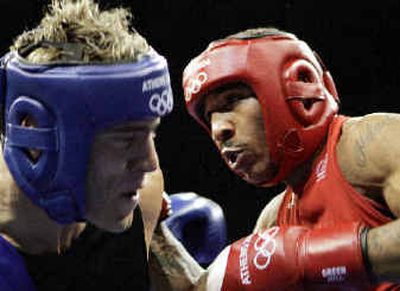
ATHENS — There was a time when the U.S. Olympic boxing team was like Andre Ward. It couldn’t lose.
American fighters helped drive Olympic television coverage, and fed the professional boxing beast. Their bouts were events. The memories they generated had the impact of a wicked right cross:
George Foreman waving the American flag; Sugar Ray Leonard with his girlfriend’s picture taped to his sock; Leon Spinks, pounding on the Soviet fighter. And Howard Cosell at ringside, in a mustard-colored blazer and at his imperious best, calling the action.
They were the stars of tomorrow, today. There was no end to the good times.
And then — they ended.
In 1976 the U.S. boxing team gave us Leonard, Leon and Michael Spinks, and five gold medals. In 1980, Americans led a boycott of the Moscow Olympics. In 1984, the U.S. won 11 boxing medals — but that was the year the Soviet Union led a boycott of the Los Angeles Games.
American fighters won three gold medals in 1988, and have won just two in the three Olympics since. In 2000, they established the gold-less standard, failing to win any of the 12 weight classes in Sydney.
Ward, of Oakland, Calif., among others, aims to reverse the trend.
“I feel like everybody (on the U.S. team) can win a gold medal,” Ward said Thursday, after defeating Italy’s Clemente Russo in his first match of the 2004 Games.
You’d be hard pressed to find a better catalyst for change than Ward. He’s mature by Olympic boxing standards — 20 years old. He’s been boxing since he was 9, and hasn’t lost in the ring since he was 14.
He withdrew from a fight (before it started) earlier this year, because of an injured hand. Technically, that counts as a loss. On a practical level, he can only estimate where his win streak stands at this point (somewhere around 90), and then only when he’s inclined.
Thursday, he wasn’t inclined.
“I’m trying to look forward, not back,” he said.
Brave man. Looking back would have been the easy call, especially considering the manner in which Ward dispatched Russo. After a slow first round, Ward gained confidence, began slipping punches at will, and scoring them with regularity.
He built a big lead through three rounds, and stayed out of harm’s way in the fourth, winning with 17 punches scored to Russo’s nine.
“He just boxed,” U.S. coach Basheer Abdullah said when asked what he liked about Ward’s victory. “I thought he used his jab well. He used the ring when he needed to use it.”
Ward’s win, coming after an unwanted first-round bye, advanced him to the quarterfinals. Six American fighters are still alive in the competition. Three have been eliminated including light welterweight Rock Allen, who was defeated by Bulgaria’s Boris Georgiev.
Ward fights again Wednesday night, and here is where looking ahead comes at a cost. His next opponent will be two-time world champion Evgeny Makarenko of Russia. Makarenko is a 6-foot-6 brute who pounded his way past Cuba’s Yoan Pablo Hernandez.
At 6 feet, Ward isn’t exactly oversized for a light-heavyweight. So how does he plan to compete with someone half a foot taller?
“I have no idea,” he said. “I have to sit down with my coaches and come up with a strategy. He’s the world champion. He’s supposed to be the favorite for the gold.
“He’s not the first big man I’ve fought. I’ve fought giants all my life.”