
Leading the way

Jaime Deacon has been involved in 4-H for so many years that, she says, “If you poke me I would probably bleed green.” 4-H green is familiar to most people as the color of the well-known 4-H clover. The emblem also includes a white letter “H” on each of the four leaves. Deacon began 4-H as a 10-year-old and has been involved continuously for 19 years. Eight of those years have been as a leader in the dairy cow, sheep, dairy goat and pet goat divisions.
“When I look back at my years in 4-H, I realize and appreciate how much responsibility those experiences have taught me,” Deacon says.
4-H is an experiential education program for all youths from the city or country and all racial, cultural, economic and social backgrounds. Members are between the ages of 8 and 18, or are still in high school.
They’re the kids who populate the fairgrounds’ barns and arenas with their rabbits, sheep and pigs during the North Idaho Fair and Rodeo, which starts Wednesday and continues through Sunday. They also helped prepare the grounds for this year’s fair.
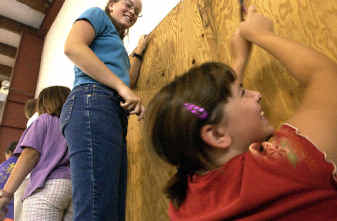
Deacon was joined recently by Joy Crupper, an 18-year 4-H leader, and other 4-H leaders, parents and members of the Mountain Gem 4-H Club to pull staples and paint walls in the Jacklin Building at the Kootenai County Fairgrounds.
It’s just one of three Community Pride Projects Mountain Gem will complete this year. They already held a Rathdrum Cemetery clean-up, and in October, they will raise money for St. Jude Children’s Research Hospital during the Saddle-Up for St. Jude Ride.
Each 4-H club is required to complete Community Pride projects, which are seen as opportunities to give back to others, says Jim Wilson, Area 4-H/Youth Extension Educator.
“Developing a spirit of caring for others and service to the community is one of the cornerstones upon which our 4-H/Youth Program is built,” Wilson says.
Crupper started Mountain Gem 4-H Club with five members in 1998. The club has grown to 25 members, ranging in ages from 6 to 16.
“Joy has a great love for 4-H,” Maryalyce Manning, 4-H leader/parent, says. “She keeps the club going even though her own children are no longer involved.”
Crupper’s daughter, Jennifer, is now a 4-H leader herself.
“Our members learn practical life skills, often not taught in school. They gain valuable experience in leadership, citizenship, working together as a team, and public speaking,” Crupper says.
A University of Idaho 4-H Impact Study conducted in the fall of 2002 revealed just how important 4-H is to the positive development of young people. The research showed that youth involved in 4-H were significantly better off than youth who did not participate in the program.
While about 11 percent of Idaho youth are not involved in any out-of-school activities or programs, 4-H youth are very involved.
The majority of all Idaho 4-H members — 68 percent — were involved in up to four out-of-school activities. They were more likely to do better in school, hold leadership positions, and be involved in activities that give back to their communities and others.
4-H youth were also significantly less likely to take illegal drugs, smoke, drink alcohol and shoplift.
“We always thought that 4-H was making a difference in the lives of young people; now we have the facts that support those claims,” Wilson says.
Emily Aizawa, 11-year-old treasurer of the Mountain Gem 4-H Club, has had to keep track of the club’s funds and says , “I have learned a lot about math like how to deposit and write a check.”
Emily’s father, Brent Aizawa, a parent/volunteer, who was helping club members pull staples, says those involved in 4-H learn a lot about integrity and responsibility.
“They become better people, are more confident and more responsible.”
4-H literature says, “It is better to build a child than to mend an adult. This in a nutshell, is the main objective of the 4-H program.”
A 4-H project is a series of educational experiences that support members in developing life skills in a focused area of interest. 4-H members are expected to attend club meetings and participate in activities and club projects.
Each member chooses a project that fits their individual interest, home situation and ability. Projects vary in difficulty according to the age and experience of the member. Most projects have nominal cost and provide real-life experiences.
4-H members learn decision-making skills through project work, judging contests and other 4-H activities. They have opportunities to gain recognition for their work by exhibiting at the North Idaho Fair and Rodeo.
Many receive ribbons, certificates and achievement seals to acknowledge their accomplishments.
4-H also offers the Cloverbuds program for 5- to 8-year-olds who are pre-4-H age. It is designed to meet the developmental characteristics of young children. It emphasizes cooperative learning, excluding competitive events.
Wilson says 4-H is for youths who want to participate in a stimulating atmosphere to develop life skills. It is also an opportunity for families to grow together.
“One of the greatest benefits of the 4-H/Youth Program is that it brings families together,” Wilson says. “Guidance by adult volunteer leaders and parental support, help youth to achieve success and personal growth through hands-on experiences.”
Idaho 4-H history began as early as 1911 when public school teachers were encouraged to make education more practical. Early clubs, like garden and sewing clubs, were formed and are considered the forerunners of Idaho 4-H.
By 1915, 9,565 boys and girls were enrolled as members of potato, corn, poultry, pig, bread, sewing and canning clubs. The clubs grew so rapidly, a field person was needed to help organize clubs and assist members.
In 1915, the Idaho Legislature passed legislation enabling Idaho to use the Agriculture Extension Service.
Eventually, the State Board of Education transferred the boys and girls clubs from the State Department of Public Instruction to the newly organized Extension Division of the College of Agriculture. Dan E. Warren became Idaho’s first state 4-H Leader in 1942.
Thanks to people like Crupper and Deacon, 4-H continues to work.
“If you really love it, you never leave,” Deacon says, flashing a big smile.