
He’s hard to label
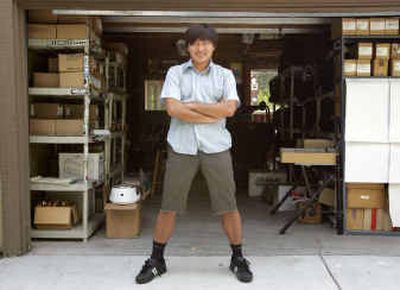
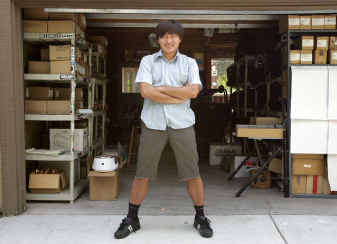
MONTE SERENO, Calif. — San Jose’s Mike Park is one of the most unlikely record executives in the country. He’s hardly known in his hometown, but is internationally recognized and respected for putting out quality albums by bands who later make it big. Over eight years, the 34-year-old has quietly sold an astounding 2 million discs out of his parents’ Monte Sereno, Calif., garage through his Asian Man Records label. Park — a musician himself — has stuck to his beliefs, insisting that things be done his way: He will produce discs only for bands that, like the title of his own recent solo album, play for “the love of music,” not just money. In a business with a 95 percent failure rate, Park is the West Coast’s version of Buffalo’s Ani DiFranco, the performer and entrepreneur who has been hugely successful despite turning her back on the mainstream music industry. He believes in the do-it-yourself punk rock ethic, and regularly turns down offers that could make him rich. “Money, I realize, is a necessary evil, but I think it drives people in the wrong way. I try to stay away from it,” says Park, who lists as one of his best accomplishments the fact that everyone who has worked for him has received a health care plan. “I sign people who are making music to make a statement. A lot of times I go about finding bands with the knowledge that this won’t sell, but I don’t care. The fun is putting out what you like.” “Today, what he has done is a huge success,” said Mark Bliesener, the author of a guide to the music industry called “The Complete Idiot’s Guide to Starting a Band.” “Records aren’t selling the way they used to. People are getting their music in other ways, and it’s not a matter of course that you will sell a few hundred thousand units of anything. If you can sell 2 million discs, especially with a small company that doesn’t have a huge overhead, that’s a great accomplishment.” Small being the operative word. Park’s company has one full-time employee, Mya Osaki, who handles accounting, graphics, answering phones, advertising and the Web site. Then there is his mother, Sonia Park, who picks up the mail at the Monte Sereno post office, makes lunches and furnishes the garage. “I think some of the general public have the wrong idea and believe we’re this huge record company with tons of employees,” Park wrote on his Web site, www.asianmanrecords.com. “But we’ve only got one phone line (with no call waiting), a fax machine, and just recently purchased a second computer.” His own musical accomplishments can’t be denied. He was one of the first to help popularize California ska music, the reggae-flavored sound that spread around beach communities and has the pop band No Doubt as one of its most popular artists. Park’s first Asian Man disc was 1995’s “Misfits of Ska,” which featured early performances by Sublime, Less Than Jake and Reel Big Fish, groups that went on to big success. He has released rock, rockabilly, punk, jazz and experimental albums by bands from as far away as Switzerland and Japan. He also keeps the price of his discs down, selling most for around $8 (he pays shipping) and some in packs of two for $10 — prices that do little to boost his bottom line. He scored his biggest hits with the first three albums by Chicago’s Alkaline Trio, an “emo” (short for emotional) punk band, a group described by the Internet site allmusic.com as “hands down, the perfect listening in the wake of a broken heart.” Those albums, released from 1998 to 2000, sold a couple of hundred thousand copies for Asian Man, before the band moved onto a bigger label. In keeping with his industry-defying ethic, Park had encouraged them to move on to a bigger label that could do more to promote and distribute their work. “I tried to get them to leave after the second album, but they wanted to stay with us,” Park says. Park was raised in Monte Sereno and attended Los Gatos High School, a childhood that is documented on his album, “For Love of Music,” a tender Elvis Costello-flavored document that deals with, among other things, racial slights he encountered as one of a few Asians at the school. His father, Shin Young Park, who came from Korea in 1965, was a biochemist at San Jose Hospital for 30 years before he died in 1999. His parents were skeptical of their son’s choice of profession. After attending San Jose State University, Park chose to play music in the ska band Skankin’ Pickle. “I always heard: ‘You have to get a real job. You can’t do this.”’ But he earned his father’s pride after articles in Korean newspapers celebrated his accomplishments with his record label. “It’s tough for Asian-Americans who want to go into the arts,” Park says. “You are encouraged to play an instrument, but if you want to do it professionally, your parents say ‘No, it’s a hobby.”’ Park wants to establish a nonprofit foundation that will create a music hall and school for teens in downtown San Jose. He’s working to raise $250,000 in the hopes of opening a hall that will offer all-ages concerts and be a place where young people can learn all aspects of concert production, including operating lights, booking acts, doing sound and selling tickets. “I feel like I haven’t supported the scene,” he says. “I never play in San Jose. I never signed any San Jose bands. I want to help out some kind of underground movement. Think of how big this city is, and we have no all-ages venue. I’d like to open something top-notch, with a pro sound system and a pro attitude.”