
Ray Martel helps keep Centennial Trail clean, safe
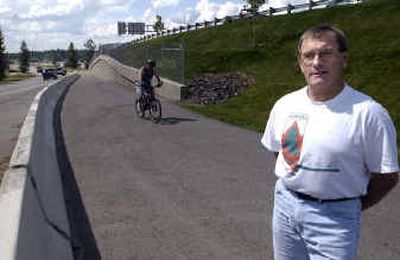

If you have noticed how well swept the North Idaho Centennial Trail is from the Coeur d’Alene Golf Course to the Rutledge Trail Head, thank volunteer Ray Martel.
Every three weeks for the last four years Martel and his wife, Karen, take equipment and sweep that section of trail “clean as a whistle.”
“People ride by on their bicycles all the time and yell, ‘Thank you,’ ” Martel says.
North Idaho Centennial Trail board member Gene O’Meara says, “Every community organization needs a volunteer like Ray Martel.”
The mission of the North Idaho Centennial Trail Foundation is to oversee the maintenance and continued improvement of the existing Centennial Trail.
O’Meara recruited the always-friendly volunteer four years ago. Now he is often the first to volunteer for anything that needs to be done on the North Idaho Centennial Trail.
That includes restocking Centennial Trail maps and newsletters in their boxes along the Trail, giving community presentations, helping with fund-raising events like the Banff Film Festival as well as kids’ and bicycle safety rodeos, attending trade shows and being an active member of the grants and fund-raising committee.
Martel currently works for Kootenai County, is an avid tandem bicycle enthusiast and is the perfect trail ambassador.
Two weeks ago, the Martels rode from Heyburn to Harrison on the Trail of the Coeur d’Alenes and greeted trail users from New York, Oregon and Kentucky.
He also answered questions from Virginia, New York and Ohio Ironman athletes, who were using the Centennial Trail to train before the race.
The growing popularity of outdoor recreation activities, such as cycling, walking and running, combined with the loss of community open space, has increased recreational trail usage.
“I am concerned for the safety of bicycle users on the trail,” Martel says. He emphasizes the importance of wearing a helmet.
“Wearing a good-fitting helmet properly reduces a cyclist’s risk of major injury and/or fatality by as much as 88 percent,” Martel says.
Safety also is enhanced by users respecting trail etiquette and rules, he says. Bicycle trail etiquette means making sure your approach is known in advance.
According to Martel, a friendly greeting or bell is considerate and works well. Bicyclists should try not to startle others, and should show respect when passing by slowing to a walking pace or even stopping.
Cyclists should anticipate other trail users around corners or in blind spots, and should always yield the trail to others. Bicyclists are required to ride as far right in the lane as possible when the lane can be safely shared.
“Animals are startled by an unannounced approach, a sudden movement or a loud noise,” Martel says. “This can be dangerous for you and others.
Martel suggests giving animals extra room and time to adjust to a bicycle approach.
Riding the trail should be a fun experience and practicing good etiquette keeps it that way for everyone.
“When people are exercising on the trail, they are happy, content,” Martel says.
Martel’s dream is to see an expanded trail system.
“I would like to see a continuous trail from Seattle to Missoula and Moscow to the Canadian border. Some day it will happen,” Martel says with a warm smile.