
City seeks land for wastewater
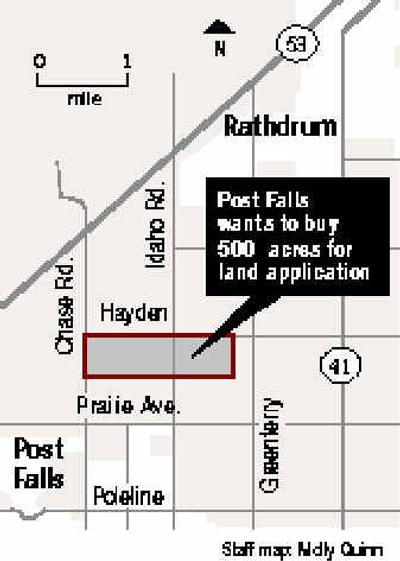
Post Falls wants to irrigate 500 acres of farmland on the Rathdrum Prairie with treated wastewater to reduce the amount of effluent it dumps into the Spokane River.
The city will ask voters Aug. 3 to approve spending $9.5 million to buy the 500 acres of bluegrass south of Hayden Avenue and perhaps another 500 acres within the next 10 years. Voters must give a simple-majority.
“It’s really important we do this for the future,” Mayor Clay Larkin said. “This is the cutting edge of preserving the prairie for us.”
And the land would help the city handle its skyrocketing population growth, especially since the U.S. Environmental Protection Agency wants to reduce the amount of treated wastewater towns put into the river.
Treated effluent that is used as irrigation doesn’t harm the aquifer because the soil works as a natural filtering system. And since the water eventually reaches the aquifer, it will also help keep river flow levels up.
Residents’ sewer rates wouldn’t increase if voters approve the expenditure. Post Falls residents are currently paying off three bonds approved in the late 1980s and early 1990s to build and improve the current wastewater plant. The largest of those payments is set to expire next year. The city wants to extend that debt and keep using the additional sewer rate money to buy the property for land application.
Larkin said the city could use the land to grow crops, trees or even a park. Eventually the area could become a city-owned golf course, Larkin said.
The Hayden Lake Recreational Water and Sewer District was the first town in Kootenai County to buy prairie property for land application. Since the 1980s, the district has grown bluegrass and poplar trees on its 477 acres off Atlas Road. Hayden pipes its treated wastewater to the Spokane River in the winter months and irrigates with it in the summer season.
“We were a little ahead of the curve,” district Chairman Gerry House said. “We knew what was coming down with (water-quality restrictions). If you land-apply, you aren’t putting stuff into the river.”
Spirit Lake also has land application property where it grows alfalfa hay. In the winter months, the town puts its treated wastewater in storage lagoons until the ground defrosts to allow irrigation.
Rathdrum has bought about 300 acres on the prairie for land application but hasn’t yet used the property. Currently, Rathdrum pipes its wastewater to the Post Falls treatment plant.
Spirit Lake Mayor Roxy Martin is glad Post Falls is finally considering land application.
“They ought to preserve the prairie as green space instead of letting all those homes go up there,” she said. “I grew up with the prairie and there is no more prairie.”
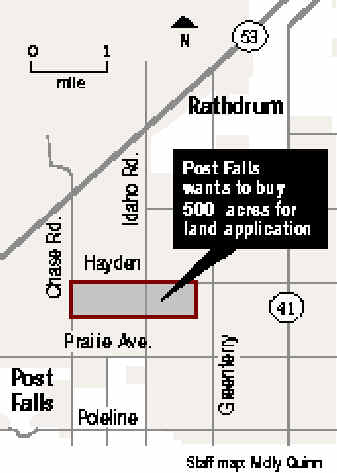
The property Post Falls wants to buy runs along the south side of Hayden Avenue between Chase Road and just east of Idaho Road. The land is currently owned by the Satchwell family.
Post Falls Finance Director Shelly Enderud said the city would pay about $5 million for the property including interest and bond costs. Then in about 10 years the city wants to buy another 500-acre chunk of land, if one is available, with the remaining $4.5 million of spending authority.
Post Falls Public Works Director Terry Werner said if voters approve the purchase it could take up to five years before land application would begin.
He said many other towns in the region use effluent to irrigate parks or farmland. Moscow uses treated wastewater to irrigate grassy areas at the University of Idaho.
Post Falls, Hayden and Coeur d’Alene are currently reapplying to the EPA for permits that allow them to discharge treated wastewater into the river.
Werner said the EPA will allow the towns to put more gallons per day in the river as the population increases, but the standards for water quality keep getting stricter, and that means more expense to treat the wastewater. That’s part of the reason Post Falls is looking at land application, besides preserving green space on the Rathdrum Prairie.
Keeping the land green and preventing up to 1,500 new homes also helps with water conservation, Larkin said.
Post Falls is trying to find enough water to serve its growing population without acquiring additional water rights.
In July 2002, Post Falls asked the Idaho Department of Water Resources for permission to pull an additional 13 million gallons of water a day from the Spokane Valley/Rathdrum Prairie Aquifer.
Friends of the Aquifer and the Sierra Club are protesting the draw, arguing the city’s water request is unwarranted and could harm the aquifer. The groups want the city to postpone its request for more water until a $3.5 million, two-state study is completed to determine how much water remains in the aquifer, which is the sole source of drinking water for more than 400,000 people.
Post Falls did ask the state in February to postpone for six months its water rights application so it can determine if there are other ways to find water.
Larkin said land application is just one component in how the city can reduce its need for future water. The city also is looking at requiring property owners to transfer their water rights to the city if they want the land brought into the city limits. And it is currently asking residents to limit lawn and garden irrigation as part of a new conservation program.
“We’re trying to show through innovative work that we may not actually need those two permits they are protesting,” Larkin said.
Spokane attorney Rachael Paschal Osborn, who represents the two groups opposing Post Falls’ water request, hadn’t heard the city was trying to buy property for land application.
“Land application is a good idea because it takes sewage treatment pipes out of river and we are getting closer to meeting water quality standards,” Osborn said. Yet she doesn’t see how it really has too much to do with the water rights protests.
“They have to reduce consumer use,” she said, and that means installing low-flow toilets, shower heads and washing machines in addition to careful management of household water use. Osborn said the city also would have to audit businesses to analyze water use and offer suggestions for reduction. Restricting lawn watering isn’t enough, she said.
“The idea is putting less water in the pipe that goes to the sewage treatment plant,” Osborn said.
Even though residents’ sewer fees wouldn’t increase to pay for the prairie land, Werner said sewer fees are expected to go up in the next year by about 4.5 percent just to pay for the additional costs of treating sewage.
Currently, Post Falls residents pay $21.45 per month for sewer and stormwater service. Werner said residents will know the exact amount when the city finishes its budget in July.