
Program pays landowners for hunt access
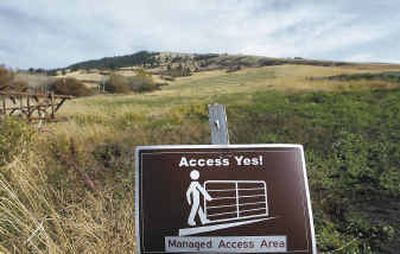
LEWISTON – Waine Martin of Clarkston likes the looks of the hunters who have been showing up at his place west of Genesee.
He says they tend to be respectful of his property and generally courteous.
Martin and six other landowners in the Clearwater Region of north central Idaho have enrolled land in the Idaho Department of Fish and Game Access Yes! program. In exchange for allowing hunters on his place, Martin receives a small payment from the department.
The 408 acres on the Palouse include a small pond and a stream thick with cattails and tall grass, an old Conservation Reserve Program plot and hundreds of acres of low-growing grass he says will take off next spring and become ideal pheasant and gray partridge habitat.
“Once the grass gets going better, the birds will just love it.”
Birds already appear to like the property, as do hunters who have been showing up in modest but steady numbers. Each time he comes to the farm to do some work, he generally sees some hunters.
The $265,000 program is providing access to just less than 15,000 acres of private land in the Clearwater Region and 222,000 acres statewide. It also has opened 250,000 acres of previously landlocked public lands.
Landowners in the program nominate their properties in a bid-like process and are chosen based on the cost, quality of habitat and the amount of access they provide.
While they agree to provide access, they can choose whom they allow on their lands, when they can be there and what they can hunt.
“They are still in control,” says Brad Compton, director of the department’s wildlife bureau at Boise. “They set the conditions of access and we honor that.”
For example, some landowners, like Martin, don’t require hunters to contact them before visiting their lands. Others require contact and written permission before hunting is allowed.
The program is in its second year and is designed to keep private habitat available to average hunters, and to reward landowners for providing quality game habitat.
“Access Yes! is a little-guy program,” says Clarence Binninger of Orofino, Idaho.
Private landowners are increasingly tempted to exclusively lease their land to well-heeled hunters, he explains.
Binninger serves on the Idaho Department of Fish and Game Advisory Committee, which had a hand in creating the program.
“We pay landowners to keep their land open,” he says, “and by doing so we reduce the temptation of those landowners to lease it for big dollars to people with heavy pockets.”
Compton says the state can’t compete dollar for dollar with the amount of money some private hunters are willing to pay, but it can offer landowners an alternative. He says the payments are often enough to cover their property taxes and in some cases enough to hire access managers.
Clay Hickey, the landowner/sportsman coordinator for the department at Lewiston, says there are advantages to landowners who choose the state program over private leases.
Those who join Access Yes! are covered by the state’s Good Samaritan Law, which protects them from liability lawsuits for anyone who might be injured while hunting on their lands.
Landowners can continue to give hunting access to friends and family under the Access Yes! program, but some private leases exclude all but the paying hunters.
Nobody knows how much land in Idaho is tied up by private hunting clubs. There is no requirement for landowners or private clubs to report such numbers.
But a deer disease that struck the region last summer gave Hickey a hint. Epizootic hemorrhagic disease killed thousands of whitetail deer in the lower elevations of the Clearwater and Salmon rivers. Hickey was shocked at the number of landowners who contacted him because they worried the die-off would reduce the amount of money they earn from leasing land to hunters.
“It was the guys that are charging for access that were screaming like they were gut-shot.”
He says it is becoming more common for somebody from out of state to have a one-on-one relationship with a landowner here. That person may pay the landowner hundreds or even thousands of dollars to keep all others off the land.
Some sportsmen have complained landowners who have always provided access to their lands are now being paid for it. They say the state should be paying landowners who have not allowed access.
But Binninger disagrees. He says landowners who have long provided access may be tempted to lease their lands. The program rewards them for their past access policy and ensures the lands will stay open.
Access Yes! is funded by department dollars and from the sale of raffle tickets for super tags and super slam tags. Those who win super tags are allowed to hunt for either elk, deer, moose or antelope in any open or controlled hunting unit in the state. Those who are drawn for the super slam tags can hunt all four species.
Hunters can find out about land enrolled in the Access Yes! program by logging on to the department’s Web site, http://fishandgame.idaho.gov/hunt. It includes maps, access requirements and contact numbers for each of the properties enrolled in the program.