
Unwelcome trend
Mickey Mouse has a bone to pick with Uncle Sam.
U.S. travel executives — including those who run Disneyland and Walt Disney World — say President Bush’s war on terror is unintentionally scaring off foreign tourists and that an international campaign is needed to lure more visitors and repair the country’s soured image.
“It’s more than just an image decline,” said Jay Rasulo, president of Walt Disney Parks & Resorts, a Lake Buena Vista, Fla.-based unit of The Walt Disney Co. “I think other countries are out there competing for tourists and we have not been.”
Rasulo and other travel executives said tourism to the United States, while rising again after several down years, is not as robust as it should be, with an estimated 10 percent fewer international visitors in 2004 than in 2000. Although the weak dollar has brought more visitors in recent months, the overall trend is still disappointing to the industry.
The stakes involved are huge. Visitors from abroad accounted for about $93.5 billion in spending and economic activity in the United States in 2004, according to Commerce Department estimates. That’s slightly larger than U.S. exports of automobiles, engines and parts.
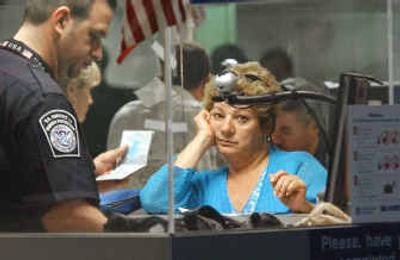
Tourism officials ascribe the decline partly to anti-Americanism that arose after the country launched military action in Afghanistan and Iraq and to the “hassle factor” associated with new visa application and airport security procedures.
Homeland Security Department spokesman Dennis Murphy said the new procedures are intended to correct vulnerabilities exploited by the Sept. 11 terrorists, without impeding trade or travel. “We can’t allow our system to be abused again,” he said.
“Because the system was not enforced rigorously in the past, any change to enforcement postures become significant changes in the minds of people who used it before,” he added.
Tourism officials emphasized that they aren’t opposed to the Bush administration’s homeland security objectives; what concerns them is the manner in which policies are implemented.
“We have developed an image in many countries as fortress America,” said Betsy O’Rourke, senior vice president for marketing at the Travel Industry Association of America, a Washington-based trade group. O’Rourke said tourists should be greeted as “customers,” not potential “invaders.”
Alan Chick of Brighton, England, has traveled to the United States once a year, on average, for the past 18 years and said that while there is some truth to the perceived hassle factor, the problem has been vastly overblown and shouldn’t deter foreign tourists.
“Unfortunately, the Americans don’t do very much to dispel these things,” said Chick. “They don’t really do anything to say ‘Hey, it’s really not that bad.’ “
The commission that investigated the Sept. 11 attacks said the nation’s beefed-up border screening system needs to become more efficient and friendly, and it noted that visa applications in 2003 were down 32 percent compared with 2001. “There is evidence that the present system is disrupting travel to the United States,” the commission said.
Meanwhile, a November poll of 8,000 consumers from eight industrialized nations found that 55 percent of respondents had an increasingly negative perception of that United States, according to Seattle-based market research firm GMI Inc.
That rankles some travel officials.
“I refuse to believe that our declining image is a fair portrayal of who we really are,” Amtrak vice president Barbara Richardson said last month at an industry luncheon in Washington.