Say cheese
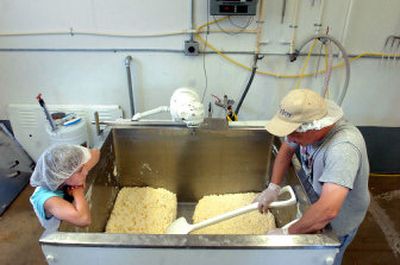
PRIEST RIVER, Idaho — Little Miss Muffet would be wise to befriend Allen Kemp. Kemp, 36, is the brains and the brawn behind the Hoo Doo Valley Creamery’s cheeses. He spends his days up to his elbows in so many curds and so much whey, it would make that little nursery rhyme girl giddy.
Right now, Kemp’s turning 150 gallons of pasteurized milk from the family’s cows into thousands of bite-sized cheddar cheese curds which will be cut, packaged and sent to more than 50 stores around the country.
It’s an all-day, sweat-inducing process completed entirely by hand.
But Kemp, one of just a few small-batch cheese producers in the Inland Northwest, says he wouldn’t do the job if he didn’t love it.
“It’s pretty neat to track a product all the way from the start, the cows, to the consumer,” Kemp says, stirring his vat of curds and whey with an oversized silver paddle.
There’s growing enthusiasm for handmade, locally produced cheese as Americans become increasingly concerned about just where our food is coming from. We’re seeking out farmers’ markets and organic produce, and we’re reading labels to learn more about what we eat.
“We’re starting to reassess our relationship with food,” says Lora Lea Misterly, who owns the Quillisascut Cheese Co. with her husband, Rick, just outside Rice, Wash. “There’s new value put on the food and the people that are producing it.”
Small-batch cheeses, Misterly says, provide a “whole different nuance of flavors” than their mass-market counterparts.
“You’re looking for all kinds of nuances,” she says. “Can I taste Eastern Washington in this cheese? What was the cheesemaker trying to get across in this cheese?”
The foodie magazine Saveur devoted its entire April issue to artisanal cheeses. Membership in the Kentucky-based American Cheese Society, dedicated to preserving cheese-making traditions, continues to climb. There’s even a blog focusing solely on Pacific Northwest cheeses (http://pnwcheese.typepad.com/cheese/).
Huckleberry’s Natural Market is one of several local stores that carries a large selection of cheeses, including a few produced in this area.
“The interest in cheese has really bumped up,” says Janet Smith, the store’s bakery/cheese specialist. “I’ve increased my cheese sales a lot in the past year.”
There are a number of artisan cheese producers on the west side of Washington (including Beecher’s, which is available locally) and in Oregon and British Columbia (check out a complete list on the Pacific Northwest Cheese Project blog). And there is a small but thriving community of small-batch cheesemakers in the Inland Northwest.
Here’s a tour of the artisanal cheese producers in this area:
Hoo Doo Valley Creamery
The Hoo Doo Valley Creamery is an outgrowth of the Kemp family’s dairy farm in Priest River. And “family” is the operative word for this business.
Allen Kemp makes the cheddars and jacks. His wife, Shellie, packages the cheese. His mom, Helen, handles all of the sales and marketing, including traveling around the region to hand out cheese samples.
And Allen and Shellie’s kids, 8-year-old Tabitha and 12-year-old Timothy, are go-fers, timer-setters and, of course, taste-testers.
Hoo Doo Valley has been producing cheese for the last couple of years, refining its recipes along the way.
It takes at least eight hours for each vat of milk to be cooked, stirred, cut, pressed, salted and turned into cheese.
“Everybody believes speed is money,” Allen Kemp says. “But I don’t.”
Right now, all of the milk is pasteurized, and the cheese is created in a 1938 pasteurizer that “belongs in the Smithsonian,” Kemp says. Kemp was finishing work on a new vat that will mechanically mix the curds and whey and will increase the creamery’s production capabilities sixfold.
Hoo Doo Valley’s dill-garlic cheese curds are the top seller of its 19 different flavors and varieties of cheese.
You can find its curds and other cheeses at a number of locations in Spokane and North Idaho, including Huckleberry’s, Pilgrim’s Nutrition, Super 1 Foods in Hayden, Tim’s Special Cut Meats in Coeur d’Alene and Egger Meats in Spokane.
Contact the Hoo Doo Valley Creamery at (208) 255-4388 for more information.
Monteillet Fromagerie
Joan Monteillet and her French-born husband, Pierre-Louis, run the Monteillet Fromagerie, just west of Dayton, Wash. The couple started making fresh, soft cheese for themselves nearly 30 years ago. About six years back, friends told the two that their cheese was so good they should go into business. So they did.
They opened the fromagerie in 2002 on 31 acres, and they now make 12 cheeses from the milk produced by their several dozen goats and sheep. They produce about 500 pounds a week.
They specialize in handmade larzac, a soft-ripened goat cheese, as well as fresh chevre, herbed chevre and cardabelle, a brie-style cheese made in both goat and sheep milk.
“Cheese-making is like art,” Joan Monteillet says. “You feel it. It’s a passion.”
The couple’s cheeses are not available at retail outlets, but they are used at some Walla Wall-area restaurants and they can be purchased directly from the Monteillet Fromagerie.
Log on to www.montecheese.com or call (509) 382-1917 for more information.
Quillisascut Cheese Co.
Curado, an aged, goat-milk cheese, is the main product of the Quillisascut Cheese Co. just outside Rice, Wash.
Lora Lea Misterly and her husband, Rick, and their 33 goats work to produce about 5,000 pounds of cheese a year. They’ve been making cheese on the farm since 1987.
The curado can be smoked or combined with the flavors of fennel, lavender, black pepper and garlic.
“When we first started out, we sold mostly to restaurants,” Lora Lea Misterly says. “A lot of chefs incorporated it into dishes. That’s the way most Americans are used to having cheese. Now, more and more people are eating cheese as a course in a meal.”
The cheese is sold at Huckleberry’s, and works well when grated on pasta or salads, Misterly says.
Chef Karen Jurgensen, who works at the Quillisascut farm, likes to wrap a quarter-inch-thick block of the cheese in a grape leaf smeared with quince or apricot paste. The bundle is then grilled until warm for an appetizer or rustic dessert, Misterly says.
For more information on Quillisascut cheese, log on to http://www.quillisascutcheese.com/ or call (509) 738-2011.
Sally Jackson Cheese
Sally Jackson is the grande dame of Inland Northwest cheesemaking. Jackson has been churning out her Sally Jackson Cheese in Oroville, Wash., for the past 25 years.
She makes cheese from the milk of her sheep, goats and a few cows and is best known for her sheep cheese wrapped in chestnut leaves, goat cheese wrapped in grape leaves and Guernsey cheese in chestnut leaves.
“It stays moist and soft,” Jackson says. “Mold grows under the leaves.”
She makes just 15 pounds of cheese a day and can’t keep up with the demand for her product. (She’s become quite the cheese celebrity; the April Saveur article listed Jackson’s product as one of the country’s 50 best cheeses.)
The cheese is available at a few shops in Seattle but is not available in Spokane. For more information, log on to www.sallyjacksoncheeses.com.
WSU Creamery
When it comes to locally produced cheeses, the Washington State University Creamery is the 400,000-pound gorilla of the bunch. That’s how many pounds of cheese — packed into 2-pound cans — the creamery produces each year. That’s a lot by artisan standards but not much compared to the big manufacturers.
“We keep increasing our production as best as we can,” says David Dean, a supervisor for the creamery’s direct-marketing department. “We’re limited by our milk. All the milk is produced by our own dairy.”
As fans of the WSU Creamery know, the cheese started out as a military experiment in the 1940s. The government wanted to develop a cheese for its troops that would fit into a can to be shipped anywhere in the world.
Cougar Gold cheddar is the creamery’s top seller by far, making up about 80 percent of all cheese purchases, Dean says. It’s aged for at least a year to develop its nutty flavor.
WSU cheese (which also got a mention in the Saveur article) is available at student bookstores on campus in Pullman and at branch campuses. The creamery’s Web site www.wsu.edu/creamery/ has ordering information as well as recipes.
But Dean, for one, likes his Cougar Gold straight up.
“I prefer just to have it on a cracker,” he says.
Many of the cheese-makers agree with Dean, saying they prefer to eat their creations as-is. But here is a of recipe to inspire some cheese creativity.
Cougar Gold, Apple and Onion Soup
From Washington State University Creamery
5 cups chicken stock or canned broth
1 cup peeled and chopped potato
2 cooking apples, peeled, cored and chopped
1/2 cup chopped onion
1/4 cup chopped carrot
1/4 cup chopped celery
1/8 teaspoon ground thyme
2 tablespoons cornstarch
2 tablespoons cold water
4 cups grated Cougar Gold Cheese
1/4 cup heavy or light cream
1/8 teaspoon nutmeg, preferably freshly ground
1/8 teaspoon white pepper
1/4 cup dry white wine (optional)
Thin apple slices for garnish
Combine chicken stock or broth, potato, apples, onion, carrot, celery and thyme in a medium stock pot. Bring just to boil, reduce heat and simmer 45 minutes, or until vegetables are tender. Puree mixture in food processor. (May need to be done in batches.)
Return soup to stock pot. Mix cornstarch with cold water and stir into soup. Cook over medium heat until slightly thickened, stirring constantly. Add cheese and cook, stirring until cheese is melted. Add cream, nutmeg and white pepper; simmer for 5 minutes to incorporate flavors. Salt to taste.
Stir in wine just before serving. Top each serving with 3 unpeeled slices of apple.
Yield: 4 to 6 servings
Approximate nutrition per serving (based on 6): 404 calories, 27 grams fat (17 grams saturated, 60 percent fat calories), 22 grams protein, 16 grams carbohydrate, 85 milligrams cholesterol, 1.8 grams dietary fiber, 856 milligrams sodium.