
New test, new taint
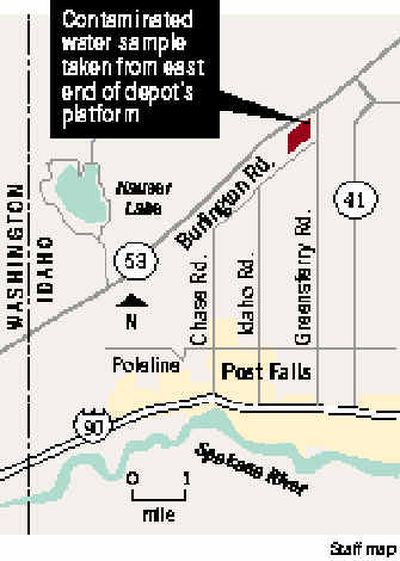
Traces of petroleum have been found in the groundwater directly below BNSF Railway’s cracked refueling platform at its depot near Rathdrum, Idaho, according to a statement issued Tuesday afternoon by the Idaho Department of Environmental Quality.
But BNSF wants a second opinion and is sending the water sample to another lab for testing, said railroad company spokesman Gus Melonas.
“We’re reviewing DEQ’s findings,” he said.
Additional drilling and testing is needed before the contamination can be definitively linked with leaks discovered Feb. 14 on the platform, but the groundwater was sampled upstream from where diesel-tainted groundwater was found in December following a separate leak, said Marc Kalbaugh, site manager for DEQ.
The single water sample revealed petroleum-related chemicals “well below” the risk to human health and just “slightly above laboratory detection limits,” Kalbaugh said. But the revelation undermines repeated railroad claims over the integrity of the depot’s fuel containment barrier system and could make it more difficult for BNSF to convince a judge that the depot is safe to reopen.
Idaho District Judge Charles Hosack ordered the depot closed two weeks ago, after an emergency closure request was made by DEQ. A hearing on the future operations of the depot was scheduled for today, but the hearing has been postponed until April 5, at the request of BNSF and the state.
Melonas would not comment on why the postponement was sought, but he dashed ongoing speculation that the railroad would be appealing the state action anytime soon in federal court.
“We anticipate to remain shut down until the next hearing,” Melonas said.
A statement from DEQ said an additional 27 days was needed before a court hearing because, “considerable work remains to be completed to demonstrate the integrity of the containment layers beneath this facility.”
From cracked concrete to malfunctioning pipe seals, the more investigators search, the more problems they seem to find at the depot. The railroad is now beginning a significant overhaul of the $42 million facility, which has been plagued with problems since it opened Sept. 1.
Much of the recent focus has been on the 35,000-square-foot refueling platform, but problems have also been discovered on a separate fuel offloading platform, as well as the fuel storage area, according to information released Tuesday by DEQ.
Cracks have been found in the concrete at both the offloading and the storage area. Faulty pipe seals have also been discovered below the offloading platform, where pipes pass through the plastic containment membrane, Kalbaugh said.
BNSF spokesman Melonas said 80 contractors and experts are now at the depot “working around the clock” to reopen the facility, which is the fastest refueling stop for BNSF’s northern mainline. Trains are being rerouted to other BNSF sites in the Northwest. Tracks at the depot have been pulled and at least four large holes have been cut into the concrete platform to allow easier access to the buried membranes, according to both Melonas and DEQ.
The railroad said it does not yet have an estimate on the costs of investigating and fixing the problems, not to mention the cost of the delays in shipping. A leak discovered in December, which was blamed on a construction accident, cost BNSF more than $1 million and sent untold thousands of gallons of fuel-tainted wastewater into the aquifer that supplies drinking water for more than 400,000 people in the region.
Depot critic Barry Rosenberg, executive director of the Kootenai Environmental Alliance, said the railroad should cut its losses.
“Spend that money and move that depot out of here,” Rosenberg said. “It’s out of control. This thing is like a Pandora’s box: the more they open the box up, the more things they find out (that are) wrong with it. The basic integrity of that whole depot is in question.”
BNSF is moving forward with repairs, including resealing the entire refueling platform and replacing faulty pipe seals. The railroad company is also considering significant overhauls to the fuel containment system, according to state and county officials.
Kootenai County Planning Director Rand Wichman said railroad company executives briefed him Monday on planned changes at the depot, including improvements to the containment system. The changes involve reducing the number of areas where pipes pass through the liner, Wichman said, and are expected to “significantly reduce the potential for leaks.”