SELECTION SUNDAY
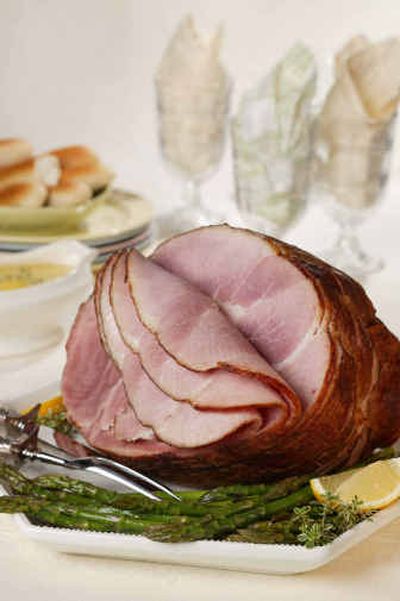
Easter, many of us believe, demands a ham. Yet the question is: What kind of ham? The term refers simply to the hind leg (“ham”) of a pig, yet it has come to encompass a bewildering array of products:
Country ham – Also called Virginia ham or Smithfield ham, this is the old-fashioned American style of ham, dry-cured by coating it with salt for months and then hanging it in a hickory smokehouse. It produces a rich, salty, smoky flavor, which is why it has become a gourmet item. Must be sliced very thin, because it’s so salty. Unless you grew up in the South, you may have never had one of these before.
“City” ham – Better known as just a plain old ham – the kind of ham you’ll commonly find at the grocery store or the meat market. It’s a wet-cured ham, which means the ham is cured by immersing it (or injecting it) with brine. It is often smoked and usually sold fully cooked. Look for a ham with “natural juices” instead of “water-added” and “bone-in” instead of “boneless.” You’ll get more flavor for your Easter feast.
Spiral-sliced ham – This is usually a fully-cooked city ham pre-sliced by machine and sold with a honey or sugary glaze packet. Originally available only through specialty shops, now they’re available at just about every supermarket meat counter. It’s a convenient way to serve an Easter feast.
Deli ham – Also labeled “ham and water product.” It usually consists of pieces of leg meat reshaped into ovals or loafs and good mainly for sandwiches.
Canned ham – A fully-cooked ham, or ham pieces, jammed into a tin and molded into shape with gelatin.
European-style hams – These are almost always dry-cured and very salty, like American country hams. Italy has its prosciutto ham, and Germany has its Westphalian hams. They too are served sliced paper thin.
Fresh ham – It’s simply the same cut of pork used for ham, but uncured and unsmoked, which means it tastes nothing like what we typically call ham. It makes a particularly flavorful and tender roast, although most cooks have yet to discover it. You might as well call it “roast leg of pork,” since, well, that’s what it is.
To help narrow the field for this Easter feast, let’s immediately toss out the deli hams. Those are suitable for sandwiches, maybe, but not Sunday dinner.
Then let’s toss out the European-style hams such as prosciutto. They’re delicious, artisan-made products, but not right for Easter.
Then, reluctantly, let’s toss the country ham, even though it would make an exceptional Easter main course. The problem is: In our part of the country, the only way you can buy one is via mail order from Virginia, the Carolinas or somewhere else in the South. If you haven’t already ordered one for Easter, you’re out of luck. (And if you have ordered one, you’ll still have to go through a long soaking and boiling process in order to make it a dinner centerpiece).
And, just as reluctantly, let’s toss the fresh ham, too, since it, too, is hard to find at the average grocery store. You can special-order it, but it might take a week.
As for the canned ham, toss it. I mean, literally: Toss it.
So let’s narrow it down to the easiest kind of “city” ham: the spiral-sliced ham, for the most ham goodness for the least work.
Now, the first thing you have to know about a spiral-sliced ham is that convenience comes at a cost. All of that exposed surface tends to dry out when re-heated. And the glaze packet that comes with it is often inferior.
One ham expert, Bruce Aidell, author of “Bruce Aidell’s Complete Book of Pork” (Harper Collins, $29.95) says a good unsliced bone-in ham “and a sharp knife” is a better option
Yet this is where the editors at Cook’s Illustrated can help. In their book “Steaks, Chops, Roasts and Ribs” (America’s Test Kitchens, $35), they have figured out how to make spiral-sliced ham come out perfectly.
In fact, their food testers even have some suggestions for which brands to try. They liked two of the least expensive and widely available hams, the Cook’s Spiral-Sliced Hickory Smoked Honey Ham and the Hillshire Farm Spiral-Sliced Brown Sugar Cured Ham. Since most people buy a half-ham (7 to 10 pounds) they also recommend choosing a shank end (with the tapered, pointed end) instead of the butt end (the rounded end).
Most importantly, Cook’s Illustrated also figured out how to re-heat a ham without drying it out.
Note that we use the term “re-heating” instead of cooking. That’s because spiral-sliced hams, like most city hams, are usually sold fully cooked. When you stick one in the oven, you are really just bringing it up to eating temperature.
However, you can’t just turn the oven to 400 degrees or even 325 degrees and nuke the thing, even if that’s what the wrapper recommends. A spiral sliced ham will lose up to two cups of liquid at those temperatures, even in its foil wrapping.
So the Cook’s Illustrated editors found an easy solution: A plastic oven bag. Slip the spiral-sliced ham into the bag, wrap it tight, cinch it, and heat the ham at 250 degrees. Inside the bag, it cooks faster, and will keep all of those thin slices moist.
They recommend heating to an internal temperature of only 100 degrees, no matter what the package recommends. That sounds low, but when the middle reaches 100, the outer inch will be at 145 degrees. The middle will continue to heat to 115 or 120 degrees – which is plenty warm enough – after it leaves the oven.
They also recommend tossing out the glaze packet, which they described as “like a layer of gooey candy.” Instead, they recommend serving the ham with a sauce as way of dressing the slices up and adding moisture. We’ve included a pair of sauce recipes below.
However, we happen to believe sweet glazes taste good on a smokey ham, so we threw in a couple of intriguing homemade glaze recipes below as well.
Spiral-Sliced Ham
Adapted from “Steaks, Chops, Roasts and Ribs,” by the editors of Cook’s Illustrated
1 spiral-sliced fully-cooked bone-in half ham (7 to 10 pounds), preferably shank end
Unwrap the ham and remove and discard the plastic disk covering the bone. Place the ham in a plastic oven bag, pull tightly for a close fit, tie the bag up and trim the excess plastic. Set the ham cut-side down in a 13-by-9-inch baking dish and cut 4 slits in the top of the bag with a paring knife. Alternatively, place the unwrapped ham cut-side down in the baking dish and cover tightly with foil.
Let stand at room temperature for 90 minutes. (You can bypass the standing time by putting the ham in the oven cold, but you’ll have to add a couple of minutes per pound to the heating time.)
Adjust the oven rack to the lowest position and heat to 250 degrees. Bake the ham until the center of the ham registers about 100 degrees on an instant read thermometer, about 1 to 1 1/2 hours (about 14 minutes per pound if using plastic oven bag, about 17 minutes per pound if using foil), depending on the size of the ham.
Remove the ham from the oven and let it rest in the baking dish in the oven bag or with the foil cover, until the internal temperature reaches 115 to 120 degrees on an instant-read thermometer, about 30 to 40 minutes.
Cut open the oven bag or remove the foil. Serve immediately.
Yield: 10 to 15 servings
Approximate nutrition per 5-ounce serving: 228 calories, 8 grams fat (2.9 grams saturated, 33 percent fat calories), 36 grams protein, no carbohydrate, 79 milligrams cholesterol, no dietary fiber, 1,927 milligrams sodium.
Bourbon Honey Glaze
From Sandra Lee and the Food Network
2/3 cup bourbon or other whiskey
1 cup clover honey
1/3 cup molasses
1/2 cup 100-percent fruit orange marmalade
In a medium saucepan, heat bourbon, honey, molasses and marmalade over low heat for 15 minutes or until reduced by half. Spread glaze on ham a half-hour before it is finished in the oven.
Yield: About 3/4 cup glaze, enough to glaze a 5-pound bone-in ham
Coca-Cola Glaze with Lime and Jalapeno
Adapted from “Steaks, Chops, Roasts and Ribs,” by the editors of Cook’s Illustrated
1 cup Coca-Cola
1/4 cup juice from 2 limes
2 cups packed dark or light brown sugar
2 medium jalapeno chilies, stemmed, seeded and cut crosswise into 1/4 inch-thick slices.
Bring the Coca-Cola, lime juice, brown sugar and chilies to a boil in a small non-reactive sauce pan over high heat. Reduce the heat to medium low and simmer until syrupy and reduced to about 1 1/3 cups, 5 to 7 minutes. Glaze the ham about a half-hour before it’s finished in the oven.
Yield: About 1 1/3 cups glaze, enough to glaze a 6- to 8-pound ham.
Dried Cherry and Stout Sauce with Brown Sugar and Allspice
Adapted from “Steaks, Chops, Roasts and Ribs,” by the editors of Cook’s Illustrated
1 cup low-sodium chicken broth
2 tablespoons cornstarch
2 tablespoons unsalted butter
3 medium shallots, chopped fine
1/8 teaspoon ground allspice
4 cups stout
1/3 cup packed brown sugar
1 cup dried tart cherries, about 5 ounces
1 1/2 tablespoons balsamic vinegar
Salt and ground black pepper
Whisk the broth and cornstarch together in a small bowl; set aside. Heat the butter in a 12-inch skillet over medium heat until foaming; add the shallots and cook until softened, about 3 minutes. Stir in the allspice; cook until fragrant, about 30 seconds. Add the stout, brown sugar and dried cherries; increase the heat to medium-high, bring to a simmer and cook until slightly syrupy, about 10 minutes.
Whisk the broth and cornstarch mixture to recombine, then gradually whisk it into the simmering liquid; return to a simmer to thicken, stirring occasionally. Off heat, stir in the balsamic vinegar; season with salt and pepper to taste. Serve with ham slices.
Yield: About 4 cups sauce
Approximate nutrition per 2-ounce serving: 87 calories, 1.9 grams fat (1 gram saturated, 15 percent fat calories), less than 1 gram protein, 17 grams carbohydrate, 4.5 milligrams cholesterol, less than 1 gram dietary fiber, 50 milligrams sodium.
Mustard Sauce with Vermouth and Thyme
Adapted from “Steaks, Chops, Roasts and Ribs,” by the editors of Cook’s Illustrated
1 1/2 cups low-sodium chicken broth
2 tablespoons cornstarch
2 tablespoons unsalted butter
3 medium shallots, chopped fine
2 cups dry vermouth
1 tablespoon packed brown sugar
1/2 cup Dijon mustard
1/4 cup whole-grain mustard
1 tablespoon chopped fresh thyme leaves
Salt and ground black pepper
Whisk the broth and cornstarch together in a small bowl; set aside. Heat the butter in a 12-inch skillet over medium heat until foaming; add the shallots and cook until softened, about 3 minutes. Stir in the vermouth and sugar; increase the heat to medium-high and simmer until the alcohol vapors have cooked off, about four minutes. (Dry white wine can be substituted for vermouth).
Whisk the broth and cornstarch mixture to recombine, then gradually whisk it into the simmering liquid; return the sauce to a simmer to thicken, stirring occasionally. Off heat, whisk in the mustards and thyme, season with salt and pepper to taste. Serve with ham slices.
Yield: About 3 1/2 cups
Approximate nutrition per 2-ounce serving: 77 calories, 2 grams fat (.8 grams saturated, 24 percent fat calories), 1 gram protein, 6.7 grams carbohydrate, 3.7 milligrams cholesterol, less than 1 gram dietary fiber, 265 milligrams sodium.