
Madden rides into Hall
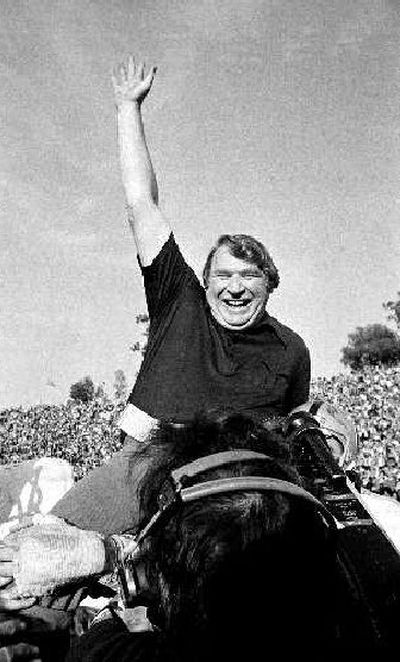
John Madden doesn’t remember anything that happened in the 10 hours following the announcement that he’d made the Pro Football Hall of Fame. He was running on familiar fuel – adrenaline.
Since regaining focus, Madden’s had time to think … think about Raiders owner Al Davis, who gave him a chance, the players who played for him and the people who have gone before him into the hall.
Madden’s had months for his induction to sink in, but said it still feels unbelievable.
“If a guy my size can float, I’m floating,” Madden said in a conference call with reporters.
Madden, along with Troy Aikman, Harry Carson, Warren Moon, Reggie White and Rayfield Wright, will be inducted into the Hall of Fame Saturday at Fawcett Stadium in Canton, Ohio.
Madden’s former team, the Raiders, will play the Philadelphia Eagles in the Hall of Fame game Sunday night.
Madden earned his first pro coaching job as the Raiders linebackers coach in 1967 at the age of 31. He might not have started coaching so young, but a knee injury suffered during training camp for the Eagles in 1958 propelled Madden down a different path. Since he couldn’t play, Madden watched.
“It was the first time in my life that I really looked at the overall game of football,” Madden said. “Then the longer the season went, the more I knew that I better start getting serious on this coaching thing because it doesn’t look like I’ll ever be playing again.”
He became head coach in 1969 and went on to accumulate an overall record of 112-39-7 for a .759 winning percentage, the highest among coaches with 100 career victories. He led the Raiders to seven Western Division titles, eight playoff appearances and one Super Bowl win in 1976. Madden’s Raiders never had a losing season.
“Pro football has been my life since 1967,” Madden said. “I’ve enjoyed every part of it. Never once did it feel like work.”
Pro football also was Aikman’s life, but it almost wasn’t. When the Dallas Cowboys quarterback was a kid, he planned to be a professional baseball player.
“I played football and I enjoyed it. But I enjoyed baseball and basketball more as a child growing up and almost gave up football when I was going into the eighth grade,” Aikman said in a conference call.
Luckily for pro football and the Cowboys, Aikman’s family moved from California to Oklahoma, where there is more of an emphasis on football.
The six-time Pro Bowler led the Cowboys to three Super Bowl wins. He also broke or tied 47 Cowboys passing records and had 17 300-yard passing games. His 90 victories in the 1990s made him the winningest quarterback of any decade.
Carson, a linebacker on the Giants team that won Super Bowl XXI, led New York defenders in tackles five seasons and recorded 14 career fumble recoveries. Carson made 20 solo tackles and five assists in a single game against Green Bay in 1982. He was a nine-time Pro Bowl selection.
Moon started by winning five Grey Cups in the Canadian Football League before signing with the Houston Oilers in 1984. By the end of his 17-year NFL career, the nine-time Pro bowler completed 3,988 of 6,823 passes for 49,325 yards, 291 touchdowns and 233 interceptions. Moon finished with nine 3,000-yard passing seasons and four 4,000-yard passing seasons.
The quarterback remembers playing fellow Hall of Fame inductee Reggie White.
“Reggie White could take a game and change it by himself,” Moon said in a conference call.
White earned the nickname the Minister of Defense partly because he became an ordained minister at 17 and partly because he posted some intimidating defensive numbers.
In his eight seasons with Philadelphia, White’s sacks (124) outnumbered his games played (121). White had 68.5 sacks to become Green Bay’s all-time sacks leader, and is second on the NFL’s all-time list with 198 career sacks. The 13-time Pro Bowler was named NFL Defensive Player of the Year in 1987, ‘91 and ‘98.
Rayfield Wright, nicknamed Big Cat, earned permanent starting status for the Cowboys when he switched from tight end to right offensive tackle. Wright adjusted to the move quickly by using basketball to understand his new position.
“So what I did was I said, ‘Well, the quarterback is the basket, and the defensive end is the guy dribbling the ball.’ So I just got to stay between these two guys, I’ll be OK,” Wright said in a conference call.
He went on to be selected to the Pro Bowl six times. He also played in five Super Bowls and was named to the NFL’s 1970s All-Decade Team.