
Significant presence
On a recent fall day we exited the freeway and drove up the narrow, winding road that leads up a hill to the grounds of the Old Mission State Park.
The Park, via Interstate 90, is about 30 minutes east of Coeur d’Alene. The Mission Church of the Sacred Heart, which gives this state park its name, sits serenely on a knoll above the floodplain of the Coeur d’Alene River and is listed in the National Register of Historic Places
This, Idaho’s oldest standing building and the second-oldest standing church in the Pacific Northwest, for more than a century and a half has been a significant presence to the faithful travelers, settlers and anyone who wants to touch, literally, the history of this region.
Its architect was a Jesuit priest, Italian-born Father Anthony Ravalli, who raised the 360-square-foot, 30-foot-tall structure with the help of two Jesuit brothers and members of a tribe of Indians who had never fabricated such a structure. Building was begun in 1848 after the mission was moved from a place just north of St. Maries on the St. Joe River because the original location was subject to seasonal flooding.
The builders’ tools were scant for such a major undertaking – the broad ax, an auger, ropes, pulleys and a pocket knife. With an improvised whipsaw the builders cut the native ponderosa pine and, with broadaxes, shaped from single tree trunks the timbers with which they framed the church.
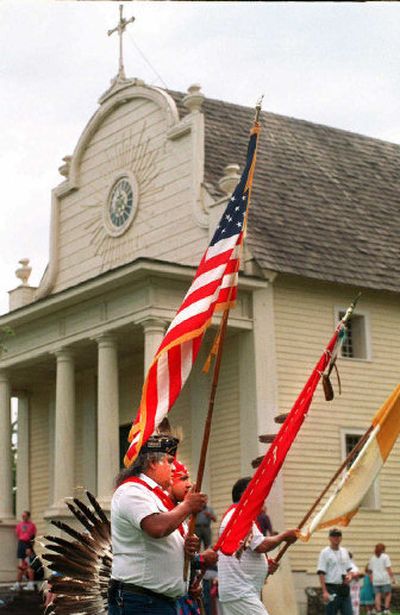
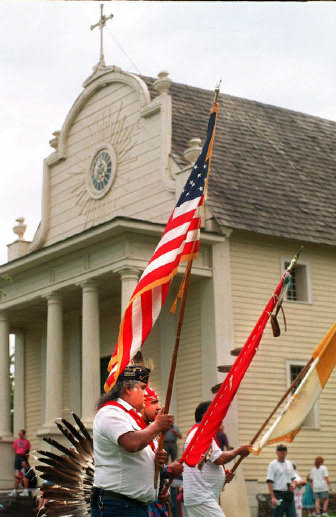
At the front entrance, modest construction was made elegant with a scalloped Baroque-style pediment, recalling churches of Ravalli’s native Italy. Beneath are six classical columns, each a single ponderosas whose girth is about that of a truck tire. The columns and timbers were all cut from nearby forests and hauled uphill in crude sledges to which the Indians were harnessed. The squared-off supporting timbers still bear the rough marks of the broad ax used to shape them.
Because the builders did not have nails they drilled holes with the auger and drove in wooden pegs to secure the joints. The next step was to provide the insulation between the uprights. For this they used a centuries-old technique known as wattle and daub. Again, workers drilled holes in the uprights. Then they laced willow saplings tightly back and forth between the uprights to provide a solid, basketlike base for the application of coats of mud taken from the river.
The results were walls a foot thick whose depth is apparent in the deeply inset windows, many of which still retain panes of wavy old glass. According to Bill Scudder, who manages the park for the Idaho Department of Parks and Recreation, the original window openings were covered with animal skins and cloth. Glass was a later addition.
The nomination form for placement in the National Register does not mention how the outside walls were finished but the normal procedure would have been to cover them inside and out with lime plaster and then apply a coat of paint. The roof was finished with hand-split cedar shakes.
Even the interior artwork, statues and wall paintings, according to register information, were the work of Ravalli and a Brother Huybrechts. Some paintings are believed to have been brought from Europe.
The Mission Church, a back-breaking undertaking, was and, is a tribute to dedication and the ability of churchmen and Indians alike to accomplish much with so little. In the face of such accomplishment, it seems strange that after 10 years of use, Father Joset, vice president of the Jesuit missions in the Northwest decided to close the mission.
Fate intervened, however, when Lt. John Mullan, who was building the military road running east and west, about one-eighth of a mile north of the mission, asked Joset to reconsider. Joset agreed and as a result the mission became a base camp for the road’s construction workers and, later, travelers along the road used the mission as an overnight stop.
Sketches of the mission on the hill, done in 1860 by a Father Gilmore, show a settlement of about a dozen buildings plus plains-style teepees, indicating an Indian encampment. The drawing indicates barns, fences agricultural fields, sheds and even a guest house for travelers. Father Cataldo, for whom the nearby town is named, visited the region in 1865 and ultimately made the mission his headquarters when he became superior of all Rocky Mountain missions.
The federal government excluded the mission site when it redrew Indian reservation boundaries in 1877, and the Coeur d’Alenes moved to the new site within the reservation at DeSmet where a new Mission of the Sacred Heart was constructed.
The move also was precipitated by the Indians’ need, in the wake of an unsuccessful buffalo hunt across the eastern mountains, to move to a place with room for farming to supply adequate food, according to the register nomination.
After the move to DeSmet, the Cataldo mission was little-used except for the annual pilgrimage of the Coeur d’Alenes on Aug. 15 to celebrate the Feast of the Assumption. This annual festive homecoming still takes place. In 1927 the Catholic diocese replaced the roof and the fragile waddle-and-daub walls inside and outside with clapboard siding. Nothing more was done until 1973 when, as the first major project of the Idaho Centennial, the mission and surrounding area were researched and documented. New siding was added and the roof joists were replaced. The front steps and porch are recent replacements as are the interior floors. However, in the altar area, visitors can still see the original flooring, worn down by the footsteps of the faithful and the curious.
The mission operates as a state park and museum even though the diocese gave the church, other buildings and the site to the Coeur d’Alene Tribe three years ago. Under the agreement, the state will manage the park until 2025, at which time the pact can be extended if both parties agree, according to Scudder.
Visitors who stop in the parking lot and climb the hill can visit the church, the restored nearby parish house the cemetery and museum. The experience is truly a walk through the past.
While visitors tend to focus upward toward the rustic majesty of the mission, to truly appreciate this state park and understand why the site was chosen for the church, one needs to take time to walk the grounds, sit at a picnic table and look outward toward the valleys and hills where, on our fall day, the autumn gold of the larches is beginning to blaze like yellow fire on the surrounding hillsides. The 21st century seems far away. Even the roar of freeway traffic seems distant.
The wind rustles the leaves of the trees and, on this late afternoon, peace falls around us like a hushed Amen.