
U.S. tourists feel pain of weak dollar

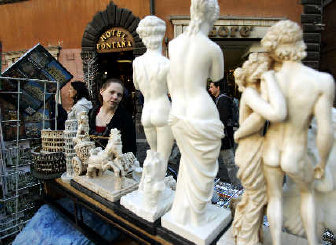
ROME – Caroline Hart chose a church convent for her stay in Rome this week instead of a hotel. She’s also walking more and eating less.
But it’s not a spiritual asceticism – it’s a monetary one.
Like thousands of traveling Americans, Hart is looking at ways to soften the blow from the plunging dollar, but like so many others also had no intention of canceling her Christmas holiday plans – after all, they say, it’s Europe.
“For cultural visits, I would try to hit all the free stuff first and then tour the other museums,” said Hart, a college student from Princeton, New Jersey, in Rome for a week at a time when it takes $1.32 to buy one euro.
Hart said she was looking at ways to contain her budget, but it wouldn’t keep her from enjoying the trip. For travelers from the U.S., even simple purchases can cause sticker shock: At a restaurant near the Pantheon in Rome, pizza for one costs $13.20 and a can of Coke is $7.90 at the current exchange rate.
“I’d rather buy food at the local market as prices there are cheaper than sitting down at a restaurant,” she said, enjoying her picnic lunch in the shadows of the Pantheon. “It is doable that way, but it is a big conscious effort.”
Tourists are adapting in other ways – opting for public transport over guided tours, taking the lower-range options on attractions, giving up trips to the theater, cutting down on the shopping and souvenirs.
“Now I get only small gifts for very select people,” said Karen Rudy, 20, a student on a year-abroad program in Britain who was visiting Berlin instead of going home to California as planned – because of the weak dollar.
Katherine Koster, an 18-year-old from Chicago who is working for New Berlin, an agency that runs walking tours of the German capital, said the dozens of American tourists she meets every week have been getting an ugly shock when they realize the cost of meals and souvenirs – but they go on spending anyway.
“Many of the tourists come here thinking that one dollar still equals one euro. Often they don’t realize it’s at $1.30 until midway through their trip when they check their bank accounts at an Internet cafe. They usually say, ‘Wow! I need to slow down.’ “
But in the end, a trip to Europe is enough of a treat that they don’t want to kill their fun, she said.
“Most Americans are here so infrequently that they can live extravagantly,” Koster said. “People complain that they’ve been spending so much, but they don’t stop spending.”
Figures released by Rome show foreign presence in the capital’s hotels reached nearly 4.3 million people so far in 2006, a 12 percent increase compared to the same time last year, although no breakdown for North American visitors was available. Estimates for the Christmas season show that the North American presence is expected to rise 14 percent from last year.
In France, the number of American tourists increased steadily from a low in 2003, rising 5 percent to about 2.7 million in 2005, according to the Tourism Ministry.
Meanwhile, numbers of Europeans are coming to the U.S. to take advantage of the weak dollar. NYC & Company, New York’s tourism office, is advertising in London’s Underground to lure British tourists with cheap shopping.
Faith Hope Consolo of Prudential Douglas Elliman, a New York-based company that tracks retailing in Europe and the U.S., said exact figures are hard to come by, but in talking with retailers and colleagues, the trend is undeniable.
On a recent foray to Bloomingdale’s department store, she saw European shoppers had been clearing out the shelves. She said reports were similar from clients in Boston, Washington, D.C. and elsewhere.
“I was standing in Georgetown and I could have been in London,” she said, of shoppers in the fashionable area of the U.S. capital.