
Film contest inspires students to think small

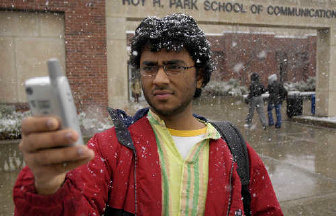
ITHACA, N.Y. — Bigger houses, bigger cars, bigger portions at the local fast food joint. In America, the guiding maxim is to think big. Really big.
An Ithaca College dean is encouraging students to instead think small. And she’s offering a $5,000 prize to do it.
The school has invited high school and college students across America to submit a 30-second movie shot entirely with a cell phone.
It may come off like a gimmick, but Dean Dianne Lynch has no doubts about the contest’s academic value.
In today’s media marketplace — where cell phones can take pictures, play music and games and connect to Web sites — it’s all about thinking small and mobile.
“Historically, we’ve always had students thinking bigger and bigger. It’s gone from radio to television to the movie screen, to the era of blockbuster films. All of a sudden, things have reversed and everything is getting smaller,” said Lynch.
The submission deadline is Jan. 10. A winner will be chosen from among 10 finalists and announced online Jan. 30.
The idea came to Lynch last year while she was in New York City attending an industry conference. One of the topics was the future of mobile delivery of content.
Disasters like Hurricane Katrina and the July bombings in London showed what cell phone cameras are capable of, as everyday people used them to provide TV stations and the Internet with vivid images of the devastation.
There are an estimated 2 billion mobile phone subscribers worldwide and 194.5 million in the United States, according to the Washington, D.C.-based CTIA The Wireless Association.
About 130 million Americans own cell phones with camera capabilities and approximately half of those camera phones also shoot video, said Roger Entner, an analyst with Ovum, a Boston-based technology consulting firm.
The rules of the contest are simple.
There must be a story, a narrative and sound, and the film must be shot on a cell phone.
The movies can be edited digitally on a computer or a cell phone that has editing functions.
The technical quality of the movies will depend on the cell phones, some of which can film with greater resolution than others. To ensure fairness, all submissions will be judged in basic VGA (video graphic array) quality, Lynch said.