
Don’t have a back 40?
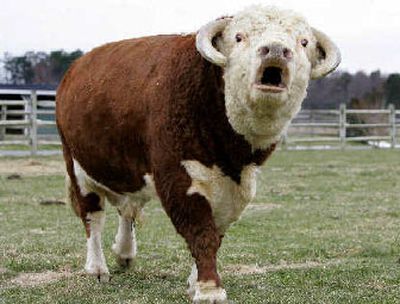
TRAPPE, Md. — If you’re a suburban cowboy hankering to raise a herd and short on ranch land, mini cattle may be for you.
New breeds of pint-sized heifers and bulls are making it easier for small farmers to raise cattle for milk, meat or just fun.
On Bill Bryan’s 50-acre spread on Maryland’s Eastern Shore, he has sold seven calves this year.
“We’ve sold the vast majority of our calves to people who have these little three- to five-acre farmettes and they’ll fence in an acre, buy a calf and more or less keep ‘em for pets,” Bryan said. Two mini cattle calves stood nearby, contentedly munching on grass in a small fenced-in area, skittering away if visitors got to close.
Bryan is among a group of pioneering breeders raising miniature cattle that can be as little as a third of the size of the larger breeds.
The reasons are many, they say. You don’t need the back 40 acres to raise these breeds; the back four will do. Mini cattle eat about a third as much as a full-sized steer, are less destructive of pasture land and fencing, and are easier to handle.
“I’m 56 years old, and you want to know something? I can handle them better,” Bryan said, recounting a struggle the winter before with a full-size steer who got his horns caught in a hay rack.
While each animal may be smaller, more meat can be produced overall from each acre, breeders say. And the smaller size of each animal also has its benefits.
While some people look to save money by buying an entire cow or a side of beef, it can be difficult to store the hundreds of pounds of meat from a 1,200- to 1,500-pound steer, of which about 40 percent makes it to the freezer.
Miniature cattle, which often are between 500 and 700 pounds, provide enough meat to last a family of four six months. That’s just about the freezer shelf life of beef, said Bryan. And the meat tastes the same, depending on how the cattle has been raised and fed.
Bryan, who runs a construction business, said his wife, Donna, does most of the farm work, spending about two hours a day taking care of their animals.
“Women can raise these steers just as well as men can,” Bryan said.
Bryan said most of his calves will die “of old age” because buyers are usually looking to breed the smaller cows themselves or keep them as pets.
Miniature cattle calves are more expensive than the standard size because they are still relatively rare. Bryan said he is getting $1,600 for female calves and $1,000 for bulls, compared to $500 to $600 for normal calves. But he expects prices to drop as the mini varieties become more common.
Richard H. Gradwohl, who has developed a number of small breeds at his Happy Mountain Miniature Cattle Farm in Covington, Wash., said six niche markets have developed for the miniature breeds.
Miniature cattle are primarily sold for use as pets, for small-scale milk production, breeding, showing, organic beef production or for the farm-grown market, which produces cattle on smaller farms, Gradwohl said. Sixty to 70 percent are sold as pets, he estimated.
Full miniature cattle are defined as those below 42 inches at the hip when fully grown, while mid-size miniatures are up to 48 inches, said Gradwohl, who registers 26 miniature breeds.
Another factor driving the popularity is that most people don’t have enough land for full-sized cattle, which need five acres for two cattle, compared to an acre for a pair of miniature cattle.