
Live from New York: poultry
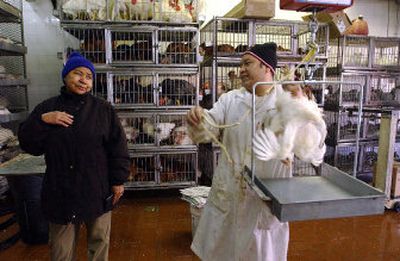
NEW YORK — The odor is the first clue, a sharp barnyard smell that seems out of place on a stretch of the Lower East Side near a Burger King and a Dunkin’ Donuts. Hand-lettered signs advertise in English, Spanish and Chinese: live chickens, ducks, quail, pheasants.
While most Americans buy their birds mass-produced and shrink-wrapped, thousands of chickens and other fowl are killed fresh every day at hundreds of live poultry markets around the country, with roughly 90 such places in the New York City area alone.
And some fear such markets could introduce the deadly H5N1 bird flu strain into the United States.
Suzan Holl, a spokeswoman with the U.S. Department of Agriculture’s Animal Plant Health Inspection Service, said live poultry markets are a bird flu threat because of the possibility that low-grade strains of the virus could mutate into the lethal form. And she said the markets do not always have the best regulation.
“With the live-bird markets, it’s a loose type of regulated business,” she said. “They’re not conscientious about biosecurity.”
Elizabeth Krushinskie, vice president for food safety at the U.S. Poultry and Egg Association, a trade group that represents mass producers, said the live markets “absolutely” pose more of a bird flu threat than big processors do.
“The birds come from a variety of different flock sources,” Krushinskie said. “They mix birds from all different origins together, birds of different species — ducks, chickens, turkeys.” By contrast, she said, mass producers of poultry control the process from beginning to end and “there’s no commingling of flocks.”
In New York, state officials insist the markets are monitored so closely as to eliminate the risk, but some customers are staying away because of the bird flu scare.
Low-grade strains of avian flu are common and rarely lethal. But the deadly H5N1 form has killed or forced the slaughter of an estimated 140 million birds since it began ravaging poultry stocks across Asia in 2003. The virus has also jumped from poultry to people, killing more than 80 people in east Asia and Turkey.
Human cases have been traced to contact with sick birds — contact that is more likely in developing countries than in the United States. But at markets like the Lower East Side’s Delancey Live Poultry, there is closer contact between bird and human than there is at a typical American supermarket.
Hundreds of birds squawked in stacked cages during a recent visit. When a customer chose one, a worker grabbed it by the feet and took it to the back of the shop, where another worker wrung its neck.
“Most of the customers at New York’s live poultry markets are, like Cruz, immigrants who grew up eating freshly slaughtered meat in their homelands.
Adel Yafai, an employee at Delancey Live Poultry, said customers have asked about the bird flu but “have nothing to fear. In America we have a lot more precautions than in other countries.”
Most of the nation’s live poultry markets are concentrated in large urban areas with big immigrant populations, such as Miami, Los Angeles and New York.