
Wild water man
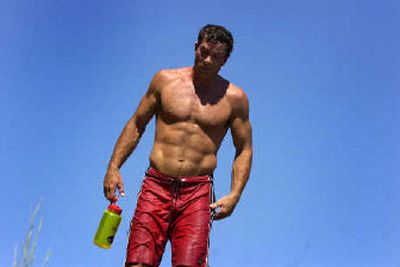
Jud Keiser plunges the bow of his bright blue kayak into a churning wave on the Spokane River. Suddenly, the boat is upside down in midair, rotating end-to-end before Keiser lands it smoothly back on the wave, ready for the next flip.
“He definitely throws the biggest tricks around this area,” said Chris Hoffer, a friend and fellow kayaker, watching him from shore. “He’s always two or three steps ahead of anybody else. If there’s a new trick out, he works on it every day until he gets it.”
Lately, that hard work has paid off for the Liberty Lake freestyle kayaker. In May, Keiser took first place in the Men’s Open section of the Reno (Nev.) River Festival, besting 18 others. In June, he placed 15th in the U.S. National Freestyle Kayaking Championships in Colorado.
The numbers are impressive on their own. But consider this: In a sport in which strength and endurance count, many of the kayakers Keiser is beating as he travels three months a year chasing his dream are young enough to be his son.
Keiser is 45 years old and didn’t discoverer kayaking until he was 36, an age that spells retirement for many professional athletes. At age 38, Keiser retired from a 20-year career at Kaiser Aluminum and began kayaking almost every day. He turned pro in 2000 and since then, has been getting better and better.
“Some people get up and drink their coffee. I get up and say, ‘What time am I going kayaking?’ ” Keiser said, grinning as he looks out at a Spokane River play feature called the “Trailer Park Wave,” just downstream from the Post Falls Dam.
“I’m just obsessed with it because I get so much enjoyment out of it.”
That obsession has him on the water, somewhere, 300 days a year. It has him breaking through ice to get to play waves in the winter, watching the zipper on his wet suit freeze as he drags his boat from the river to his truck. But there are also blistering hot summer days when the river is just so refreshing, and nights under a full moon when he can glide silently back and forth on a wave. Keiser said kayaking is the only sport he knows that can be done year-round, in almost any weather.
“It’s this magic carpet that just keeps coming at me,” he said.
Keiser kayaks freestyle, a style also referred to as play-boating or rodeo. Kayakers play on standing waves in the river, doing twists, flips and other tricks with crazy names such as the Phonics Monkey, McNasty or Donkey Flip. The forward curling action of the wave helps hold them in place to execute the moves. Play spots generally are accompanied by an eddy downstream which boaters can catch once the wave washes them out. In the eddy, where the water flows back upstream, they wait for their next turn.
In addition to the Trailer Park Wave, popular play spots on the Spokane River include: Dead Dog Hole, under the state line bridge; the Sullivan Hole, near Sullivan Road; the Mini-Climax Wave, near Flora Road; and a wave at Corbin Park, in Post Falls. Another feature is being built, as the nonprofit Friends of the Falls works toward creating a whitewater play park beneath the Sandifur Bridge in downtown Spokane.
Devon Barker, a two-time women’s national freestyle champion from McCall, Idaho, said boaters in this area may not realize how lucky they are. The play spots are plentiful and so challenging that they force kayakers to become better, she said.
“They really aren’t that way around the rest of the world,” Barker said. “I think that’s really given Jud a big boost, too. We have so many high quality features.”
Barker and Keiser met years ago on the Salmon River in Riggins, Idaho. Keiser had recently turned pro and was trying to convince Barker to do the same. It took him two years to convince her, she said, and a year later, she won her first national championship.
Friends say that’s typical Keiser: encouraging people to get into the sport, and passing on his boundless enthusiasm. Josh Davis, team manager for Team NRS, one of Keiser’s sponsors, said Keiser is an excellent ambassador for the sport. Northwest River Supply (NRS) is based in Moscow, Idaho.
“Our goal for NRS is to try and get the best athletes we can out there. We place a lot of emphasis on character and Jud is probably the premier athlete in that aspect for us,” Davis said. “He takes more time to help people understand what the sport is about.”
Davis said he thinks Keiser is breaking a barrier by showing people that they can be competitive at any age.
“I don’t see him not being competitive anytime soon,” Davis said.
Keiser’s obsessive training is a huge factor in that. Four years ago, the self-described “gym rat” determined he wasn’t strong enough to kayak at his desired level. So he started doing 1,300 sit-ups per day.
The ideal kayaker’s body is shorter in stature, delivering a lower center of gravity for balance and more flexibility for fitting into freestyle boats, which average just over 6 feet long. A few years back, Keiser, who stands 6 feet tall and weighs around 190, found he was having trouble squeezing his weight-lifter legs into smaller and smaller boats. So he stopped weight-training his legs and watched them shrink 2 inches in diameter.
“These to me are like bird legs,” he said, laughing. “Everything is designed with kayaking in mind.”
Extreme kayaker Tao Berman, whom Sports Illustrated calls “the best-known kayaker on the planet,” said his friend Keiser is an anomaly, along with two-time world freestyle champion Eric Jackson, who is 42.
“(Keiser) is in amazing shape,” Berman said. “I’m 27 years old and he’s really an inspiration for me. I want to be in the shape he’s in when I’m his age. He’s in better shape than most of the professional kayakers I know.”
Keiser said natural athleticism runs in his family. He played three sports at Northwest Christian School growing up and is a licensed ski guide. While working at Kaiser Aluminum, he moonlighted as a model for freelance sports photographers, jumping off cliffs in his skis or barefoot water skiing.
It was during a photo shoot at Snoqualmie Falls that he discovered kayaking. He’d never been in one before, but thought it was fun and bought one six months later. Following hot, sweaty days working the furnace at Kaiser, the river became somewhat of an oasis.
“Kaiser was so frickin’ hot in the summertime,” Keiser said. “Kayaking on the other hand was wet, clean.”
Keiser started at Kaiser Aluminum two days after his high school graduation, thinking he’d work there for the summer and earn some money for college. But a summer turned into a year, then a career, when he saw how much money he could make. Twenty years later, the employees went on strike and were subsequently locked out by the company.
When the strike was settled two years later, some employees, including Keiser, were offered buyouts. He took it, with plans to retire. He and his wife of 21 years, Melanie, who is a financial planner, had made solid investments and paid off cars and their home in preparation.
“I didn’t want to return to that type of environment,” Keiser said.
Since then, in some ways, he’s the envy of other kayakers. He’s financially comfortable, and his gear comes from sponsors – NRS, Liquidlogic Kayaks, AT Paddles and Shred Ready Helmets. He can kayak every day if he wants, and most days, he does. He might make $2,000 a year through kayaking, which helps offset his costs without having to make huge commitments to sponsors. Some companies pay athletes to represent them at events like “demo days” or “learn to kayak” seminars.
“He’s the guy who’s self-funded. He kayaks on his own terms,” Berman said. “He’s got the life because he kayaks all the time.”
Keiser said he just loves to paddle.
“Every year I think this is it,” Keiser said. “Then spring comes around and I feel like I want to travel, I want to compete. It seems like I’m doing better and better the older I get.”