Beauty & a feast
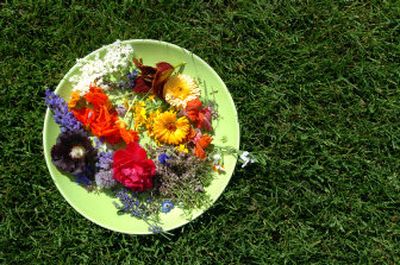
There is something about flowers that makes even the most daring diners hesitate.
Barb Arnold, owner of Nothing but Herbs nursery in Hayden, Idaho, has seen it all – even had a few party guests pick out the bright pink chive blossoms sprinkled on her green bean dishes.
“It’s not an acquired taste, it’s more of a continuous education,” she says. Arnold sells edible flowers pots at the Kootenai Farmers Market on Saturdays. She has been growing and eating edible flowers from roses to snap dragons since 1980. She never lets customers or visitors get away without nibbling on a few of her citrus marigolds or pineapple sage leaves. Part of her enjoyment in growing edible flowers is seeing people’s reactions.
Maggie Smith of Fleur de Provence Lavender Farm says that those who visit her fields wonder “What else is there to do with lavender except stick them in a vase?”
“I tell them to let the lavender dry, and then collect the buds when they fall. Get the most from your flowers,” she says. Smith grows four different kinds of lavender, some more suitable for cooking than others. Visitors to her farm usually don’t think of using lavender in their cooking, but Smith provides recipes for customers.
Chef Bryce Ahrens of Twigs on North Nevada Street says that Spokane is a fairly meat-and-potatoes kind of town, and the introduction to flowers in dishes is likely to startle many people. But for Ahrens, using flowers in everyday cooking helps the bistro stay on top of their game.
“It’s something that used to start off as garnishes, and you don’t really want to overpower (a dish) with flowers,” he said. But he says as more restaurants are using flowers in their cuisine, people will eventually see them in all kinds of dishes. “We’ll get to that point where people will say, ‘OK, we’re ready for this.’ “
The key to cooking with flowers is versatility.
Arnold sprinkles scented geraniums on the bottom of a baking pan before pouring yellow or pound cake batter in so that the cake is infused with the sweet scent of geraniums. Sometimes, she drops a black hollyhock flower in her cup of tea because it dyes the water a deep purple and just plain looks pretty. Smith will sprinkle some homemade lavender sugar on strawberries to give it an extra dash of flavor and aroma.
At Twigs, Ahrens uses lavender as a rub with honey for their prime rib. The bistro also infuses rice with lavender. “It adds a different flair to the dish,” Ahrens says.
Edible flowers add luxurious color to any meal, make a dish smell delightful and are a flavorful touch, but there are precautions the curious cook needs to take before biting into any flowers.
First and most importantly, do not buy edible flowers from a florist or a flower shop. Specialty nurseries, like Arnold’s, grow their flowers without pesticides or fertilizers. Arnold says many of her flowers are safe to eat straight from the garden.
“They have the most value when they are fresh and pretty,” she says. If you must store picked flowers, (it’s best that you eat fresh flowers right after you pick them) keep them in a self-sealing bag with a wet paper towel to keep their color. And color is crucial when it comes to edible flowers.
“That’s half the fun,” says Arnold.
Her recipes are fairly simple. She mostly uses flowers in salads and as a garnish, and says cooking flowers can sometimes drain the color from them. “The color is so important, if it fades, it doesn’t have that same value it did.”
According to a report by the National Sustainable Agriculture Information Service, there are more than 100 different kinds of edible flowers. Yet Arnold says even if a certain flower is edible doesn’t mean it has any flavor. The report explains that there are healthy benefits to eating flowers – rose hips, for example, have large amounts of vitamin C and all flowers also have little to no calories.
It’s best to pick flowers when they are in full bloom after any dew had dried off. For those who are allergic to pollen, remove any portion of the flower that contains pollen. Always remove the stem from flowers. Never try flowers that are not listed as edible or anything you’re not absolutely certain about.
Use a light hand when seasoning with edible flowers. Smith says that when it comes to lavender, a little goes a long way. The essential oils are in the buds of the lavender flower so a teaspoon or so is strong enough to flavor a dish. “It doesn’t seem like much but people are likely to put more than they should,” she says.
Flowers aren’t limited to just foods. Ahrens says that the martinis Twigs serves have been decorated with edible flowers. The “botanical-tini” is occasionally garnished with a wild orchid. Some martinis use crystallized rose petals to add flavor and a light pink color.
It’s hard for some of us to remove the stereotype of flowers as just something we stick in a vase to something we put in salads and cakes. The transition of flavors from the vase to the dinner plate isn’t smooth, but the taste is worth it. As long as Arnold continues to pipe cream cheese into the necks of peppery nasturtiums for appetizers, we’re likely to “ooh” and “ahh” and ask what the unique taste is. They are likely to smile and point to their flower pots.
Lavender Sugar
From Fleur de Provence Lavender Farms in Mead. Use it on sugar cookies, fresh-cut fruit and in teas.
2 cups sugar
1 tablespoon dried lavender
In a blender, mix sugar and dried lavender. Blend several minutes until buds are pulverized and infused into the sugar. Store in a sealed container. Use sparingly as a garnish for fresh fruit or sugar cookies.
Yield: 2 cups lavender sugar
Approximate nutrition per serving: Unable to calculate.
Lavender Lemonade
From “Fresh From the Garden Cookbook,” by Ann Lovejoy
1 tablespoon fresh or dried lavender
4 cups lemonade
4 sprigs mint, for garnish
1 organic lemon, thinly sliced, for garnish
Put the lavender in a small saucepan, pour 1 cup boiling water over it, and let steep for 20 minutes. Strain (a tea strainer works great) and add to the lemonade. Pour into tall glasses over ice, garnishing each with a mint sprig and a lemon slice.
Yield: About 5 cups lavender lemonade
Approximate nutrition per serving: Unable to calculate.
Rose Petal Ice Cream
From Clark Frasier and Mark Gaier of Arrows Restaurant, Ogunquit, Maine, via www.StarChefs.com1 cup sugar
1 1/2 cups loosely packed, very fragrant, rose petals, washed and spun dry
1 cup heavy cream
1 cup whole milk
5 large egg yolks
Prepare an ice bath by placing ice cubes in a large, flat-bottomed container that will hold the bowl where the ice cream can be chilled. Place the sugar and the rose petals in a food processor fitted with the metal blade and make paste. Place the heavy cream, milk and sugar paste in a medium-sized saucepan and place on medium heat, stirring until the sugar dissolves. Bring to a simmer and turn off heat. Place the egg yolks in a medium-sized bowl. Whisk yolks until light; add the hot liquid slowly, while whisking until the mixture is homogenized. Return liquid to saucepan and cook on medium heat, stirring constantly with a wooden spoon, until it reaches a temperature of 180 degrees Fahrenheit on a candy thermometer or it coats the back of the spoon. Strain the mixture through a fine sieve into a clean container and place in the ice bath. Once completely chilled, freeze in ice cream machine, following the manufacturer’s instructions for freezing.
Yield: About 3 cups
Approximate nutrition per serving: Unable to calculate.
Sautéed Halibut with Citrus Marigold Sauce and Lemon Candy
From Clark Fraiser and Mark Gaier of Arrows Restaurant, Ogunquit, Maine, via www.StarChefs.com
6 (6- to 7-ounce) halibut fillets
3 tablespoons clarified butter
1/2 cup picked citrus marigolds
For the sauce:
10 peppercorns
6 shallots, finely chopped
1/2 cup of lemon juice
1 cup white wine
6 tarragon stems
1/2 pound butter
Salt and pepper, to taste
For the lemon candy:
Julienne strips of six lemons
3 1/4 cups sugar
2 cups water
To make the sauce: Combine the peppercorns, shallots, lemon juice, white wine and tarragon stems and simmer until reduced by two thirds. Reduce heat and whisk in the butter. Pour sauce through a fine sieve. Adjust seasonings.
To make the lemon candy: Heat three cups sugar and two cups water to a boil. Blanch the zest in the sugar water for three minutes. Strain out the zest and immediately toss in the remaining 1/4 cup sugar and set aside.
Sauté the halibut fillets in the clarified butter until golden brown. Place a pool of the beurre blanc on each plate and place filet in the pool. Sprinkle the sauce with the citrus marigolds and place a portion of the lemon candy on each fillet.
Yield: 6 servings
Approximate nutrition per serving: Unable to calculate.
Edible Flower Salad
From “Fresh from the Garden Cookbook,” by Ann Lovejoy
4 cups of young greens
1 cup of herb tips (fennel, dill, chives, cilantro, sage, lemon balm)
4 green onions, sliced
1 tablespoon fresh calendula petals
1 tablespoon fresh borage flowers
1 tablespoon fresh rose petals
For the dressing:
2 tablespoons rice vinegar
1/3 cup virgin olive oil
1 teaspoon fresh lemon thyme leaves
1/4 teaspoon kosher salt
Combine the greens, herb tips and green onions in a large salad bowl, top with the flowers and set aside. To prepare the dressing, in a small jar blend the vinegar, olive oil, lemon thyme and salt. Drizzle over the salad, toss lightly and serve at once.
Yield: 4 servings
Approximate nutrition per serving: Unable to calculate.