
Boy with epilepsy heading to D.C.

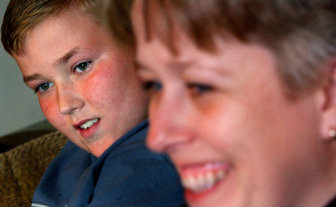
Most days, 10-year-old Jakob Sears is more interested in video games and fishing than in influencing the workings of the U.S. Senate.
But next week, when the Post Falls fourth-grader arrives in Washington, D.C., he’ll join the ranks of unlikely government lobbyists.
Jakob is one of more than 40 children with epilepsy who will travel to the nation’s capital on Monday as guests of the national Epilepsy Foundation. As selected members of the Kids Speak Up! program, Jakob and other youngsters ages 7 to 16 will be charged with persuading lawmakers to restore funding for the neurological disorder that affects more than 326,000 children nationwide.
“We know from experience that kids make a tremendous impact,” said Nichelle Schoultz, who coordinates the program that began in 2001. “It gives a more personal, human touch.”
But Jakob and his colleagues from across the U.S. won’t have to recite statistics about the recent elimination of epilepsy funding from the national Centers for Disease Control budget. Agency representatives will discuss some $7.6 million cut from President Bush’s federal budget in February.
“We send children with varying degrees of ability. Some are not even verbal,” explained Schoultz. “The child is there to validate the story.”
Jakob will travel with his mother, Tonya Sears, and Kim Huender, a representative for the Idaho Epilepsy Foundation. The job for Jakob and other participants will be to simply share their experience of what it’s like to live with seizures.
“They are pretty scary to have,” explained Jakob, who suffered his first seizure at age 2, when he fell in the bathtub and hit his head. “You pretty much can’t do anything during one.”
Jakob will describe how it feels to live with a vagus nerve stimulator, a $40,000 implant that sends electrical impulses to his brain about every five minutes. The device was inserted in his abdomen in 2004; it’s been about 18 months since his last seizure.
“It’s easy to tell when it goes off,” said Jakob, whose voice becomes shaky when the implant fires.
Jakob doesn’t mind talking about epilepsy, whether his audience is strangers or the kids in his class at Mullan Trail Elementary School.
“There’s always 100 questions,” he said.
In Washington, D.C., Jakob won’t tell his story to just anyone, however. Children selected for the program are chosen for geographic diversity – and potential political influence, organizers said.
Jakob, for instance, is from Idaho, home of Sen. Larry Craig, a Republican, who serves on the powerful Senate Appropriations Committee.
“He’s a key member,” Schoultz said.
Jakob’s dad, Shane Sears, hopes that the senator will come away with awareness that restored funding is necessary to improve understanding of and research into the disorder. Too many people still harbor outdated notions of what it means to have epilepsy, which isn’t a single disease but a family of more than 40 related disorders. In some circles, it still carries a stigma.
“When they first told us that Jakob has epilepsy, I was like, ‘Holy Cow! He’ll never lead a normal life,’ ” said Shane Smith. “You can see the look on people’s faces when you tell them.”
Instead, society must understand that people with epilepsy can be successfully treated with medication and equipment so that they’re able to live full, satisfying lives.
With that in mind, Sears said he’s happy to have his son become an advocate for the epilepsy foundation.
“If that works, it’s great,” he said. “Besides, if I had to have an adult tell me a story or a 10-year-old tell me a story, I’d listen to the 10-year-old.”
Reach reporter JoNel Aleccia at (208) 765-7124 or by e-mail at jonela@spokesman.com