
A father’s impact
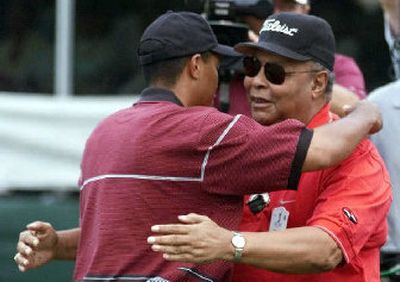
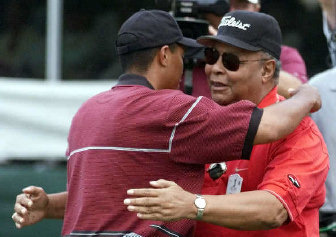
Earl Woods was no stage father.
The last time he watched Tiger Woods play in a tournament was at the end of his son’s worst year on the PGA Tour, in December 2004 at the Target World Challenge. He stayed out of the way, riding in a cart that was parked behind a wall of spectators.
Tiger knew he was there all along.
“It’s the first time I’ve seen him on the golf course following my play in a lot of years,” was the first thing Woods said that day after rallying to win with a 66 in the final round. “It was pretty exciting for me.”
Woods donated the $1.25 million check to the Tiger Woods Foundation, which his father helped establish, to pay for the $25 million Tiger Woods Learning Center, which his father inspired.
Nothing bothered Earl more than being compared with an overzealous father of a famous athlete. A former Green Beret who served two tours in Vietnam, his death Wednesday is notable because of his son. But his intention wasn’t to raise a champion golfer.
“My greatest satisfaction is that he’s a good person,” Earl once said.
He died of cancer at home in Cypress, Calif., the modest house where he raised his son and refused to move even after Tiger was making close to $90 million a year in endorsements and could have built him a palace.
Earl said he might turn the place into a museum one day.
The garage is where Tiger sat in a high chair, mesmerized by the motion of his father swinging a golf club. One day he climbed out of the chair and produced what Earl said was a flawless swing. The bedroom is where Tiger placed a chart of everything Jack Nicklaus achieved and at what age.
“His expectations are a lot higher than anything you or I would ever imagine,” Earl said. “He was imagining winning the Grand Slam when he was 10 years old.”
Tiger had the career Grand Slam at age 24, the youngest in history. He held all four professional majors at age 25, the first to do so.
Tiger wanted to be like his father.
They played golf nearly every day, although Earl would make his son call him at work and ask if they could practice. Earl set par higher than it really was, reducing it as Tiger got better so he wouldn’t be rattled by shooting a low score. He trained him to be mentally tough, saying things like, “Water on the right” when Tiger was in the middle of his swing.
Two years ago, Tiger spent a week at Army Special Forces training in Fort Bragg, N.C., still trying to walk in his father’s footsteps. At the Buick Invitational this year, in the middle of his second round, Tiger talked about Navy Seals having to take a boat ride out to an island in water so choppy some of them had bruised ribs. If not for golf, he probably would be in the military, just like his dad.
The golf training was uncanny.
Earl told stories about jingling change in his pocket to teach Tiger not to lose his focus, and how he identified in him at an early age the ability to produce shots under stifling pressure.
The best putt I saw Tiger make was at the Presidents Cup in South Africa, a playoff against Ernie Els when it was nearly dark. The 15-foot putt went over a ridge, then fed down to the hole with 10 inches of break.
I asked Earl about that putt, and he said Tiger learned to stick to his routine no matter the situation. You can put a clock on him when he’s in a zone, the proud father said. So I took him up on the offer at the Byron Nelson Championship. On three straight holes, Tiger had putts of about 10 feet.
His routine took 18.1 seconds on the first one, 18 seconds on the next one and 18.2 seconds on the third.
Earl said a lot of outrageous things about Tiger. Most times, he turned out to be right.
When Tiger signed endorsements with Nike and Titleist worth $60 million as a 20-year-old, Earl called it “chump change.” Four years later, the next Nike deal was worth more than $125 million.
He said his son would “do more than any other man in history to change the course of humanity,” and referred to him as the “Chosen One” who would “have the power to impact nations.”
Tiger’s influence on his sport is undeniable. He raised the profile of golf perhaps more than any other player, and he is the reason prize money on the PGA Tour has quadrupled in the 10 years he’s been around.
As for the power to impact nations, perhaps, as Dad said, the painting isn’t finished.