
Big water ride
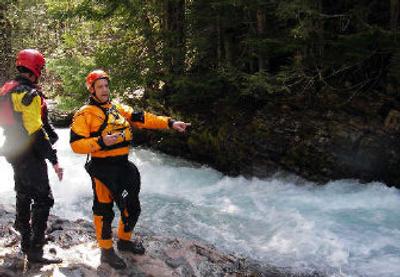
Idaho Gov. Dirk Kempthorne declared a statewide flood disaster emergency in early spring – alerting homeowners to prepare for potential flooding from heavy runoff from a deep snowpack. To hikers like me, that’s a warning to keep away from mountain streams. To skilled kayakers looking for a season-opening adrenaline fix, it’s an invitation to jump in their little plastic boats and fight rip-roaring, Class V white water as frigid waters from melting snow charge down ravines into mountain creeks.
James Black, Steve Pugh and Andy Bright all lead fairly sedate lives in Spokane. Black is an operations inspector/pilot with the Federal Aviation Administration; Pugh is a neurologist; and Bright is a general surgeon. On the river, they don colorful dry suits and helmets, and push their crafts into the water, and the battle is on.
“When you kayak difficult white water, with possible severe consequences, you must rely and trust your fellow kayakers,” explains Black . Each man has years of experience and “looks after each other on the water,” he adds.
Inviting me to watch the trio’s latest adventure, Black announced Slate Creek, in the St. Joe National Forest, as their quest. To get more of a feel for conditions in the area, I called the local forest ranger office and inquired about kayaking tributaries of the St. Joe. I’m pretty sure I detected a snicker as the clerk told me the St. Joe was expected to soon run at 10,000 cubic feet per second. That sounds serious, and I took her word that it was above normal. She added that a ranger had just floated the St. Joe in a large cataraft (a metal frame supported by two large pontoons) and found the water very rough and dangerous, with logs blocking some areas of the river. She strongly advised against river-running in the area until the waters calmed.
Not found in the usual kayak guidebooks, Slate Creek is near the fly-fishing town of Avery, population 57, and two hours from Coeur d’Alene. Named for the slick, gray rocks in this mountain stream, Slate Creek flows rapidly into the world’s highest navigable river, the St. Joe.
Black grew up exploring this backcountry with his grandfather and knows it well. Prior to the float, he did a recon in a Cessna airplane and then confirmed his aerial observations on the ground on his all-terrain vehicle. The water was running big and clear, and a one-lane, cliff-hugging logging road was littered with rockslides and impassable to the calmer water upstream. The kayakers would have to portage the last half-mile and jump into the fast white water from the start.
My first glimpse of Slate Creek was from a goat trail of a road, which on the water, would not be seen by the kayakers until they reached the St. Joe. Way below, the raging water was not only visible, but I could hear the rumble. The boulders and log “sweepers” made me wonder if these guys knew what they were getting into, so I had to ask each why they do it.
Reflecting on his near-drowning in waters like these as boy in Arkansas, Pugh wonders out loud if that is part of the reason he returns to the challenge.
“I’m nervous right now,” he admits. Looking around to the vast wilderness with no one else within 10 miles, he adds, “The real reason we do this is for the chicks that come out to watch!” With a loving wife and two kids waiting for him at the end of the run, Pugh’s humor temporarily broke the tension felt by the group.
“I enjoy being outdoors, good times with friends and that copper taste from this adrenaline sport,” added Black.
Standing by his fire-engine-red kayak Black says it is new, but it looks like it lost in a serious knife fight, with a crisscross of deep cuts and scrapes marring the bottom. Weighing 40 pounds and only about 6 feet long, it appears to me as more of a kid’s pool toy than a craft worthy of safely transporting one down a Class V river.
Looking over Black’s shoulder to the water raging over boulders, the first thing that comes to mind is what happens if the kayak is overturned – doesn’t that mean smashing one’s head on the rocks while racing down the river with your face underwater?
“That’s why we don’t turn over,” smiles Black.
Bright finds the solitude rewarding, often seeing elk, river otters and deer – and no humans other than his partners. Citing the level of experience obtained from each of his previous adventures, he calls his creek boat the “SUV of kayaks.” Bright exudes confidence, pointing out that even though there may be drops of as much as 12 feet, the kayaks can always be pulled from the water and portaged. On this trip, Bright would get an extra dose of solitude, as his “SUV” took its own course, and he would suffer the only loss.
Watching the three men splash down the rapids, I’m torn between two feelings. First, there’s the relief of being on the riverbank and not in one of the miniature plastic tubes bouncing over, under and through the waves. Second, I know I’m missing a great adventure (must be how my dog feels when I leave home without him), but I would have to wait for a report from the guys.
I’m impressed by the agility and quickness of all three as they dodge boulders and are flushed downstream, occasionally all but disappearing within a wave in the turbid waters. If all went well, a frosty beer or glass or cheap wine would be enjoyed on the take-out. If not, help is a long way from Slate Creek.
Taking a breather two miles into the aerobic and sometimes-frightening run, Pugh appropriately questions if they were in over their heads. But they were past the point of return – pulling out in the steep canyon now meant a 2,000-foot climb straight up, then miles to the main road. They stayed the course, carefully scouting the rapids and walking around them as needed.
The falls section of Slate Creek was deemed too dangerous, even by this experienced team, and meant portaging. “There is no use in turning a fun trip into carnage,” Black said.
It wasn’t all smooth sailing – while scouting “a particularly nasty looking rapid,” Bright’s kayak freed itself from the shore and continued the run solo. With Bright racing along the shoreline on foot and Pugh and Black in hot pursuit in their kayaks, the chase was on. After hours of climbing along cliffs, through thorny berry patches and down loose hills, Bright made it to the confluence of Slate Creek and the St. Joe River. His partners recovered his kayak, lodged in tree roots along the shore, but his $400 paddle was lost. Pugh’s promise came true – the ladies were there to watch, at least at the end of the run. Pugh’s wife and Bright’s girlfriend were waiting to drive the tired, but pumped paddlers back to camp.
The trip was deemed a success, even with Bright’s unplanned bushwhacking and paddle loss, which reminded Black of an old-timer’s words of wisdom to him after his own kayaking misstep: “Sometimes school’s very expensive.”