
A diesel-powered dream
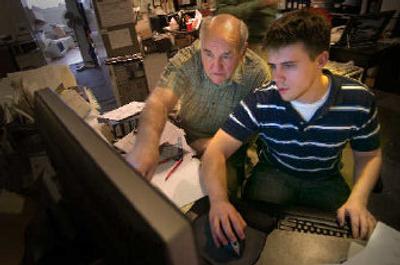
Twenty-five years ago, Hugh Evans’ concept for an airplane engine that runs on diesel fuel seemed ludicrous.
Today, an engine that runs on diesel and uses half the fuel of traditional motors — and can make the switch to Kerosene, a fuel common in third-world countries — is cutting edge.
“I used to preach diesel engines and no one would listen,” recalls Evans, an engineer who has spent a quarter-century developing the engine.
Merlyn Products Inc., a 13-employee company, channeled profits from sales of its general aviation retro-fit kits to fund the product’s research and development. Now the company has a working model that’s done well in preliminary tests and is ready for tweaking and more rigorous testing.
“We’ve run the engine; we know the concept is good,” said Suzanne Evans, Hugh Evans’ wife and president and owner of the company.
The Merlyn motor has 650 horsepower, compared with the 350 horsepower piston engines that typically power light twin airplanes by burning high-octane fuel. The diesel engine uses half as much fuel and operates with fewer parts, which could make for easier maintenance and increased longevity. It’s also patented in 31 countries.
The project has garnered support from a group of customers who regularly stop by or call to see how the engine is progressing, Suzanne Evans said, adding that some hope to use the diesel engine in their boats and planes.
Merlyn Products Inc. operates in a four-bay hangar at Spokane International Airport. Since Evans first started modifying aircraft, in the mid-1970s, the couple has occupied over a dozen different sites at the airport.
In an industry dominated by giants, Merlyn Products found a niche custom-making parts and pairing those items with factory-made products to create kits that enhance safety and performance for small aircraft.
Over the years, the couple looked for outside investors to help shoulder some of the development cost for the diesel engine, Suzanne Evans said, but that didn’t pan out.
“It’s the type of project that venture capital doesn’t work with. They wanted a return in two years; that’s not going to happen with this type of research,” she said.
So, the company funded the diesel project internally.
“We’d get some money and work on it, put it aside. Get some money and work on it. That’s the way it has gone,” she said.
Hugh Evans said he was drawn to diesel engines because they’re more efficient than turboprops. Early diesel engines were too heavy to be taken seriously by the weight-conscious industry. Several decades of manufacturing and engineering advancements, such as the advent of space-age alloys, enabled Evans to build a lighter, more powerful engine. It now weighs 485 pounds, down 80 pounds from an earlier model, and less than a traditional engine.
The engine did well in preliminary tests, and now Hugh Evans wants to see how the engine performs for crop dusters. Agricultural planes are a punishing market because they stop and start frequently and max out speed, while sucking in dust and pesticide, he said.Pilots tend to be experienced, an added safety precaution.
But getting the engine off the ground for commercial production will require about $2 million, as further development and testing burns through fuel and breaks parts, Suzanne Evans said.Recently, the company received a Federal Aviation Administration certification that opens the door for the company to sell a new modification kit priced at about $60,000, which could help raise money for the project.
Pat McMurray, director of sales and marketing, said Merlyn Products Inc. is approved to do a new type of engine modification on Beechcraft Baron, a twin-engine aircraft. Most of their Beechcraft customers come from other areas, including North Carolina and Florida.
“Airplanes are a different industry,” McMurray said. “It’s like a small town over a big area.”