
Hunt for treasure
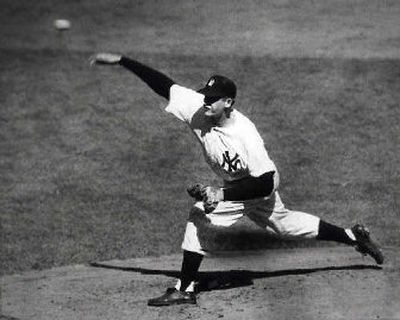
NAPERVILLE, Ill. – When Don Larsen pitched his perfect game in the World Series 50 years ago this month, Doak Ewing couldn’t watch because his mother wouldn’t allow a television in the house. The family entertainment was watching 16-millimeter films his father borrowed from the public library.
In a roundabout way, it helps explain why Ewing is the owner of the only known copy of the TV broadcast of Game 5 of the 1956 World Series. The 58-year-old founder of Rare Sportsfilms Inc. didn’t really become a baseball fan until five years after Larsen’s historic performance.
But the early love affair with films triggered an interest that has made Ewing the country’s foremost, if not only, serious collector of old baseball telecasts. Highlight films with dubbed sound are relatively plentiful, but actual telecasts of sporting events from the 1950s, ‘60s and even early ‘70s are mostly gone.
Replays of the final moments of the Larsen game – with catcher Yogi Berra leaping into the pitcher’s arms – come from movie films. It was not uncommon in those days for several cameras to be filming, without sound, for the movie reels and highlight films. But there has been no public access or viewing of the TV broadcast; not even Larsen has seen it.
Ewing has owned the Larsen telecast for about 15 years but is just now revealing its existence.
The networks didn’t keep copies of the shows because of the expense and because they took up too much room. A few clips of memorable moments were filmed and saved, but there is little before videotape was introduced in the late 1960s.
“The networks taped over tape or just stuffed it in a landfill,” says Dick Johnson, curator of the Sports Museum of New England, which has a significant collection of sports films from the archives of WHDH-TV in Boston. “It was not the thought back then to preserve entire games. … Nobody had any idea there would be a mechanism by which you could sit home, pull out a disc and watch it on TV.”
Those that have survived from the 1950s and early 1960s are kinescopes, a process in which a motion picture camera was set up in front of a television or monitor to record the game. Through an agreement among the networks, baseball and U.S. Armed Forces, the games were filmed to be sent to U.S. troops overseas, Ewing says, “and were to be destroyed a week after they were shown.”
Not the typical “wild goose chase’
Larsen’s game would make most fans’ top five list of most coveted action. Ewing says the Holy Grail would probably be the ‘51 playoff between the Brooklyn Dodgers and New York Giants, which ended with Bobby Thomson’s home run “shot heard ‘round the world.” It probably was never recorded on kinescope because it wasn’t a World Series game, Ewing says.
Another find would be Game 7 of the 1960 World Series, which ended in a Pittsburgh Pirates championship on Bill Mazeroski’s ninth-inning home run against the New York Yankees.
Ewing once thought he had a lead on that one. He recalled hearing that the family of late Pirates manager Danny Murtaugh had it. He contacted the manager’s widow and son, who checked and discovered only the Series highlight film. “I’ve been on a lot of wild goose chases,” Ewing says.
The Larsen game is one that paid off. An Oregon film collector saw Ewing’s standard advertisement in Big Reel magazine and offered him a few items he acquired from a dealer at a flea market.
The collector, not a sports fan, said the dealer mentioned he had some partial baseball games and, at Ewing’s behest, followed up. (A complete game on kinescope would take five or six film reels, and it’s not unusual for one or two reels to be lost.)
The collector wrote back to say the man had “John Larson’s” Series game, except for the first reel. Ewing bought it.
He won’t disclose the price and has the game picking up with one out in the top of the second. A search for the first reel was fruitless. The dealer recalled selling a used projector with a reel attached to it to show it worked. That reel could have been the first inning of Larsen’s game.
“That tells me it’s out there somewhere. That may exist,” Ewing says.
The film apparently came from a teacher/coach from Alaska who was in the Armed Services stationed in Hawaii, Ewing says. He kept the film and took it back to Alaska to show in school. When he died, his son sold his film collection to that dealer.
Market for radio broadcasts
Ewing started collecting baseball films in 1980 when he worked for the Atlanta Braves. He was cleaning out a storeroom in the basement of Atlanta-Fulton County Stadium when he found several shelves of highlight films. In return for repairing and cataloguing the collection, the Braves gave him the duplicates, he says.
He sells copies of some vintage sports films on VHS and DVD, but has no plans to put the Larsen game on DVD for sale. He says he’ll show it at private or public gatherings by request for an undetermined fee.
The market for complete games of the past is increasing, and Major League Baseball Productions is becoming involved with boxed sets of past Series, such as the 1975 classic between Cincinnati and Boston.
MLB has every postseason game since 1981 in its archives, several from the 1970s and all seven games from the 1965, ‘68 and ‘69 World Series, says David Gavant, vice president of MLB Productions. (The three 1960s Series are kinescopes, except for Games 3-5 of 1969, which are on color tape. The later copies are color tape.)
The oldest existing complete games are kinescopes from Games 6 and 7 of the ‘52 World Series, won by the New York Yankees against the Brooklyn Dodgers. Game 6 was put out on VHS several years ago.
About 300 miles from Ewing, in Evansville, Ind., 75-year-old John Miley is compiling an even more staggering collection of radio broadcasts of sporting events. The oldest complete baseball radio broadcast known to exist is a 1934 game between the Yankees and Detroit Tigers.
Miley, who began preserving sporting events with a wire recorder in 1947, has acquired audio of the TV and/or radio broadcasts of several World Series games from the 1950s, including Larsen’s. (Collectors saved the broadcasts by placing a tape recorder in front of the TV or radio).
He’s still at it, now using the Internet to record historic moments, such as the radio call of every home run Barry Bonds has hit in the last three years or the first major league homer of a potential star. (mlb.com subscribers can pull up archived broadcasts, so Miley doesn’t have to tape every game every night.)
More than searching for hidden gems, Miley is looking for someone to whom he can pass the tape recorder one day.
“I’m one of a kind,” he says. “Nobody is doing what I’m doing. It’s a shame somebody is not interested in taking this over.”
Among lost broadcasts, the ‘46 World Series – won in seven games by St. Louis against Boston – is No. 1 on Miley’s baseball wish list, he says.
“We think we’ve searched every basement in the country, but there is no question in my mind stuff is out there,” he says.
After a USA TODAY story about him seven years ago, Miley got a call from a man in Nashville who said he thought his father had a box of tapes that included Game 7 of the ‘55 World Series won in seven games by the Dodgers against the Yankees.
“I’ve heard that story 100 times,” Miley says.
In this case it was true, and he had a previously lost gem.
Such tales give the collectors eternal hope.
“I’m hoping somewhere there’s a corner of a warehouse from the military” stacked with old films, says the Sports Museum’s Johnson.
“All the films I buy, I figure if I don’t buy them I’ll never see it again,” Ewing says. “There’s stuff out there. I’m still looking.”